MLOps Consulting Companies for Startups: How to Choose
MLOps consulting firms help startups ship models, automate retraining and watch models in production. Here are six firms worth a shortlist and how to pick one.
On this page
Short answer
MLOps consulting companies help startups put machine learning models into production and keep them working there. They set up training pipelines, deployment, monitoring and retraining, so a small team can ship models without building all of that plumbing itself.
What MLOps consulting firms do for startups
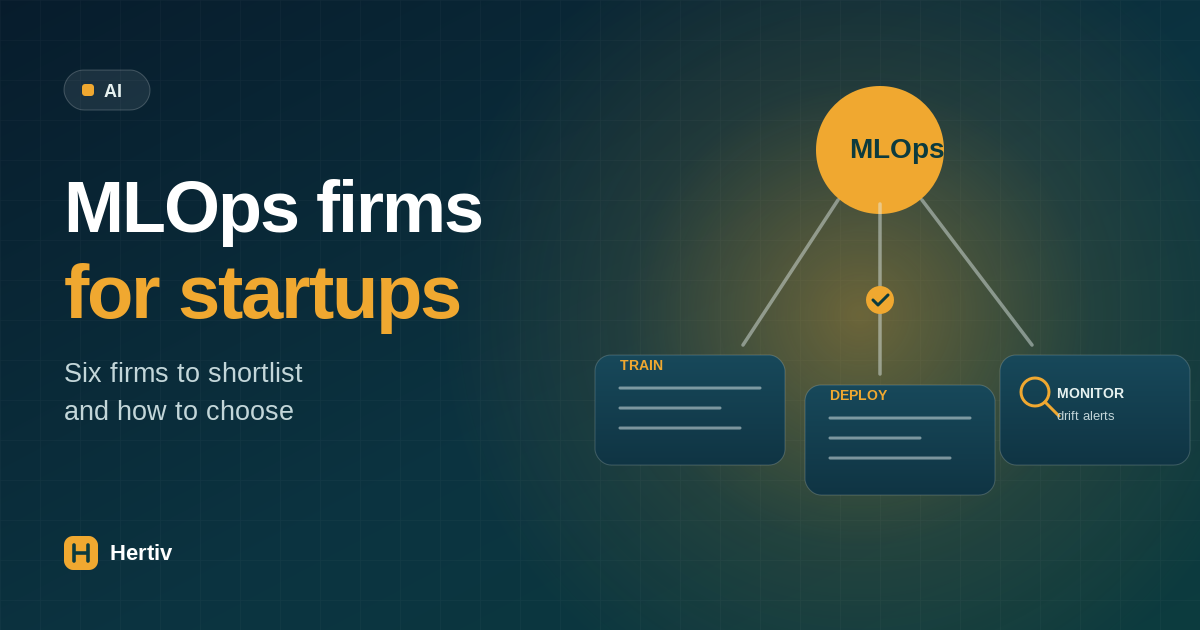
MLOps consulting firms help startups move a model from a notebook into a product that runs every day. They build the training pipeline, the deployment setup, the monitoring and the retraining loop, and they hand the team a system it can run without them.
Startups hire them for three reasons: speed, experience and focus. A good firm has done the same setup for other clients, so it knows which tools fit a small team and which ones add cost without benefit. The team keeps its attention on the product while the firm handles the plumbing.
| Firm | Best for | Typical focus |
|---|---|---|
| Thoughtworks | Platform design | Custom ML platforms |
| EPAM Systems | Regulated teams | Governed pipelines |
| Globant | Product teams | AI product delivery |
| SoftServe | Data-heavy products | Data and model pipelines |
| Cognizant | Scale-up support | Enterprise-grade MLOps |
| Nagarro | Cost-conscious teams | Cloud ML pipelines |
The firms below differ in size, price and depth. A startup should shortlist two or three, ask each one to describe a similar past engagement, and check who would actually do the work day to day.
<h3>1. Thoughtworks: best for platform design</h3>
Thoughtworks is a technology consultancy known for building custom software platforms, and its data and AI teams design ML platforms for clients that need more than a standard toolset. For a startup, it fits when the product needs a platform shaped around its own data and release habits.
Its teams work in small, senior groups and hand over code the client team can run and change. That matters for a startup that wants to own its platform after the engagement ends rather than depend on the firm for every change.
Pros:
- Strong engineering practice and clean handover
- Experience across industries and cloud platforms
- Good fit for teams that want to own the platform
Cons:
- Rates sit above smaller specialist firms
- Small engagements may wait for team availability
<h3>2. EPAM Systems: best for regulated teams</h3>
EPAM Systems is a large engineering firm with deep data and AI practices, and it works with clients in finance, health and other regulated fields. For a startup in a regulated market, that background helps when the pipeline must log decisions, control data access and pass an audit.
Its teams build governed pipelines with versioned data, model registries and approval steps. The work is heavier than a light startup setup, but it gives a team the controls a regulator or a large customer will ask for later.
Pros:
- Strong governance and audit trail practice
- Large pool of data and ML engineers
- Experience with regulated industries
Cons:
- Process can feel heavy for a very small team
- Engagements often start at enterprise scale
<h3>3. Globant: best for product teams</h3>
Globant is a digital product company that builds AI features into customer products, and its teams cover data engineering, model work and product design in one engagement. For a startup shipping an AI feature to users, that mix can shorten the path from model to screen.
Its MLOps work tends to sit inside a wider product build, so the pipeline is shaped around what the product needs rather than treated as a separate system. That suits teams that want the model, the API and the interface delivered together.
Pros:
- Product, design and engineering in one team
- Strong record shipping AI features to users
- Good fit for consumer and business products
Cons:
- Less suited to pure infrastructure work
- Teams may be shared across clients
<h3>4. SoftServe: best for data-heavy products</h3>
SoftServe is an engineering firm with a large data practice, and its teams build data platforms, model pipelines and cloud infrastructure for product companies. For a startup whose product depends on large or messy data, that depth is the main draw.
Its engineers work on data quality, feature stores and pipeline reliability, which are the parts of MLOps that break most often in real products. A team that already has a model but struggles with data will get more from this kind of firm than from a pure model shop.
Pros:
- Deep data engineering bench
- Strong cloud and pipeline practice
- Good fit for data-heavy products
Cons:
- Less known for model research work
- Project scope can grow past the first brief
<h3>5. Cognizant: best for scale-up support</h3>
Cognizant is a large IT services firm with AI and data practices that support companies moving from pilot to production at scale. For a startup that has raised a round and needs to run models for many customers, it offers the staffing and process to do that without hiring a whole platform team at once.
Its teams build standardised pipelines with monitoring, alerts and runbooks, so the system keeps working as usage grows. The trade-off is that a startup is a small client for a large firm, so the team should confirm who leads the work and how decisions get made.
Pros:
- Can staff large and long engagements
- Standardised pipelines with runbooks
- Good fit for fast-growing teams
Cons:
- Startups are small clients for a large firm
- Rates and minimum scope can be high
<h3>6. Nagarro: best for cost-conscious teams</h3>
Nagarro is an engineering firm that builds cloud and data systems for product companies, and its teams often work at rates below the largest consultancies. For a startup with a tight budget, it can deliver a working MLOps pipeline without the price of a big-name firm.
Its engineers cover cloud setup, CI/CD for models, monitoring and retraining, and the firm is used to working with small product teams. The team should still ask for a named lead engineer and a clear handover plan, since the value of the work depends on who does it.
Pros:
- Competitive rates for the work delivered
- Used to working with small product teams
- Covers cloud, pipeline and monitoring
Cons:
- Less brand weight with large customers
- Quality varies by team, so check references
How to choose
Choosing an MLOps consulting firm comes down to fit: the right firm matches your model, your data, your budget and the way your team works.
- Define the outcome. Write down what must work in three months: one model in production, a retraining loop, or a full platform. A firm can only quote against a clear target.
- Ask for a similar past engagement. Ask each firm to describe one startup client with a similar model and data size, and what went wrong as well as what worked.
- Meet the people who will do the work. The sales team is not the delivery team. Ask to speak with the lead engineer before signing.
- Check the handover. Ask how the team will document the pipeline, train your engineers and hand over access, so you are not locked in.
- Compare total cost, not day rates. A cheaper rate with a longer timeline costs more than a higher rate that finishes in half the time. Ask for a fixed scope and a clear end date.
For more on what the pipeline itself should contain, how to build an MLOps pipeline walks through the stages a firm should cover.
If you are still deciding whether your model is ready for production, how to test AI models is a useful check before you spend on outside help.
Common mistakes
The most common mistakes are hiring before the model is ready, picking on brand alone, and skipping the handover plan.
- Hiring before the model works. A firm cannot fix a model that has not been tested on real data. Validate the model first, then pay for the pipeline.
- Choosing by brand. A famous firm with the wrong team is worse than a smaller firm with the right lead engineer. Judge the people, not the logo.
- Skipping the handover. If the firm leaves with the only knowledge of how the pipeline runs, every later change needs a new engagement.
- Overbuilding the platform. A startup with one model does not need the platform of a bank. Ask the firm to build for the next year, not the next five.
- Ignoring monitoring. A model that is not watched will drift quietly. Make monitoring and alerts part of the scope, not an extra.
To scope the work, MLOps consulting describes what an engagement usually covers and how it is priced. See vendor site for current rates.
Key takeaways
- MLOps firms build the pipeline, monitoring and retraining loop around your model
- Shortlist by fit with your model, data and budget, not by brand alone
- Meet the lead engineer who will do the work before you sign
- Insist on documentation and a handover so your team can run the system
- Start with one model in production, not a platform built for five years ahead
Frequently asked questions
What does an MLOps consulting company do?
An MLOps consulting company designs and builds the systems that take a machine learning model from a notebook into production. That covers training pipelines, deployment, monitoring, retraining and the handover to your own team.
How much does MLOps consulting cost for a startup?
Cost depends on scope, team size and length. A short engagement to put one model into production costs far less than a full platform build. Ask each firm for a fixed scope and an end date, and compare total cost rather than day rates. See vendor site for current rates.
Should a startup hire an MLOps firm or build in-house?
Hire a firm when you need production systems fast and your team is small. Build in-house when you already have platform engineers and the model is core to the product. Many startups do both: a firm builds the first pipeline, and the team takes it over.
How long does an MLOps engagement take?
A focused engagement to ship one model usually takes four to eight weeks. A full platform with monitoring, retraining and governance takes longer. The timeline depends on data quality and how many models need to go live.
What should I ask an MLOps firm before hiring?
Ask for a similar past engagement, the name of the lead engineer, the handover plan and the total cost for a fixed scope. Also ask what happens if the model drifts after launch, and who owns monitoring once the engagement ends.
Do I need MLOps if I only have one model?
Yes, if the model serves real users. Even one model needs deployment, monitoring and a way to retrain it when data changes. The setup can be small, but skipping it means the model will fail quietly when the data shifts.


