What Is Minima Blockchain, and How Does It Work?
Minima is a layer-1 blockchain where every user runs a full node, even on a phone. Learn how its design works and what it changes for builders.
On this page
Short answer
Minima is a layer-1 blockchain designed so that every participant runs a full node, including on an ordinary mobile phone. Instead of relying on a small set of validators or miners, each user checks transactions for themselves, and a lightweight proof of work attached to each transaction keeps the chain secure. The result is a network with no central point of control.
What is Minima blockchain?
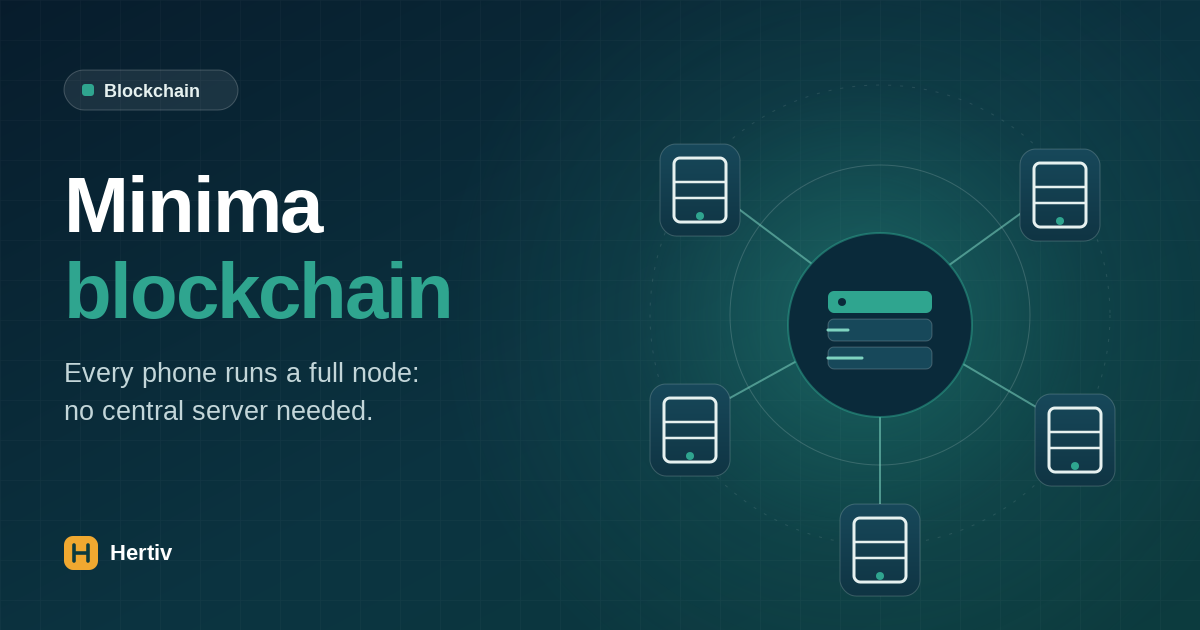
Minima is a layer-1 blockchain built on a simple idea: every user runs a full node. A full node keeps a complete copy of the ledger and checks every transaction against the rules, so no user has to trust anyone else's version of the chain.
Most blockchains split users into two groups. A small number of miners or validators do the checking, while everyone else trusts their work. Minima removes that split. If you use the network, you run the software that checks it.
The design aims at phones first. The node software is light enough to run on an ordinary mobile phone, which means the network can grow wherever phones already exist. That is the core of the project: decentralisation that comes from ordinary users, not from data centres.
The network has a native token, MINIMA, which is used to pay for transactions. It also has its own way of reaching agreement, called transaction proof of work, which is explained below.
How does Minima work?
Minima works by attaching a small proof of work to every transaction. Before a transaction is accepted, the sender does a small amount of computational work, and every node checks that work as part of validating the transaction.
That design replaces the usual race to produce blocks. There is no separate group of miners competing for rewards, and no staking set that can concentrate power. The work is spread across every transaction, so the security of the chain comes from the users themselves.
Nodes connect directly to each other in a peer-to-peer network. When a user sends a transaction, it spreads from phone to phone until the whole network has seen it. Each node keeps its own copy of the ledger and applies the same rules, so the network agrees without a central coordinator.
Because every node holds the full chain, a user can check a payment, a token balance or a contract state without asking a third party. That self-checking is what makes the network hard to censor or shut down.
What makes Minima different from other layer-1 blockchains?
Minima differs from other layer-1 blockchains in who does the checking. On most chains a small set of validators or miners secures the network. On Minima, every user is a full node, so the checking is spread as widely as the user base.
| Feature | Minima | Typical proof-of-stake chain |
|---|---|---|
| Who validates | Every user runs a full node | A limited validator set |
| Hardware needed | An ordinary phone | A server with a stake |
| Consensus | Transaction proof of work | Staked voting |
| Central point of control | None by design | Validator set and governance |
| What a user must trust | Their own node | Validators and light clients |
The trade-off is speed of development, not speed of the chain. A phone-first network has less room for heavy computation, so applications need to be light. Teams used to server-grade chains should plan for that limit from the start.
To see how this compares with the usual layer-1 and layer-2 split, read layer 1 vs layer 2 before choosing a chain.
What can you build on Minima?
You can build tokens, payments, messaging and small applications on Minima. Applications are called MiniDapps, and they run on the user's own node rather than on a central server.
Tokens are the most direct use case. A project can issue its own token on the chain, move it between users, and let each holder check the supply and their balance from their own node. That fits community currencies, loyalty points and local payment schemes.
Payments are the second natural fit. Because every user already runs a node, a payment between two phones can be checked by both sides without a middleman. That suits small merchants, markets and peer-to-peer transfers where fees and trust matter.
Messaging and data applications are also possible. A MiniDapp can store small amounts of data on chain and let users exchange it directly. Anything that needs heavy computation or large files is a poor fit, and should stay off chain.
Teams that want help scoping a build can start with blockchain development to check whether a phone-first chain matches the product.
Example (hypothetical): a market where every stall runs a node
Example (hypothetical): a community market has 40 stalls, and each stallholder runs Minima on a phone. Every stall is a full node, so the market has 40 copies of the ledger, not one.
On a busy day the market makes 200 token payments between stalls and customers. Each payment carries its own small proof of work, and each of the 40 nodes checks it. No single stall can rewrite the record, because the other 39 hold their own copies.
Now suppose 12 phones go offline at once. The market still has 28 copies of the ledger, because 40 minus 12 is 28. Payments continue, and the 12 phones catch up from the others when they come back online.
The point of the example is redundancy, not speed. The market does not need a server room. It needs enough phones running to make the ledger hard to lose or rewrite, and 28 copies is plenty for that.
What are the limits of Minima?
The limits of Minima start with the ecosystem. It is a smaller network than the large layer-1 chains, so there are fewer tools, fewer libraries and fewer developers who already know it. A team should expect to do more groundwork.
Phone hardware is the second limit. A phone node cannot do the heavy computation a server can, so applications must stay light. Games with complex logic, large data processing and high-frequency trading are poor fits.
Liquidity is the third limit. The MINIMA token trades on fewer venues than the tokens of larger chains, so moving large amounts in or out can be slow. A project that needs deep liquidity should plan around that.
Finally, the design is unusual. Developers used to smart-contract platforms will need to learn how MiniDapps work and how transaction proof of work changes the way transactions are built.
What are the common mistakes?
The most common mistakes with Minima come from treating it like any other chain. Teams copy a design from a server-based chain and then find it does not fit a phone.
- Building heavy logic on chain. Phone nodes are light by design, so keep computation small and move the rest off chain.
- Assuming deep liquidity. Check where the token trades before promising easy conversion to customers.
- Skipping the node step. The value of the network comes from users running nodes, so a product that hides that step loses its main advantage.
- Ignoring the small ecosystem. Budget time for missing tools instead of assuming they exist.
- Overpromising decentralisation. A network is only as distributed as its real user base, so count live nodes rather than claiming a number.
If the product needs a more familiar smart-contract environment, what is layer 2 explains the other common scaling path.
How should a team start with Minima?
A team should start with Minima by running a node first, then building a small MiniDapp, then testing with real users before committing to a launch.
- Install the node on a phone. Run it for a week and watch how it syncs, stores data and uses battery.
- Send test transactions. Learn how transaction proof of work works in practice before building on it.
- Build one small MiniDapp. A token or a simple payment flow is enough to learn the tools.
- Test with a small group. Give the app to ten users and watch where they get stuck.
- Check liquidity and listing. Confirm how users will buy and sell the token before launch.
Start small and measure what the phone can actually do. A working MiniDapp used by real people teaches a team more about the chain than any white paper.
Key takeaways
- Minima is a layer-1 blockchain where every user runs a full node, even on a phone
- Transaction proof of work spreads security across users instead of miners or validators
- MiniDapps run on the user's own node, which suits tokens, payments and messaging
- Phone hardware and a smaller ecosystem are the main limits to plan around
- Start by running a node, then build one small MiniDapp with real users
Frequently asked questions
What is Minima blockchain used for?
Minima is used for tokens, peer-to-peer payments, messaging and small applications called MiniDapps. Its main strength is a network where every user runs a full node, so payments and balances can be checked without a central server.
Can Minima really run on a phone?
Yes. The node software is designed to be light enough for an ordinary mobile phone. That is the core of the design: the network grows wherever phones already exist, rather than depending on data centres.
What is transaction proof of work?
Transaction proof of work means each transaction carries a small amount of computational work. Every node checks that work as part of validating the transaction, so security comes from the users themselves rather than from a separate group of miners.
How is Minima different from Bitcoin?
Bitcoin relies on miners competing to produce blocks, while Minima spreads a small proof of work across every transaction and asks every user to run a full node. Both are layer-1 chains, but they distribute the checking work in very different ways.
Does Minima have smart contracts?
Minima has its own application model built around MiniDapps, which run on the user's node. It is not a copy of the smart-contract model used by larger chains, so developers should expect to learn a different way of building.
Is Minima a good choice for a new project?
It fits projects that value a fully distributed network and light applications, such as community tokens and small payments. It is a poor fit for heavy computation, large data or projects that need deep token liquidity.


