MiCA Regulation Timeline: The Dates That Matter
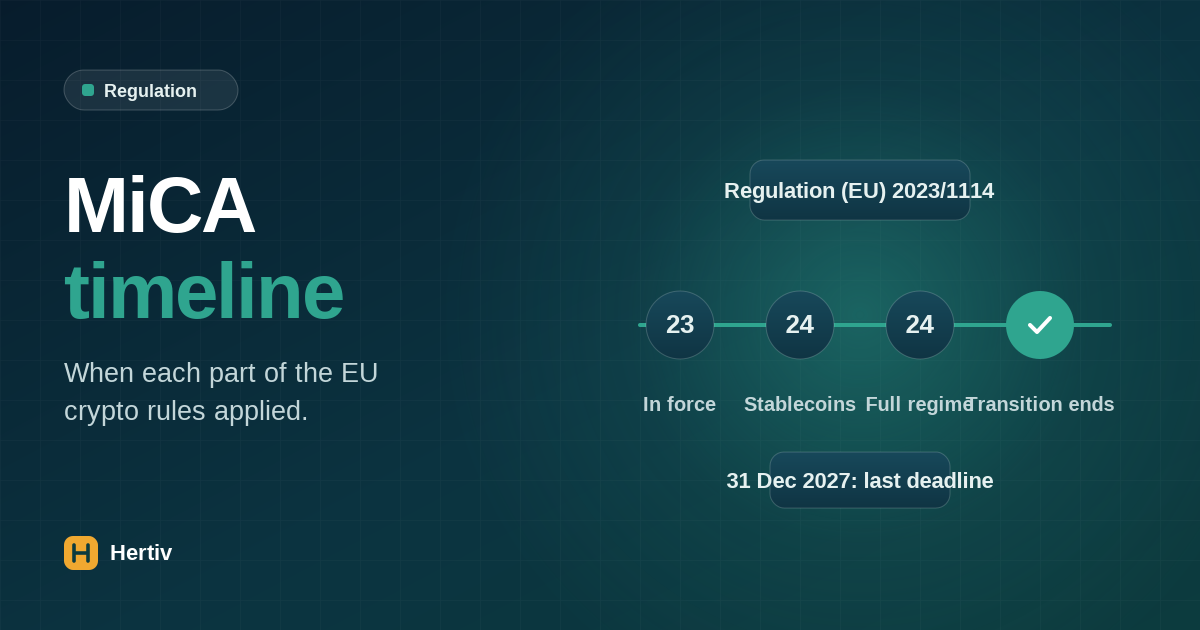
MiCA applied in stages: stablecoin rules from 30 June 2024, the full regime from 30 December 2024, and the last transitions ending 1 July 2026.
On this page
Short answer
The Markets in Crypto-Assets Regulation (MiCA) entered into force on 29 June 2023 and applied in stages: the stablecoin rules in Titles III and IV applied from 30 June 2024, and the rest of the regulation, including the crypto-asset service provider regime, applied from 30 December 2024. Existing providers could keep operating under national law during a transitional period that ended on 1 July 2026 at the latest.
What is the MiCA regulation timeline?
The MiCA regulation timeline is the schedule on which Regulation (EU) 2023/1114, the European Union's Markets in Crypto-Assets Regulation, came into force and started to apply to issuers and crypto-asset service providers. It matters because the regulation did not switch on all at once: different parts applied on different dates, and firms that missed a date faced a different set of duties.
The table below gives the dates that matter most. Each one changed what a firm had to do, and the last two are the ones teams still need to plan around.
| Date | Milestone | Who it affects |
|---|---|---|
| 9 June 2023 | MiCA published in the Official Journal | All firms in scope |
| 29 June 2023 | MiCA enters into force | All firms in scope |
| 30 June 2024 | Titles III and IV apply (stablecoins) | Stablecoin issuers |
| 30 December 2024 | MiCA applies in full, including the CASP regime | CASPs and other issuers |
| 1 July 2026 | End of the last transitional periods | Existing CASPs |
| 31 December 2027 | White papers due for older listed crypto-assets | Trading platforms |
Two dates cause the most confusion. Entry into force, 29 June 2023, is when the regulation became law. Application dates are when its duties actually started to bind firms, and those came a year or more later. A firm that treated 29 June 2023 as its deadline prepared far too early, and one that waited for it prepared far too late.
When did MiCA enter into force?
MiCA entered into force on 29 June 2023, twenty days after it was published in the Official Journal on 9 June 2023. That date is the starting point for everything that followed, but it imposed almost no duties on its own.
The regulation's own Article 149 then set two application dates. Titles III and IV, the rules for asset-referenced tokens and e-money tokens, applied from 30 June 2024. Everything else, including the rules for crypto-asset service providers and for other crypto-assets, applied from 30 December 2024.
This split was deliberate. Stablecoins were seen as the most urgent risk because they promise a stable value and are used for payments, so their rules came first. The service-provider regime needed more preparation time, for firms and for supervisors, so it came six months later. For background on what the regulation covers, see what the MiCA regulation is and who has to follow it.
What applied from 30 June 2024?
From 30 June 2024, the rules in Titles III and IV applied to issuers of asset-referenced tokens and e-money tokens. An asset-referenced token is one that keeps its value by referencing something else, such as a basket of currencies or commodities. An e-money token is one that references a single official currency, such as the euro.
Issuers of asset-referenced tokens must be authorised or be a credit institution, and they must hold reserves, publish a white paper and give holders a way to redeem. Issuers of e-money tokens must be a credit institution or an electronic money institution, and they must redeem at par when asked. Neither type of issuer may pay interest to holders.
The practical effect was immediate. A stablecoin issuer serving EU customers needed its authorisation, reserves and redemption process in place by that date, not by the end of 2024. Teams that read the timeline as a single deadline in December 2024 found themselves six months late on the stablecoin rules.
What changed on 30 December 2024?
From 30 December 2024, MiCA applied in full. That date brought in the crypto-asset service provider regime in Title V: custody, operating a trading platform, exchanging crypto-assets for funds or for other crypto-assets, advice, portfolio management and transfer services all needed a CASP authorisation or a notification route for regulated financial firms.
The same date brought in the white paper duties for crypto-assets other than stablecoins, the market abuse rules, and the disclosure and complaints duties that protect users. It also brought in the Transfer of Funds Regulation, which sets the travel rule for crypto transfers: the originator and beneficiary information that must travel with a transfer.
For a firm that only provides services and does not issue tokens, 30 December 2024 was the date that mattered most. Until then it could operate under national law; from then on it needed MiCA authorisation or a valid notification. How MiCA compares with the rules elsewhere is covered in MiCA vs global crypto rules.
What happened to the transitional period?
The transitional period was a bridge for firms that were already operating under national law before 30 December 2024. Under Article 143(3), such a provider could carry on until 1 July 2026, or until it was granted or refused a MiCA authorisation, whichever came first.
Member states were allowed to shorten the period or not apply it at all, and many did. The periods ranged from six months in some states to the full eighteen months in most others, so the deadline a firm actually faced depended on where it was based. A firm that planned on the full eighteen months in a state that chose six found its bridge far shorter than expected.
Since 1 July 2026 there is no grandfathering left anywhere in the EU: serving EU clients without a MiCA authorisation is a breach. Two related dates also matter. DORA, the digital operational resilience rules, applied to authorised CASPs from 17 January 2025, and DAC8 crypto-asset tax reporting started for 2026 data on 1 January 2026.
Example (hypothetical): a trading platform plans around the dates
Example (hypothetical): a trading platform with 40,000 EU customers starts preparing on 1 January 2024. It counts the gaps between the dates. From 1 January 2024 to 30 June 2024 is 6 months, so it has half a year before the stablecoin rules apply to the tokens it lists. From 1 January 2024 to 30 December 2024 is 12 months, so it has a full year before the CASP regime applies to its own services.
The platform then looks at the transition. From 30 December 2024 to 1 July 2026 is 18 months, which is the longest bridge available. But its home state chose a 12-month period, so its real bridge runs only to 30 December 2025. It plans its authorisation application to be filed 9 months before that date, leaving 3 months of slack if the authority asks for more information.
The platform also notes the last open deadline: white papers for crypto-assets admitted to trading before 30 December 2024 are due by 31 December 2027. That is 36 months after full application, and it puts the task on its 2027 plan rather than treating it as finished business. The arithmetic is simple; the mistake to avoid is reading any one of these dates as the only one.
What are the common mistakes?
The most common mistakes around the MiCA timeline come from reading one date and ignoring the rest. Teams that anchor on a single deadline miss the staggered structure the regulation was built on.
- Confusing entry into force with application. MiCA became law on 29 June 2023, but its duties applied from 30 June 2024 and 30 December 2024.
- Assuming the transition ran to 2026 everywhere. Many member states shortened it, so the real deadline depended on where the firm was based.
- Forgetting the 31 December 2027 white paper deadline. Trading platforms still owe white papers for crypto-assets listed before 30 December 2024.
- Treating MiCA as covering everything crypto. Unique non-fungible tokens and tokens that already qualify as financial instruments stay under their own law.
- Ignoring the related regimes. DORA, the travel rule and DAC8 each have their own dates and bind the same firms.
For teams building a compliant exchange, the build side of the work is covered in how to build a MiCA-compliant OTC exchange. The timeline tells you when each duty starts; the build work tells you what to do about it.
Key takeaways
- MiCA applied in stages: stablecoins from 30 June 2024, the rest from 30 December 2024.
- Entry into force (29 June 2023) is not the same as application.
- The transitional period ended on 1 July 2026 at the latest, and earlier in many states.
- Trading platforms still owe white papers for older listings by 31 December 2027.
- DORA, the travel rule and DAC8 each add their own dates for the same firms.
Frequently asked questions
When did MiCA start to apply?
MiCA entered into force on 29 June 2023, but its duties applied in stages: the stablecoin rules from 30 June 2024 and the rest, including the CASP regime, from 30 December 2024.
What is the difference between Titles III and IV and the rest of MiCA?
Titles III and IV cover issuers of asset-referenced tokens and e-money tokens, including reserves, redemption and white papers. The rest covers crypto-asset service providers, other issuers, market abuse rules and user protection duties.
Did the transitional period end everywhere on 1 July 2026?
No. That was the latest possible end date under Article 143(3). Member states could shorten the period, and many did, with some bridges lasting only six months from 30 December 2024.
What is the 31 December 2027 deadline?
Trading platforms must produce white papers for crypto-assets admitted to trading before 30 December 2024 by 31 December 2027. It is the main MiCA deadline still open for firms today.
Does MiCA cover NFTs?
No. Crypto-assets that are unique and not fungible with others fall outside MiCA, as do tokens that already qualify as financial instruments, deposits or other regulated products under their own law.
What should a firm do now that the deadlines have passed?
It should hold a CASP authorisation or a valid notification route, meet the stablecoin rules where they apply, and plan for the 2027 white paper deadline for older listings before it falls due.


