LLM vs Generative AI: How They Differ
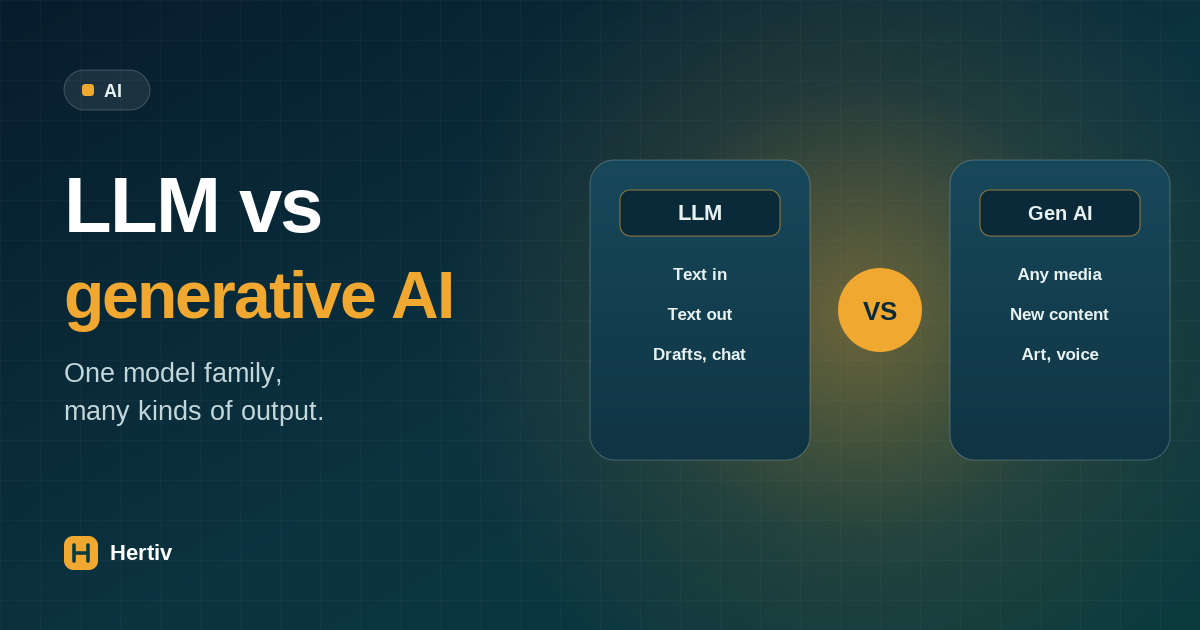
An LLM is one kind of generative AI: a model trained on text. Generative AI is the wider family, including image, audio and video models.
On this page
Short answer
An LLM is one kind of generative AI: a model trained on text that predicts the next word. Generative AI is the wider family of models that create new content, including image, audio, video and code models. Every LLM is generative AI, but not every generative AI model is an LLM.
What is the difference between an LLM and generative AI?
The difference between an LLM and generative AI is scope. Generative AI is the broad family of models that create new content: text, images, audio, video, code and music. An LLM, or large language model, is one member of that family: a model trained on large amounts of text that predicts what comes next, one word at a time.
Think of it like the difference between a car and a vehicle. A car is a vehicle, but a vehicle can also be a truck, a bus or a bike. In the same way, an LLM is a generative AI model, but generative AI also includes image models, voice models and music models that never handle text at all.
| Point | LLM | Generative AI |
|---|---|---|
| What it is | A model trained on text | Any model that creates new content |
| Output | Text only | Text, image, audio, video, code |
| Input | Text prompts | Text, images, audio or more |
| Common uses | Drafting, summarising, chat | Drafting plus art, voice and video |
| Example tools | Chat models, copilots | Chat models, image and voice tools |
| Data needed | Text: docs, tickets, code | Depends on the media type |
The confusion comes from marketing. Many products call themselves AI or generative AI when they are really one LLM behind a chat box. Knowing which one is under the hood tells the team what the product can and cannot do.
What is generative AI?
Generative AI is a family of models that learn patterns from data and then create new examples that follow those patterns. A text model learns how sentences are built and writes new ones. An image model learns how pictures are composed and draws new ones. A music model learns how songs are structured and composes new ones.
What makes these models different from older software is that they do not follow fixed rules. A rule-based program can only do what its author wrote down. A generative model learns from examples, so it can handle inputs its author never saw, such as a new question, a new image style or a new voice. That flexibility is also the risk: the model can produce confident output that is wrong.
Generative AI covers many model types. Diffusion models make images, transformer models make text, and other architectures handle audio and video. The shared idea is the same: learn the pattern, then generate something new that fits it.
What is an LLM?
An LLM is a large language model: a model trained on a huge amount of text, usually with a transformer architecture, that predicts the next word in a sequence. Given a prompt, it works out the most likely continuation, one word at a time, and keeps going until it reaches a stop. That simple mechanism produces summaries, drafts, translations, code and answers to questions.
LLMs are trained in two stages. First they learn general language from a large mix of public text, which teaches them grammar, facts and common patterns. Then they are tuned for a job, such as following instructions or answering from a company's own documents, using smaller sets of examples and human feedback.
An LLM only handles text, but text is a flexible input. Code, tables, JSON and even simple diagrams can be written as text, which is why LLMs show up in so many products. For how teams test one before building, see how to build an AI proof of concept.
When should you use an LLM, and when something else?
Use an LLM when the job is about text: drafting, summarising, translating, answering questions from documents, or writing code. LLMs are strongest when the output needs to be fluent and the input is text, and when a human or a system can check the result before it is used.
Use another kind of generative AI when the output is not text. An image model draws pictures, a voice model speaks, and a video model makes clips. An LLM can write the script for a video, but it cannot draw the frames. Teams often combine them: an LLM writes the text, an image model draws the picture, and a voice model reads the result aloud.
Use neither when the job needs exact answers from a database. A generative model guesses the most likely answer, which is wrong for balances, prices and records. A search or a database query gives the exact figure every time. For how to ground an LLM in real documents, see what retrieval augmented generation is.
How do LLMs and generative AI work together?
LLMs and other generative models work together in products that mix media. A marketing tool may use an LLM to write the copy, an image model to draw the banner, and a voice model to record the narration. Each model does the part it is best at, and the app stitches the results together.
The LLM often acts as the coordinator. It reads the user's request in plain language, decides which tools to call, passes the right inputs to each one, and checks the results. This pattern is common in agents: the LLM plans and talks, while specialist models handle images, audio and structured data.
Teams should keep the boundary clear. The LLM should not be asked to draw or to calculate exact figures, and the image model should not be asked to write. When each model stays in its lane, the product is faster, cheaper and easier to test. For how prompts shape LLM output, see what prompt engineering is.
Example (hypothetical): a support team picks between the two
Example (hypothetical): a shop gets 1,000 support tickets a day. The team wants an AI draft for each ticket so agents can reply faster. The question is whether an LLM alone is enough, or whether the team needs wider generative AI as well.
The team tests an LLM on 1,000 past tickets. It drafts a usable reply for 880 of them, which is 880 out of 1,000, or 88 percent. A rule-based system the team tried earlier managed 620 usable drafts, which is 62 percent. The LLM wins by 260 tickets a day.
On time, the numbers are clear too. An agent writes a reply in 4 minutes by hand, so 1,000 tickets take 1,000 x 4 = 4,000 minutes, or about 67 hours a day. With LLM drafts to check and send, each ticket takes 1.5 minutes, so 1,000 tickets take 1,000 x 1.5 = 1,500 minutes, or 25 hours a day. The team saves about 42 hours a day.
The team also wants product photos in some replies, such as a picture of the right spare part. The LLM cannot draw, so the team adds an image lookup from its own catalogue instead of an image model. The lesson is that the LLM solved the text job, and the image job needed a different tool, not a bigger model.
What are the common mistakes?
The most common mistake is treating an LLM as if it were all of generative AI. A team that asks an LLM to draw, to calculate exact figures, or to remember facts it was never trained on will get confident wrong answers. Each model type has a job, and the team should match the job to the model.
Another mistake is skipping the check step. Generative output looks finished even when it is wrong, so a draft that nobody reviews will eventually reach a customer with a wrong price, a wrong date or a made-up fact. Every generative output that reaches a user should pass a human or a rule-based check first.
Teams also confuse the demo with the product. A model that writes a good paragraph in a demo may still fail on the team's own documents, because its training data did not include them. Test on real examples from the team's own data before promising a launch date. For how to measure whether the model helps, see how to test AI models.
Key takeaways
- Every LLM is generative AI, but not every generative AI model is an LLM.
- LLMs handle text; image, audio and video need other generative models.
- Use an LLM for drafting, summarising and answering from documents.
- Use a database, not a generative model, for exact figures.
- Check generative output before it reaches a user; it can look right and be wrong.
Frequently asked questions
Is ChatGPT an LLM or generative AI?
ChatGPT is both. It is built on an LLM, which is one kind of generative AI model, and it is sold as a generative AI product. The LLM is the engine; the product around it adds memory, tools and a chat interface.
Can an LLM create images?
No, not by itself. An LLM works with text, so it can write a description of an image, but it cannot draw one. Image creation needs an image model, often called from the same app by the LLM acting as a coordinator.
What is the difference between an LLM and a chatbot?
A chatbot is a product: an interface that talks to users. An LLM is a model that can power a chatbot, but a chatbot can also run on rules, search or a small classifier. The LLM is one way to build the brain of a chatbot.
Are LLMs the same as machine learning?
No. Machine learning is the wider field of learning patterns from data, and it includes classification, prediction and ranking as well as generation. LLMs are one kind of machine learning model, built for text.
When should a team not use an LLM?
A team should not use an LLM when the answer must be exact, such as a balance, a price or a legal date, or when the data is small and structured. A database query, a rule or a small classifier is cheaper and more accurate for those jobs.
How do teams choose between an LLM and another generative model?
They match the output to the model: text to an LLM, images to an image model, audio to a voice model. When a product needs more than one kind of output, the team combines models and lets the LLM coordinate them.


