IX AI Foundry: What It Is and How It Works
The IX AI Foundry is Intellectyx's reusable foundation for production AI, so teams stop rebuilding orchestration, governance and measurement on every project.
On this page
Short answer
The IX AI Foundry is the reusable enterprise AI foundation that Intellectyx uses to design, build, integrate, govern, operate and measure production AI. Instead of rebuilding the same plumbing for every project, delivery teams start from pre-built parts for agent orchestration, knowledge services, integration, governance and value measurement, then add only the workflow logic that is specific to the client.
What is the IX AI Foundry?
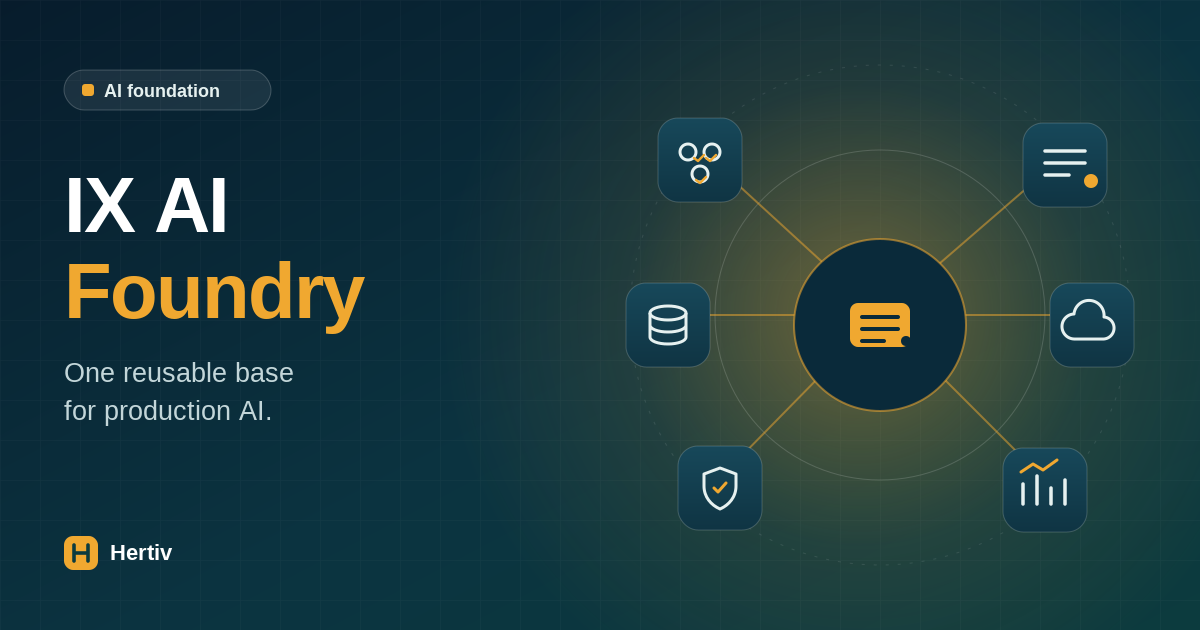
The IX AI Foundry is a reusable technology foundation that Intellectyx, an enterprise AI delivery company, uses to build production AI systems for clients. It is a set of pre-built, hardened capabilities that cover the parts almost every enterprise AI project needs: agent orchestration, a model gateway, knowledge services, an integration fabric, a control plane and a value engine.
The point of a foundry is repetition. Most enterprise AI projects need the same foundation: connect to the model, pull facts from company data, call internal systems, watch what the agent does, and show whether it saved time or money.
Building those parts from scratch on every project is slow and error-prone, so the foundry keeps them ready and reuses them. The agents it powers are the same kind of AI agents that run multi-step work inside enterprise systems.
It is important to be clear about what it is not. The foundry is Intellectyx's own delivery IP, not a product customers license or maintain. It is deployed into the client's environment as part of a solution, and it stays Intellectyx's property. The client owns the workflows, the data and the results; the foundation underneath is reused across engagements.
What are the six parts of the foundry?
Each part of the foundry handles one job that production AI keeps needing. Together they form the base layer that sits under the client's own workflows, so a new use case starts from working parts rather than a blank page.
| Part | What it does | Why it matters |
|---|---|---|
| Agent orchestration | Plans tasks, uses tools, keeps memory and coordinates agents | Agents can run multi-step work without a new harness each time |
| Model gateway | Routes requests, falls back between models, caches and caps cost | Models can change without rebuilding the app |
| Knowledge services | Retrieval, grounding, citations and permissions | Answers stay tied to approved company content |
| Integration fabric | Connection patterns for enterprise and legacy systems | Agents can act inside real systems, not only chat |
| Control plane | Agent identity, observability, evaluation and audit | Every action can be traced and reviewed |
| Value engine | Baseline, measurement and ROI reporting | Teams can show whether the AI paid off |
No single part is unusual on its own. The value is that they are built once, tested in production and reused, so the second use case costs less than the first.
How does a project move through the foundry?
Work moves through five stages, and each stage uses the parts above rather than building new ones. A team that follows this order spends its time on the client's workflow instead of on plumbing.
- Build. Use AI Studio and the agentic AI runtime to shape the assistant or agent, its prompts and its tools.
- Connect. Hook up knowledge services, the AI gateway and the integration fabric so the agent can read company data and act in real systems.
- Deploy. Run it where the client needs it: public cloud, private cloud, on-premises or hybrid.
- Govern and operate. Put the control plane to work: agent identity, observability, evaluation and audit trails.
- Measure. Use the value engine to compare results against the baseline and report what changed.
Skipping a stage is the usual source of trouble. A team that deploys before the control plane is ready has no way to see what the agent did, and a team that never sets a baseline cannot say whether the project worked.
How is it different from buying an AI platform?
Buying a platform and using a foundry solve different problems. A platform such as Copilot Studio, Bedrock, Vertex or Agentforce gives you model access and a runtime. The foundry sits on top of those platforms and adds the domain logic, enterprise integration, evaluation and value measurement that turn a model into a working enterprise workflow.
The foundry is designed to work alongside those platforms rather than replace them. If a client has already invested in one, the foundry connects to it through the model gateway instead of forcing a switch. That matters because most large companies already have a platform in place, and ripping it out is rarely worth it.
The other difference is ownership. With a licensed platform, the client buys and maintains the software. With the foundry, the client buys the outcome: Intellectyx builds on its own foundation and the client keeps the workflows and results. That suits teams that want production AI without building and maintaining the foundation themselves.
When does the foundry approach fit?
The foundry approach fits best when a company plans several AI use cases rather than one. The first project pays for the foundation; the second and third reuse it, so each new workflow starts further along. A single one-off chatbot rarely justifies that kind of base layer.
It also fits when the work must run inside real enterprise systems. Agents that only answer questions can live on a thin layer. Agents that look up a part, check a warranty, update a work order or open a case need integration, identity and audit, which is exactly what the foundry provides.
It fits less well when the team wants full control of every line of code, or when the use case is a simple document search with no actions and no governance needs. In those cases a smaller tool, or the platform the company already owns, is usually enough. The honest test is whether the foundation will be reused: if the answer is no, skip it.
Example (hypothetical): a claims team ships its first agent
Example (hypothetical): a mid-size insurer wants an agent that reads incoming claim emails, pulls the policy from its system, and drafts a reply for a human to approve. The team starts from the foundry instead of building from scratch.
The agent uses knowledge services to read the policy documents, the integration fabric to call the claims system, and the control plane to log every lookup. The value engine records a baseline first: handlers take 20 minutes per claim email on average. After two weeks the agent drafts 100 emails a day, handlers spend 5 minutes checking each one, and the team saves 25 hours a day across 100 emails.
The second use case, a warranty-check agent, reuses the same knowledge services, gateway and control plane. Only the workflow logic is new. That reuse is the whole point of the foundry: the first project is the expensive one, and the ones after it get cheaper.
What are the common mistakes?
The most common mistake is treating the foundry as a product to buy. Teams ask for a price list or a licence, but there is none: it is delivery IP that comes with an engagement. Expecting a boxed product leads to the wrong conversation and the wrong budget.
Another mistake is skipping the baseline. Without a measured starting point, the value engine has nothing to compare against, and the project ends with opinions instead of numbers. Set the baseline before the agent goes live, even if it is rough.
A third mistake is adding agents without the control plane. An agent that can act in real systems without identity, logging and review is a risk, not a feature. Wire up observability and audit before the agent touches production data, not after the first incident.
Key takeaways
- The IX AI Foundry is Intellectyx's reusable foundation for production AI, not a licensed product.
- Its six parts cover orchestration, the model gateway, knowledge, integration, control and value measurement.
- Projects move through build, connect, deploy, govern and operate, then measure.
- It works alongside platforms such as Bedrock, Vertex and Agentforce instead of replacing them.
- It pays off when several use cases reuse the same foundation.
Frequently asked questions
What does IX stand for in IX AI Foundry?
IX is the brand name Intellectyx gives its enterprise AI foundation. The foundry is the reusable technology base the company uses across its delivery work, covering the build, integration, governance, operations and measurement layers of production AI.
Is the IX AI Foundry a product I can buy?
No. It is Intellectyx's own reusable IP, deployed into the client's environment as part of a solution. Clients do not buy or maintain it; they buy the workflows and outcomes built on top of it, while the foundation stays with Intellectyx.
What kinds of AI does the foundry support?
It supports generative AI applications, AI agents, multi-agent workflows and decision-support solutions across industries. The same foundation can carry a document assistant, a customer-facing agent or an agent that acts inside internal systems.
How does the foundry handle governance?
Through its control plane, which covers agent identity, observability, evaluation and audit. Every action an agent takes can be traced, reviewed and checked against the rules the team set before deployment.
Can it work with a platform we already use?
Yes. The foundry is designed to sit alongside platforms such as Copilot Studio, Bedrock, Vertex and Agentforce. Those platforms provide model access and a runtime, while the foundry adds the workflow logic, integration and measurement on top.
When should a team not use a foundry approach?
When the work is a single, simple use case with no actions in real systems and no governance needs. A document search tool or a one-off chatbot usually does not justify a shared foundation, and the platform the team already owns is enough.


