AI Agents vs Agentic AI: What's the Difference?
An AI agent does one job you give it. Agentic AI plans and runs a whole workflow on its own. Here is how they differ, and how to pick the right one.
On this page
Short answer
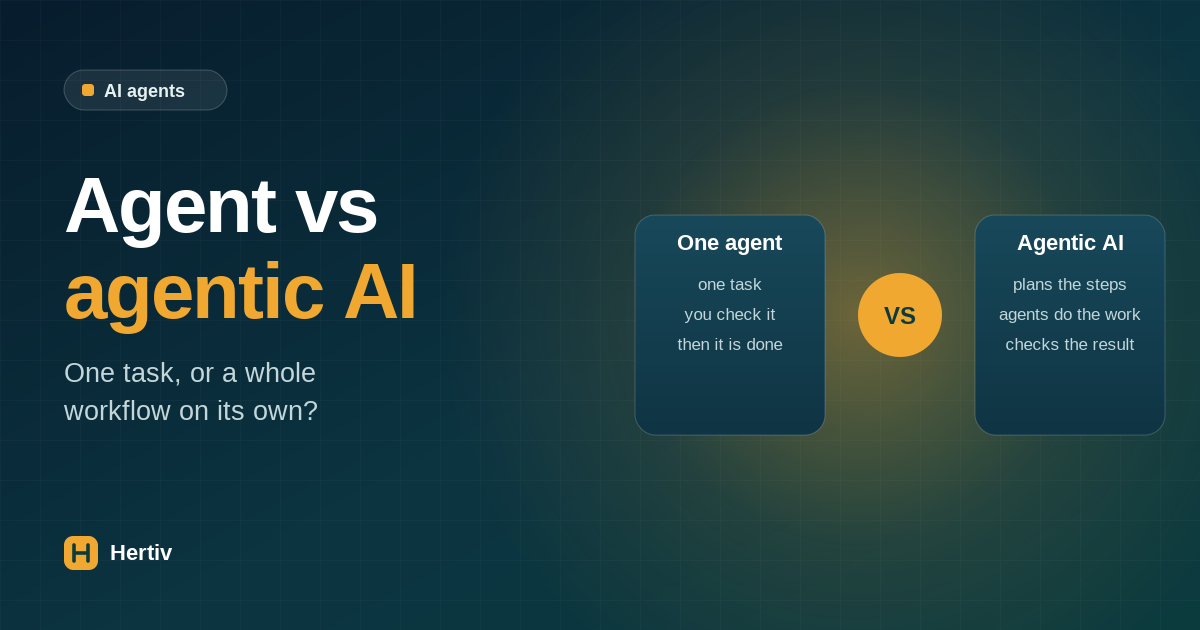
An AI agent is software that takes a task, such as answering a support question or booking a meeting, and completes it with tools you give it. Agentic AI is a system of agents that plans the steps, splits the work, checks results and keeps going until a goal is done, with a person setting its goal and limits. The difference is scope: one task versus a whole workflow.
What is an AI agent?
An AI agent is software that takes a task from a person, works out what to do, and uses tools to get it done. It can read documents, call an API, search a database, draft a reply or update a record, and it reports back when the task is finished.
A support agent, for example, reads a customer message, finds the order in the system, checks the returns policy, and drafts a reply for a person to send. A research agent reads a brief, gathers sources, and returns a short summary with the points it found. In both cases the agent works inside limits a person set: which tools it may use, which data it may read, and when it must stop and ask.
Agents are useful because they remove routine steps. They do not remove the need for a person to check the result, especially where money, safety or a customer relationship is involved. If you want the wider picture, read the AI agent use cases that save teams real time.
What does agentic AI add?
Agentic AI adds planning and coordination on top of single agents. Instead of one agent doing one task, a system of agents works toward a goal: one agent plans the steps, others carry them out, and another checks the results before anything is sent or changed.
Three things make a system agentic rather than a single agent. First, it plans: it breaks a goal into steps and picks the order. Second, it keeps state: it remembers what has already been done and what is still open. Third, it loops: when a step fails or a result looks wrong, it tries a different approach or asks a person, instead of stopping.
A travel-booking system, for instance, might have one agent check flights, another check hotels, and a third compare the options against the budget, with a planner agent keeping the whole job on track. The person sets the goal and the budget; the system handles the steps in between.
AI agents vs agentic AI: side by side
The two ideas overlap, so a side-by-side comparison helps. An agent is a building block; agentic AI is what you get when agents are organised into a system that can run a workflow end to end.
| Point | AI agent | Agentic AI |
|---|---|---|
| Scope | One task, such as drafting a reply | A whole workflow toward a goal |
| Planning | Follows steps you gave it | Plans its own steps and order |
| Memory | Remembers the current task | Tracks progress across many steps |
| When it fails | Stops and asks for help | Tries another approach first |
| People in charge | Check each result | Set goals, limits and checkpoints |
| Best first use | One repeated, well-defined task | A process with several handoffs |
The table shows the real trade-off. A single agent is simpler to build, test and control. An agentic system can handle more of a process, but it needs more guardrails, more logging, and a person who can step in when it goes off track.
When should you use a single AI agent?
A single AI agent is the right choice when the task is clear, repeated and easy to check. Answering common support questions, summarising documents, tagging tickets, drafting emails and updating records all fit this shape.
Start with one task that your team does many times a day and where a wrong answer is easy to spot. Give the agent one data source, one or two tools, and a clear rule for when it must hand the work to a person. Measure the result for two weeks: how many tasks it finished, how many needed a fix, and how much time it saved.
Keep the agent narrow on purpose. An agent that does one thing well is easier to trust than one that tries to do five things and fails quietly at two of them. You can add a second agent later, once the first one has proved itself.
When does agentic AI make sense?
Agentic AI makes sense when a job has several steps, several tools and several handoffs between people or systems. Onboarding a supplier, preparing a monthly report from five sources, or resolving a support case that needs a refund, a replacement and a follow-up message are all multi-step jobs.
Before you build one, check that the process is worth automating end to end. If the steps change every week, or if each step needs human judgement, a single agent with a person in the loop will serve you better. Agentic systems pay off when the process is stable, the steps are clear, and the cost of a slow handoff is high.
Budget for the guardrails, not just the agents. You need logs of every action, limits on what the system may change, and a checkpoint before any step that spends money or contacts a customer. Our guide to building an AI proof of concept shows how to test this on a small scale first.
How to test the difference in one week
You can test both approaches in one week with a single support workflow. Pick one process your team runs every day, such as handling refund requests, and run it three ways: fully manual, with a single agent, and with a small agentic setup.
- Measure the manual baseline. Count the requests per day, the minutes per request, and the share that need a second look.
- Try a single agent first. Let it draft replies and fetch order data while a person sends each reply.
- Add a planner agent second. Let it split refund, replacement and follow-up work across agents, with a person approving each step.
- Compare the same numbers. Time saved, errors caught, and how often a person had to step in.
- Keep the winner for one more week. If the agentic version saves time without new errors, keep it; if not, keep the single agent.
Example (hypothetical): a support team handles 300 questions a day, each taking 5 minutes, which is 300 x 5 = 1,500 minutes, or 25 hours a day. With a single agent drafting replies, staff review each draft in 1 minute, so 300 x 1 = 300 minutes, or 5 hours a day, saving about 20 hours a day.
With an agentic setup, the system resolves 200 simple questions itself and sends 100 complex ones to staff at 5 minutes each, which is 100 x 5 = 500 minutes, or about 8 hours 20 minutes a day. The agentic version saves less time here, but it needs less review, so the right choice depends on whether your team values time saved or hands-on control more.
What are the common mistakes?
The most common mistakes are choosing the bigger system too early, giving agents too much freedom, and skipping the checks that catch errors before they reach a customer.
- Building an agentic system for a one-step task. A planner, a checker and three agents for a job one agent could do adds cost and failure points.
- Letting agents act without limits. An agent that can refund, email and update records with no approval step will eventually make an expensive mistake.
- No logging of agent actions. If you cannot see what an agent did and why, you cannot fix it when it goes wrong.
- Trusting the first draft. Agents sound confident even when they are wrong, so check outputs against the source data, as our guide to testing AI models explains.
- Skipping the handoff design. The moment an agent must pass work to a person is the moment most systems fail, so design it first.
Key takeaways
- An AI agent does one task; agentic AI runs a whole workflow toward a goal
- Agentic AI adds planning, memory and retry loops on top of single agents
- A single agent is simpler to build, test and control than a multi-agent system
- Use agentic AI only for stable processes with several steps and handoffs
- Log every agent action and set approval checkpoints before money moves
- Test both approaches on one real workflow before you commit to either
Frequently asked questions
What is the difference between an AI agent and agentic AI?
An AI agent completes one task using tools you give it, such as drafting a reply or fetching an order. Agentic AI is a system of agents that plans steps, splits work, checks results and keeps going toward a goal, with a person setting the goal and the limits.
Is agentic AI just several AI agents working together?
Mostly, yes, with one addition: a planning layer. Several agents working side by side are still just agents. They become agentic AI when something plans the steps, tracks progress across them, and retries or reroutes when a step fails.
Do I need agentic AI for a support chatbot?
No. A support chatbot is usually one agent answering one question at a time, which is the simpler and safer shape. Agentic AI fits better when a case needs several steps, such as a refund, a replacement order and a follow-up message.
How do I keep an agentic system safe?
Set clear limits on what it may change, log every action it takes, and add approval checkpoints before steps that spend money or contact customers. Start with read-only access, then add write access one tool at a time after testing.
What tools do agentic AI systems use?
They use the same tools as single agents: APIs, databases, document search and messaging systems. The difference is coordination: a planner decides which agent runs next, and shared memory keeps the state of the whole job.
Can agentic AI replace a team?
No. It replaces routine steps inside a process, not the judgement that shapes the process. People still set goals, handle exceptions, check quality and take responsibility for the outcome. The agent does the routine work; the person owns the result.


