IoT Product Development: Use Cases and Process
An IoT product joins hardware, firmware and cloud software into one working device. Here are the main use cases and the six-step process teams follow to build one.
On this page
Short answer
IoT product development is the process of building a connected product: a physical device with sensors, the software that runs on it, and the cloud service and app that turn its data into something useful. It covers hardware, firmware, connectivity, cloud and testing as one product.
What is IoT product development?
IoT product development is the process of building a connected product: a physical device with sensors, the software that runs on it, and the cloud service and app that turn its data into something useful. A smart thermostat, a fleet tracker and a connected irrigation valve are all IoT products.
Unlike a pure software product, an IoT product has three parts that must work together: the hardware, the firmware on the device, and the cloud and app software. A fault in any one of them can make the whole product useless, so the process has to test all three together, not one at a time.
The work also lasts longer than a software release. Once a device is in a customer's home or factory, updating it is slow and sometimes impossible, so decisions about hardware and firmware carry more weight than a change to a web page.
Where IoT products are used
IoT products are used wherever a physical measurement or a remote action saves time, cuts waste or prevents a failure. The use cases below cover the most common ones.
| Use case | What the device does | Who benefits |
|---|---|---|
| Smart home | Controls heating, locks and lights | Homeowners |
| Asset tracking | Reports location and condition | Logistics teams |
| Predictive maintenance | Spots wear before failure | Factory operators |
| Energy management | Measures and cuts usage | Building managers |
| Precision agriculture | Measures soil and weather | Farmers |
| Remote health monitoring | Tracks vital signs at home | Patients and carers |
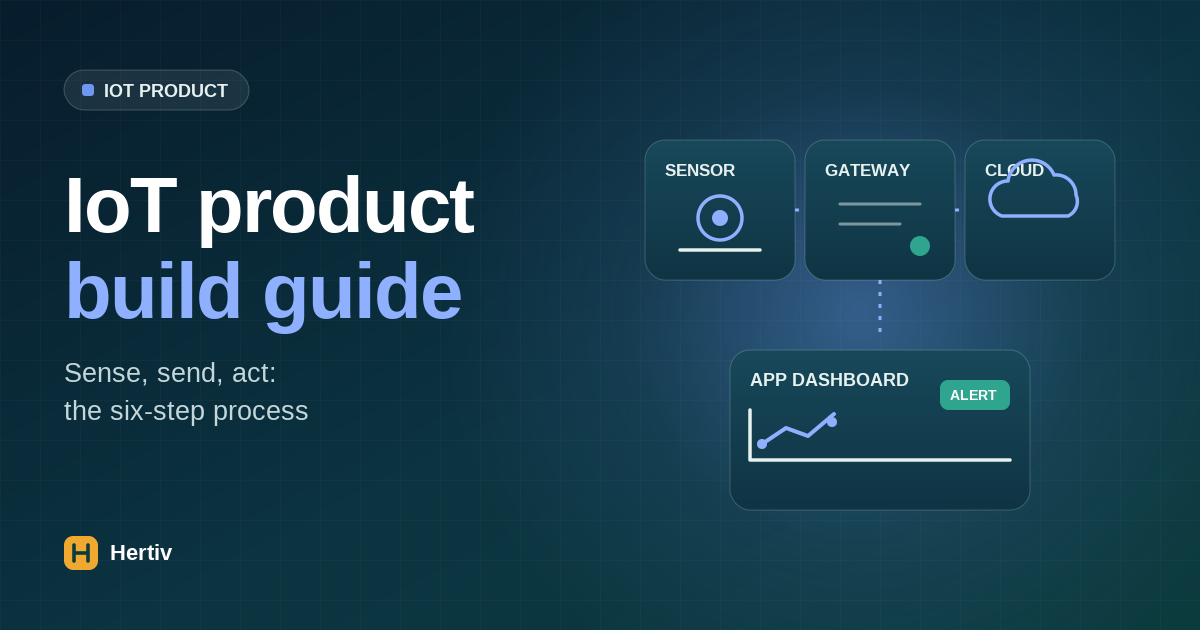
The pattern is the same in every row: a sensor measures something, the data travels to the cloud, and the app turns it into an alert, a report or an automatic action. Products that stop at measurement, without an action, rarely keep their users.
The development process in six steps
The IoT development process runs in six steps, from the first idea to a product that can be made at scale.
- Define the use case. Write down the exact problem, the user and the result that counts as success.
- Prototype the hardware. Build a rough device with off-the-shelf boards and sensors to prove the idea works.
- Design for production. Turn the prototype into a custom board, a case and a power plan that can be made in volume.
- Build the firmware and cloud. Write the device software, the data pipeline and the app together, so they agree on the data format.
- Test in the field. Run the product in real homes, factories or fields, not just on a bench.
- Launch and support. Set up updates, monitoring and a way to replace faulty units.
Teams that skip the field test pay for it later. A sensor that works on a bench can fail in a cold warehouse or a dusty factory, and a device that cannot be updated remotely turns every small fix into a return shipment.
For a sense of what these products cost to build, the earlier post on IoT app development cost breaks down the budget.
The IoT use cases by industry post covers more of the ground in step one.
Hardware and firmware choices
Hardware and firmware choices decide what an IoT product can do, how long its battery lasts and how much it costs to make.
The first choice is the processor and the connectivity: Wi-Fi for homes, cellular for vehicles and fields, and low-power options such as LoRaWAN or NB-IoT for sensors that must run for years on one battery. The choice follows the use case, not the other way round.
The second choice is the sensor set. A device that measures temperature, humidity and vibration needs different parts from one that only tracks location, and each extra sensor adds cost, power draw and failure points. The best devices measure only what the use case needs.
Firmware is the software on the device, and it has its own rules: it must recover from a failed update, keep working when the network drops, and store data locally until it can send it. A device that stops working when the connection drops will be returned, however good the app is.
Connectivity and the cloud
Connectivity and the cloud decide how device data becomes a useful product. The device sends small messages, often only a few bytes, and the cloud turns them into history, alerts and actions.
Most IoT products use a publish-and-subscribe pattern: the device publishes readings to a topic, and the cloud services that need them subscribe. This keeps the device simple, because it never has to know which services exist, and it lets the team add new services without touching the firmware.
The cloud side needs three things: a way to take in messages at scale, storage that fits the data shape, and rules that turn readings into alerts. A temperature reading above a limit should trigger an alert in seconds, while a monthly energy report can wait for a batch job.
Security runs through all of it. Each device needs its own identity and keys, messages should be encrypted, and the cloud should reject data from devices it does not recognise. A product that skips this is easy to abuse, and the damage lands on the customer.
Testing an IoT product
Testing an IoT product means testing the hardware, the firmware and the cloud together, in the conditions where the product will actually be used.
Hardware testing checks the board, the case and the battery: does it survive heat, cold, dust and a drop from a desk? Firmware testing checks the device software: does it recover from a failed update, store data when offline, and reconnect on its own? Cloud testing checks the pipeline: do messages arrive, are they stored correctly, and do alerts fire on time?
Field testing ties it together. A pilot with a small group of real users, in real buildings or fields, finds the faults a lab never sees: weak signal in a basement, a sensor that drifts in humidity, or a battery that dies in winter.
Teams that plan the testing early usually pair it with system testing practices, so the whole product is checked as one system before launch.
The data engineering side matters too, because bad sensor data will mislead every report the product shows.
Example (hypothetical): a cold-chain tracker
Example (hypothetical): a team builds a tracker for refrigerated food deliveries. The device measures temperature every 5 minutes, sends the reading over cellular, and the app alerts the driver if the temperature rises above 4 degrees.
The numbers: a delivery route takes 6 hours, so the device sends 72 readings per trip. With 50 trucks on the road each day, the cloud takes in 3,600 readings a day, or about 108,000 a month. Each reading is small, so the data bill stays low, and the alert rule is simple: two readings above 4 degrees in a row trigger a message.
In the field pilot, 2 of the 20 test devices lose signal in a cold-storage basement, so the team adds local storage that holds readings until the signal returns. The fix costs a week, but it saves the product: without it, the team would have no record of what happened during the coldest part of the trip.
Common mistakes
The most common mistakes in IoT product development are building hardware before the use case is clear, skipping field tests and treating security as an afterthought.
- Hardware before the use case. A device built around a sensor nobody asked for solves nothing.
- Too many sensors. Each extra sensor adds cost, power draw and a new way to fail.
- No offline plan. A device that stops working when the network drops will be returned.
- Skipping the field test. Lab results do not predict cold warehouses, basements or dust.
- Weak device security. Shared keys and unencrypted messages are easy to abuse at scale.
- No update plan. A device that cannot be updated remotely turns every fix into a recall.
Key takeaways
- An IoT product has three parts: hardware, firmware, and cloud plus app software
- Every use case follows the same pattern: sense, send, then act on the data
- The process runs in six steps, from use case to field test to launch
- Devices must store data offline, recover from failed updates and reconnect alone
- Field testing finds the faults a lab never sees, such as weak signal and cold batteries
Frequently asked questions
How long does IoT product development take?
It depends on the hardware. A product built on off-the-shelf boards can reach a pilot in a few months, while a custom board, case and certification can take a year or more. The cloud and app usually move faster than the hardware.
What does an IoT product cost to build?
The main costs are hardware design, firmware, cloud development and testing, plus the per-unit cost of each device. A first version built on standard boards costs far less than a custom design, and the earlier cost post breaks the budget down in detail.
Do IoT products need their own app?
Most do, because users need a way to see readings, change settings and get alerts. Some products work through an existing dashboard instead, but a dedicated app is the usual choice when the product is sold to consumers.
How do IoT devices stay secure?
Each device gets its own identity and keys, messages are encrypted, and the cloud rejects data from devices it does not recognise. Firmware updates must also be signed, so a device cannot be tricked into running code it should not.
What happens when an IoT device loses its connection?
A well-built device stores readings locally and sends them when the connection returns. It should also keep its core function working offline, for example by keeping a thermostat running its last schedule instead of stopping.
Can an IoT product be updated after it ships?
Yes, if the firmware supports over-the-air updates and the device can recover from a failed one. Products without this need a physical return for every fix, which is why the update plan should be designed before the first unit ships.


