IoT in Healthcare: What It Does and Where It Helps
IoT in healthcare connects monitors, wearables and equipment so care teams see patient data as it changes. This guide covers the main uses, data flow and safety.
On this page
Short answer
IoT in healthcare is the use of connected devices, such as monitors, wearables and smart hospital equipment, to collect patient and facility data and send it to care teams in near real time. It helps staff spot changes early, cut manual checks and keep equipment running, while raising strict demands on privacy and security.
What is IoT in healthcare?
IoT in healthcare is the use of connected devices to collect and share health data. A bedside monitor sends heart rate and oxygen levels, a wearable tracks activity and sleep, and a smart fridge reports the temperature of stored medicine. The data flows to a system that alerts staff when something needs attention.
The idea is simple: measure more often, with less manual work, and act sooner. A nurse who once checked vital signs every four hours can now see them continuously and focus visits on the patients whose readings are changing. The devices do not replace clinical judgement; they give staff better information to judge with.
IoT here covers three groups: devices worn or used by patients, monitors and machines inside hospitals, and sensors in the building itself, such as air quality and fridge monitors. IoT in logistics uses the same pattern of sensors and alerts in a different setting.
Where does IoT help in healthcare?
IoT helps most where timing matters or manual checks are slow. Remote monitoring lets patients recover at home while a care team watches their readings. Asset tracking finds infusion pumps and wheelchairs instead of staff searching wards. Environmental sensors guard medicine storage and operating rooms.
| Use | What the device does | Who benefits |
|---|---|---|
| Remote monitoring | Sends vitals from home | Patients and care teams |
| Wearables | Tracks activity, sleep, heart rate | Patients and clinicians |
| Asset tracking | Locates pumps and beds | Hospital staff |
| Smart beds | Reports movement and pressure | Nurses and patients |
| Cold chain | Monitors fridge temperature | Pharmacy teams |
| Fall detection | Alerts staff after a fall | Elderly patients |
Chronic care is a strong fit, because conditions such as heart failure and diabetes need steady tracking between visits. A wearable that flags a change early can lead to a call or a visit before the problem grows.
What devices collect the data?
Patient devices include wearables, blood pressure cuffs, glucose monitors and connected inhalers. Many pair with a phone app that sends readings to the care team. Hospital devices include bedside monitors, infusion pumps, smart beds and imaging machines that report their own status.
Building sensors are easy to overlook but matter for safety. Fridges holding vaccines or blood must stay in a narrow temperature range, and a sensor that alerts staff when the temperature drifts can save a stock of medicine. Air quality sensors help in operating rooms and isolation wards.
Most devices connect over Wi-Fi, Bluetooth or low-power networks, and many have batteries that last months. The choice of connection affects range, battery life and how much data can be sent, so teams should match the network to the device rather than the other way round. Some wearables also track falls or irregular heart rhythms and send an alert without the patient pressing anything.
How does the data reach the care team?
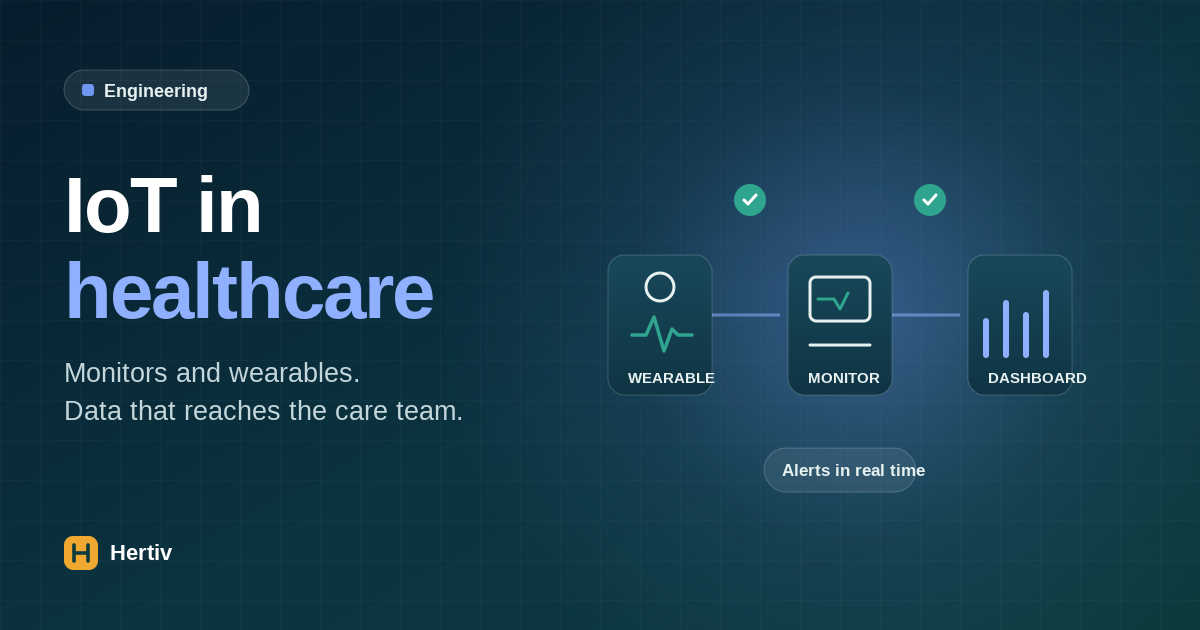
Data usually flows from the device to a gateway or phone, then to a cloud or hospital system, and finally to a dashboard or alert. The gateway handles the local connection, while the cloud stores the readings and runs the rules that decide when to alert. Staff see a list of patients with the most urgent readings first.
Alerts need care. Too many alerts and staff start ignoring them, which is worse than too few. Good systems set thresholds per patient, combine related readings into one alert and let staff adjust the rules. A heart rate that is normal for one patient can be a warning sign for another.
Integration with the electronic health record matters most. Readings that stay in a separate app get missed, while readings that flow into the patient record are seen during rounds and follow-ups. Building a healthcare IoT platform covers the integration work in more depth.
What about privacy and safety?
Health data is among the most sensitive data there is, so IoT in healthcare carries strict privacy and security rules. Devices should encrypt data in transit and at rest, use unique credentials and receive security updates. A device that cannot be updated becomes a risk the moment a flaw is found.
Regulations such as HIPAA in the United States set rules for how patient data is stored, shared and accessed. Teams should check which rules apply before choosing devices, because a consumer wearable and a clinical monitor are held to different standards. HIPAA-compliant mobile apps explain the app side of those rules.
Example (hypothetical): remote monitoring after discharge
Example (hypothetical): a hospital sends 40 heart patients home with a wearable and a blood pressure cuff after discharge. Each patient takes two readings a day, which gives 80 readings a day across the group. A nurse reviews a dashboard each morning and calls the patients whose readings cross their personal threshold.
In the first month, the dashboard flags 12 patients, and the nurse calls each one. Nine need only a medication reminder, while three are asked to come in early. Without the devices, those three might have waited until their next scheduled visit two weeks later.
The arithmetic is simple: 40 patients times two readings is 80 readings a day, and 12 flags out of 1,200 readings in a month is a 1 percent alert rate. The team keeps the alert rate low by setting thresholds per patient, so the nurse can act on every flag instead of ignoring most of them.
Common mistakes
The most common mistake is buying devices before deciding what the data should change. A ward full of sensors that nobody watches is worse than no sensors, because it creates a false sense of safety. Start with one decision the data will improve, then pick the device that serves it.
Another mistake is ignoring alert fatigue. If staff get dozens of alerts a day, they will start to ignore them, and the one that matters will be missed. Set thresholds per patient, review alert rates weekly and remove alerts that never lead to action.
Key takeaways
- IoT connects monitors, wearables and hospital equipment to care teams.
- Remote monitoring and asset tracking are the strongest early uses.
- Data should flow into the patient record, not sit in a separate app.
- Privacy rules and update support decide which devices are safe to use.
- Pilot one ward and one use before scaling across a hospital.
Frequently asked questions
What is IoT in healthcare?
It is the use of connected devices such as monitors, wearables and smart equipment to collect patient and facility data and send it to care teams. The aim is earlier action, fewer manual checks and safer buildings.
Do patients need to be tech-savvy to use IoT devices?
No. Most patient devices are designed to work with one button or no interaction at all, and readings are sent automatically. The care team handles the setup and the monitoring.
Is IoT in healthcare secure?
It can be, if devices encrypt data, use unique credentials and receive security updates. Devices without updates or with default passwords are a real risk and should not touch patient data.
What is remote patient monitoring?
It is the use of connected devices to track a patient's readings at home, such as blood pressure or heart rate, and send them to a care team. Staff review the readings and act when they cross a threshold.
Does IoT replace nurses or doctors?
No. It gives them more frequent data and earlier warnings, but clinical judgement still decides what to do. The goal is to focus staff time on the patients who need it most.
How much does IoT in healthcare cost?
It varies by device, network and integration work. Pilot costs are modest, while hospital-wide rollouts need budgeting for devices, connectivity, integration and ongoing support.


