How to Develop a Healthcare IoT Platform That Clinicians Trust
A healthcare IoT platform connects medical devices and wearables to one system, so readings become alerts clinicians can act on. Here is how to build one safely.
On this page
Short answer
A healthcare IoT platform is software that connects medical devices, wearables and sensors to one system, collects the readings they produce, and turns them into alerts and records that clinicians can use to care for patients.
What is a healthcare IoT platform?
A healthcare IoT platform is software that connects medical devices, wearables and sensors to one system, collects the readings they produce, and turns them into alerts and records that clinicians can act on.
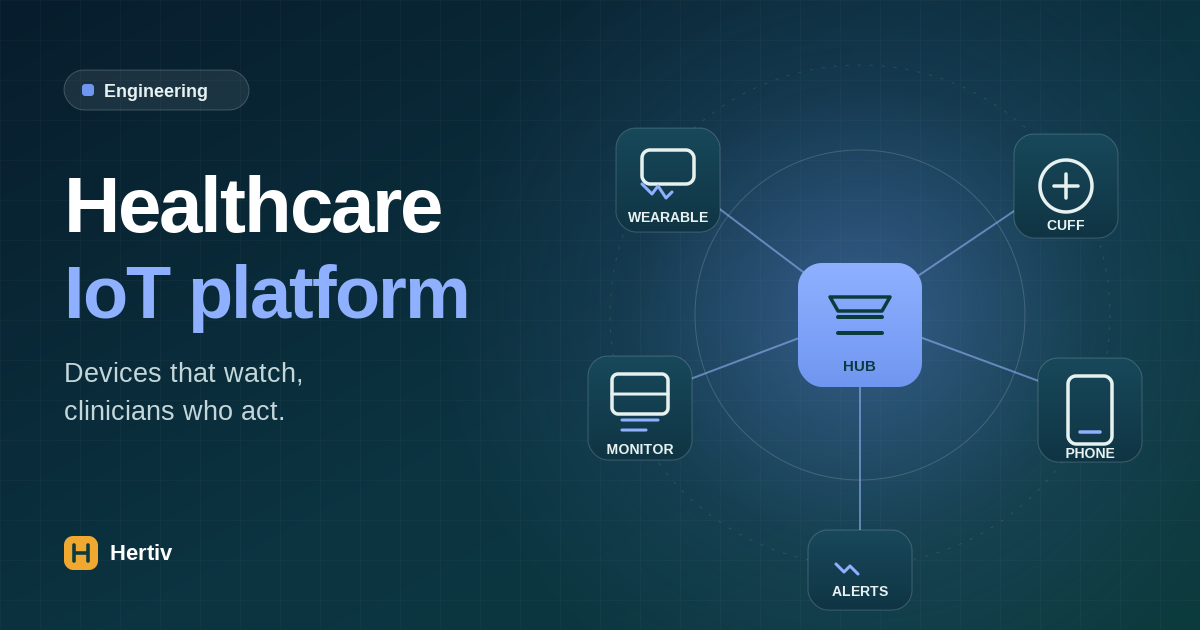
The devices include blood pressure cuffs, glucose monitors, pulse oximeters, fall detectors and hospital equipment that reports its own status. The platform sits between the device and the people who need the data: nurses, doctors, carers and the patient.
A platform is more than a dashboard. It also handles device registration, data cleaning, alert rules and audit logs, so a reading can be traced back to the device and the time it was taken.
| Part | What it does | Example |
|---|---|---|
| Device | Measures and sends readings | Blood pressure cuff, wearable |
| Gateway | Collects device data and forwards it | Phone app, bedside hub |
| Cloud service | Stores, cleans and checks readings | Alert rules, trend charts |
| Clinician dashboard | Shows patients who need attention | Alert list, patient timeline |
| Patient app | Lets patients see their own data | Readings, reminders, messages |
What can a healthcare IoT platform do?
A healthcare IoT platform can watch patients between visits, track equipment inside a hospital, and cut the manual work of recording readings by hand.
Remote monitoring is the most common use. A patient measures blood pressure or blood sugar at home, the reading reaches the care team the same day, and a nurse can call before a small change becomes an emergency visit.
- Remote monitoring. Daily readings from home, with alerts when a value leaves its safe range.
- Fall detection. Wearables that raise an alert when a patient falls and does not get up.
- Asset tracking. Finding pumps, beds and monitors inside a hospital instead of searching wards.
- Medication reminders. Prompts that help patients take doses on time and record that they did.
- Ward monitoring. Temperature, humidity and air quality in rooms where patients recover.
The value is not the device. It is the speed between a reading and a decision. A platform that shows a nurse the ten patients who need attention today is worth more than one that stores a thousand readings nobody reads. The same pattern appears in other sectors, as enterprise IoT platforms show.
What data does the platform handle?
A healthcare IoT platform handles four kinds of data: vital signs, device status, alerts and location, and each kind needs different care.
Vital signs are the readings themselves: blood pressure, heart rate, oxygen saturation, glucose and temperature. These are health data, so they need the strongest protection and the clearest audit trail.
Device status covers battery level, signal strength, firmware version and last connection time. This data tells the team whether a missing reading means a healthy patient or a dead battery.
Alerts are the platform's decisions: a reading outside its range, a device offline for a day, or a pattern that drifts over a week. Every alert should record what triggered it and what happened next.
Location data shows where a device or patient is, which matters for asset tracking and for fall alerts. Collect only the location you need, and keep it with the same protections as the vital signs.
How do you protect patient data?
You protect patient data by encrypting it in transit and at rest, limiting who can see it, and logging every access so it can be reviewed later.
Start with the rules that apply where your patients live. In the United States, health data is governed by HIPAA, which sets requirements for safeguards, access control and breach reporting. Design the platform around those requirements from the first sketch, not as a fix at the end.
- Encryption. Encrypt data on the device, on the network and in storage, with keys held separately from the data.
- Access control. Give each role only the patients and fields it needs: a nurse sees her own patients, an admin sees device status, not readings.
- Audit logs. Record who viewed, changed or exported a record, and keep the logs where they cannot be edited.
- Consent. Record what each patient agreed to share, and make it easy to withdraw consent later.
For the wider security picture, data security and compliance covers the controls that health platforms share with other regulated systems.
How to build a healthcare IoT platform in 6 steps
You build a healthcare IoT platform by proving the clinical value with one device and one patient group, then adding devices, integrations and scale only after the first pilot works.
- Pick one use case. Choose a single patient group and a single reading, such as blood pressure for heart patients, and define what success looks like.
- Choose devices that already work. Prefer devices with published data formats and a track record in clinics over new hardware that needs custom drivers.
- Build the data pipeline first. Device to gateway to cloud to dashboard, with retries when the network drops and a record of every reading received.
- Set the alert rules with clinicians. Agree the thresholds, who gets each alert, and what happens when nobody responds within an hour.
- Connect to the record system. Send summaries to the electronic health record so readings live where clinicians already work.
- Run a small pilot, then scale. Start with tens of patients, fix the alert noise and device failures, and only then roll out to hundreds.
Keep the first version small. A platform that handles one device well teaches you more about alert noise, battery life and clinician habits than a platform that handles ten devices badly. The insurance sector shows the same pattern in IoT in insurance.
Example: a remote monitoring pilot for heart patients
Example (hypothetical): a clinic runs a pilot for 200 heart patients, each with a blood pressure cuff that sends four readings a day. That is 200 x 4 = 800 readings a day reaching the platform.
About 5% of readings fall outside the agreed range, so the platform raises 800 x 0.05 = 40 alerts a day. A nurse reviews each alert in about 5 minutes, which is 40 x 5 = 200 minutes, or about 3 hours and 20 minutes of review time each day.
The pilot budget is 200 devices at $80 each, which is $16,000, plus $30,000 for the platform build and the first three months of hosting. That is $16,000 + $30,000 = $46,000. A 15% reserve adds $6,900, bringing the total to $52,900.
After four weeks the clinic checks the numbers. If nurses spend most of their time on false alerts, the thresholds move. If devices keep dropping off the network, the gateway changes. The pilot earns its next round of funding only when the review time stays under four hours a day.
What are the common mistakes?
The most common healthcare IoT mistakes are starting with too many devices, setting alert thresholds without clinicians, and treating data protection as a late addition.
- Too many devices at launch. Each device adds pairing, battery, firmware and support work. One device type, done well, beats five half-working ones.
- Alerts nobody tuned. Thresholds copied from a manual create hundreds of alerts a day, and nurses soon stop reading them.
- No plan for offline devices. Home wifi fails and batteries die. The platform must show which patients have gone quiet and for how long.
- Security added last. Retrofitting encryption, access control and audit logs costs more than building them in from the start.
- Readings with no home. If results never reach the health record, clinicians must check two systems, and the platform slowly stops being used.
Key takeaways
- A healthcare IoT platform connects devices to one system so readings become alerts clinicians can act on
- Remote monitoring, fall detection and asset tracking are the most common first uses
- Vital signs need the strongest protection, with encryption, access control and audit logs
- Build one use case with one device first, then add devices after the pilot works
- Alert rules must be set with clinicians, or nurses will drown in false alerts
Frequently asked questions
How is a healthcare IoT platform different from a fitness app?
A fitness app tracks activity for the user. A healthcare IoT platform sends readings to a care team, raises alerts when values leave a safe range, and keeps an audit trail that clinicians and regulators can review.
Which devices work best for a first pilot?
Devices with a published data format and a record of use in clinics, such as blood pressure cuffs and pulse oximeters. Avoid new hardware that needs custom drivers until the platform itself is proven.
Do I need HIPAA compliance for a healthcare IoT platform?
If you handle patient data in the United States, yes. HIPAA sets requirements for safeguards, access control and breach reporting. Design for those requirements from the start, and get legal advice on your specific setup.
How do you stop alert fatigue?
Set thresholds with clinicians, review which alerts led to action, and raise the bar for alerts that never change care. A weekly review of alert outcomes keeps the noise down.
What happens when a device goes offline?
The platform should flag the patient as quiet and show how long the device has been silent. A nurse can then call the patient instead of assuming the readings are fine.
Can readings go into the electronic health record?
Yes, and they should. Send summaries to the record system so clinicians see readings where they already work, instead of checking a second dashboard. A single view also makes handovers easier, since the next clinician sees the same readings and alerts without asking for them.


