Why Blockchain Matters for Business: What It Actually Changes
Blockchain matters where several parties must trust one shared record. This guide explains what it changes, where it helps and where it does not.
On this page
Short answer
Blockchain matters for business because it lets several parties share one record that none of them can quietly change. That matters where companies must agree on what happened: who paid, who shipped, who owns what, or whether a document is genuine. It does not make every business better, but for shared records between parties that do not fully trust each other, it removes a real source of cost and dispute.
What does blockchain change for a business?
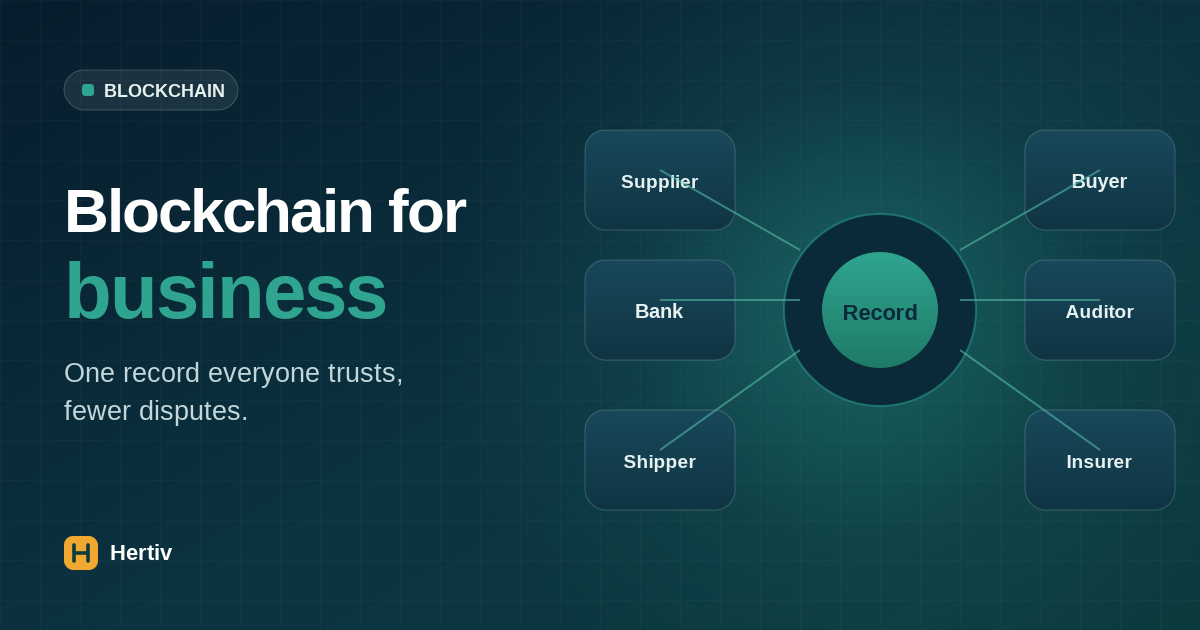
Blockchain is a shared record that several parties can read and add to, where entries cannot be quietly changed after the fact. For a business, the change is not the technology itself but what it removes: the need for each party to keep its own copy of the record and then argue about which copy is right.
Most business disputes about records are disputes about copies. A supplier says an order was shipped on Tuesday; the buyer says the system shows Wednesday. With one shared record, both sides look at the same entry, and the question becomes whether the entry is correct, not which copy to believe.
That is the core value. Blockchain does not make a business faster or cheaper on its own. It makes shared records harder to dispute, which saves the time and money spent reconciling copies and resolving arguments.
Where does blockchain help a business most?
Blockchain helps most where several independent parties share a process and none of them is the obvious owner of the record. Supply chains, trade finance, identity checks and royalty payments are the classic cases, because each involves parties that do not fully trust each other but must agree on the facts.
| Business area | What blockchain changes | Why it helps |
|---|---|---|
| Supply chain | One shared record of each handover | Fewer disputes about delivery |
| Trade and payments | Shared record of payment and release | Faster settlement between parties |
| Identity and credentials | Records a person can carry and prove | Less repeated checking |
| Royalties and rights | Record of ownership and use | Clearer payments to creators |
| Compliance and audit | Records that cannot be altered quietly | Easier, faster audits |
The pattern is the same in each case: the value comes from agreement, not from the chain itself. What is blockchain explains the underlying ideas in more detail.
Where does blockchain not help?
Blockchain does not help where one party owns the record and everyone else trusts it. A company keeping its own internal records does not need a shared ledger: a database is faster, cheaper and easier to fix when a mistake is made.
It also does not help where the hard problem is getting the data right in the first place. A chain can prove that a record was not changed, but it cannot prove that the record was true when it was written. If a sensor is faulty or a person enters the wrong number, the chain faithfully preserves the wrong number.
Finally, blockchain does not remove the need for rules and enforcement. A smart contract can release a payment automatically, but someone still has to decide what happens when the goods arrive damaged. The technology settles the record; people still settle the dispute.
How do smart contracts fit in?
A smart contract is a small program stored on a blockchain that runs when its conditions are met. For a business, the useful idea is that an agreement can execute itself: a payment is released when delivery is confirmed, or a licence is issued when the fee is received.
The benefit is not that contracts become automatic, but that the rules are visible to all parties and the outcome is the same for everyone. That removes a whole class of arguments about what was agreed and whether it happened.
The risk is that a contract with a bug is hard to fix, since the code is on the chain. Smart contracts should be kept small, tested carefully and reviewed by someone who understands both the business and the code. What is smart contract development covers how these contracts are built and checked.
Example (hypothetical): a supply chain that stops arguing about delivery
Example (hypothetical): a food distributor ships to 40 stores, and each delivery is recorded by the driver, the warehouse and the store. Before blockchain, reconciling those three records takes about 6 hours a week, because the records disagree on roughly one delivery in ten.
With a shared record, each handover is entered once and seen by all three parties. The time spent reconciling falls to about 40 minutes a week, saving roughly 5 hours and 20 minutes a week. Over a year of 50 working weeks, that is about 267 hours, or more than six working weeks.
The saving comes from agreement, not speed. The deliveries take the same time; the arguments about them mostly disappear. The chain did not fix the deliveries, it fixed the record of the deliveries.
How to start with blockchain in 5 steps
Starting well matters more than starting fast. Follow these five steps before committing to a build.
- Find a shared-record problem. Look for a process where two or more parties keep separate copies and argue about them. If only one party keeps the record, a database is enough.
- Check the business case. Estimate what reconciliation, disputes and delays cost today. If the cost is small, blockchain will not pay for itself.
- Pick the right kind of chain. A private chain between known partners fits most business cases better than a public one. How to create a private blockchain explains the choice.
- Run a small pilot. Put one process, one product line or one corridor on the chain with real partners, and measure the time saved.
- Plan the rules first. Agree who can write, who can read, and what happens when a record is wrong, before the first entry is made.
A pilot that saves measurable time is the only proof that matters. A demo that looks impressive but changes no process is a cost, not a result.
Common mistakes
The most common mistake is starting with the technology instead of the problem. Teams buy a platform, then search for something to put on it. Start with the record that causes arguments, and only then ask whether a chain fits.
Another mistake is putting everything on the chain. Large files, personal data and anything that changes often belong off the chain, with only a reference stored on it. A chain is a record, not a database.
Teams also forget the off-chain work. Getting the data in correctly, agreeing the rules and handling exceptions take more effort than the chain itself. And never promise that blockchain makes data true: it makes records hard to change, which is a different thing entirely.
Key takeaways
- Blockchain matters where several parties must trust one shared record.
- Its value is fewer disputes about records, not speed or lower cost.
- It does not help where one party owns the record or the data itself is wrong.
- Smart contracts make agreements visible and self-executing, but need careful review.
- Start with a small pilot on one process and measure the time saved.
Frequently asked questions
Why is blockchain important for business?
Blockchain is important where several parties must trust the same record without trusting each other. It gives them one record none of them can quietly change, which cuts the time spent reconciling copies and arguing about what happened.
Which businesses benefit most from blockchain?
Supply chains, trade finance, identity checks, royalty payments and compliance benefit most, because each involves several independent parties that must agree on shared facts. A business where one party owns the record gains little from a chain.
Does blockchain make a business faster?
Not on its own. Blockchain can make shared records harder to dispute, which saves time spent on reconciliation, but it does not speed up the underlying work such as shipping or manufacturing.
Is blockchain the same as a database?
No. A database is faster and easier to change, and it fits records owned by one party. A blockchain fits records shared between parties that do not fully trust each other, because entries cannot be quietly altered.
What is a smart contract in business terms?
A smart contract is a small program on a blockchain that runs when its conditions are met, such as releasing a payment when delivery is confirmed. It makes the rules visible to all parties and the outcome the same for everyone.
How should a business start with blockchain?
Start by finding a shared-record problem, check what disputes and reconciliation cost today, and run a small pilot on one process with real partners. Measure the time saved before committing to more.


