IEO vs ICO: How They Differ and Which Fits
An ICO sells tokens directly to the public, while an IEO sells them through an exchange that reviews the project first. How they compare on cost and risk.
On this page
Short answer
An ICO is a token sale run by the project team itself, while an IEO is a token sale run on a cryptocurrency exchange that reviews the project first. The IEO usually costs more but brings the exchange's buyers and a basic check, while the ICO is cheaper and faster but leaves buyers with almost no protection if the project fails.
What is an ICO?
An ICO, or initial coin offering, is a way for a blockchain project to raise money by selling its own tokens directly to the public. The project publishes a white paper, sets a token price and a sale period, and buyers send cryptocurrency, usually ETH or a stablecoin, to a smart contract in exchange for the new tokens.
The ICO model grew in 2017 and 2018, when hundreds of projects raised money this way. The appeal was speed: a team could raise funds from a global audience without a bank, a venture fund or a stock exchange. The risk was that buyers had little protection. Some projects never shipped, and some were frauds, so regulators in many countries stepped in with rules or warnings.
In an ICO, the project team handles everything: the sale page, the smart contract, the marketing and the token distribution. That gives the team full control, but it also means buyers must trust the team completely, because there is no exchange or third party checking the project first.
What is an IEO?
An IEO, or initial exchange offering, is a token sale run on a cryptocurrency exchange. The project team applies to the exchange, the exchange reviews the project, and if it is accepted, the sale takes place on the exchange platform. Buyers need an account on that exchange, and they buy the tokens with funds already held there.
The exchange acts as a gatekeeper. It usually checks the team, the white paper, the smart contract and the token economics before listing the sale, and it handles the payment and token distribution. That review does not guarantee the project will succeed, but it removes the weakest projects and gives buyers a known place to complain if something goes wrong.
The IEO model grew in 2019, when exchanges started offering token sales as a service. For a project team, the main benefit is the exchange audience: the sale reaches the exchange's existing users without the team having to build that audience from zero. For buyers, the main benefit is a simpler and safer purchase flow.
How do ICOs and IEOs differ?
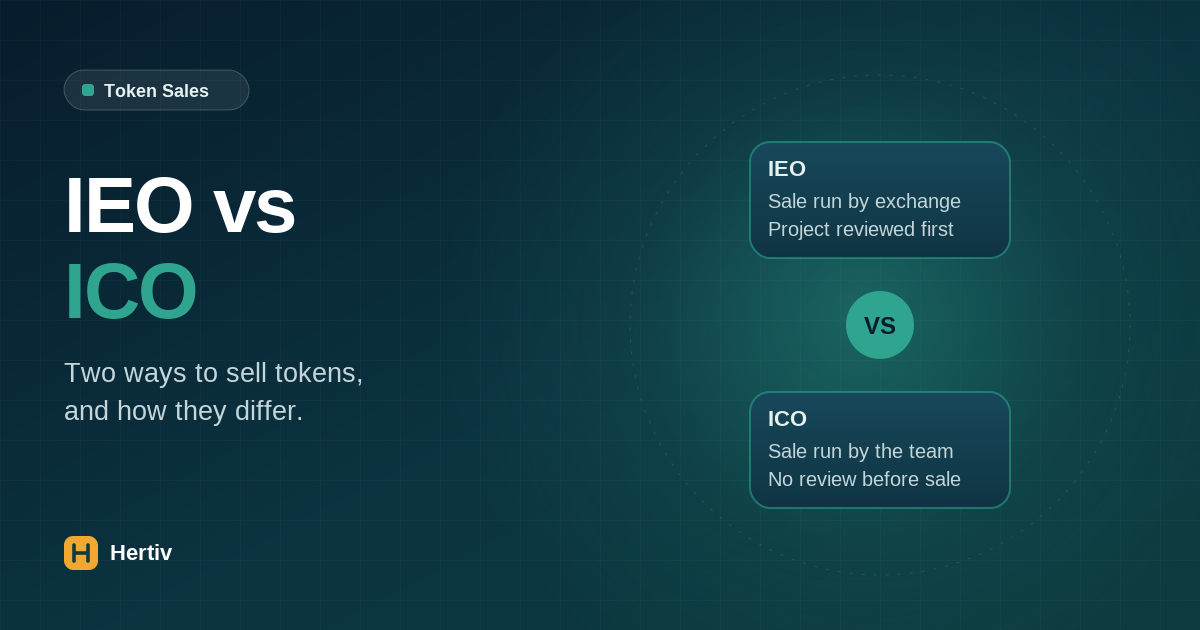
The main difference between an ICO and an IEO is who runs the sale and who checks the project. In an ICO, the project team runs the sale itself and nobody checks it first. In an IEO, the exchange runs the sale and reviews the project before it lists. That one difference shapes the cost, the reach and the risk of each model.
| Factor | ICO | IEO |
|---|---|---|
| Who runs the sale | The project team | The exchange |
| Project review | None, buyers check it themselves | Exchange reviews team and documents |
| Where buyers pay | Project smart contract | Exchange account |
| Audience | Team must build it | Exchange's existing users |
| Cost to the team | Marketing and contract costs | Exchange listing and service fees |
| Buyer protection | Very little | Exchange rules and support |
| Speed to launch | Fast, no approval needed | Slower, needs exchange approval |
The cost pattern is also different. An ICO costs the team marketing and smart contract work, while an IEO adds exchange fees, which can be a flat fee, a share of the tokens, or both. A team should compare the total cost, not just the headline fee, and read how to launch an IEO before choosing a model.
What are the risks of each model?
The main risk of an ICO is fraud and failure. Because nobody checks the project, a team can raise money and never ship, or sell tokens with no real use. Buyers who send funds to a project smart contract have little recourse if the team disappears. Even honest projects can fail, and ICO buyers usually have no refund rights.
The main risk of an IEO is different: the exchange review is not a guarantee. Exchanges have listed projects that later failed, and the exchange's incentives are not the same as the buyer's, since the exchange earns fees from the sale. Buyers should still read the white paper, check the team, and treat the exchange listing as a filter, not as approval.
Both models share a market risk. Token prices can fall sharply after the sale, especially when early buyers sell quickly. A token that raised money at one price can trade far lower within weeks, so buyers should only put in money they can afford to lose. A smart contract audit helps with the technical risk, and teams should read what a smart contract audit covers before any sale.
How do you choose between an IEO and an ICO?
You choose between an IEO and an ICO by weighing trust, reach and cost. A team with a strong reputation and a large community may do well with an ICO, because it can reach buyers directly and keep the full raise. A new team with no audience usually gets more from an IEO, because the exchange brings both buyers and a basic level of trust.
The decision also depends on the token and the market. A token with a clear use in a working product is easier to sell in either model. A token with no working product is hard to sell anywhere, and an exchange may refuse to list it. Teams should have a working product, or at least a working demo, before planning a sale.
Regulation is the third factor. Some countries treat token sales as securities offerings, which need a licence or an exemption, and the rules differ by country. A team should get legal advice on its own sale before choosing a model, because the wrong structure can lead to fines or a forced refund. The legal position matters more than the marketing plan.
Example (hypothetical): a team planning a $2 million raise
Example (hypothetical): a team wants to raise $2 million for a payments token. It compares an ICO with an IEO on a mid-size exchange. For the ICO, it budgets $150,000 for marketing, $40,000 for the smart contract and audit, and $30,000 for legal advice, a total of $220,000 before the sale.
For the IEO, the exchange charges a $100,000 listing fee plus 5 percent of the tokens sold. On a $2 million raise, 5 percent of the tokens is worth $100,000, so the exchange cost is $200,000. The team still needs $40,000 for the audit and $30,000 for legal advice, so the IEO total is $270,000, which is $50,000 more than the ICO.
The team picks the IEO anyway, because it has no audience of its own. Its own mailing list has 2,000 people, while the exchange has far more active buyers. The extra $50,000 buys reach and a basic review, which the team judges worth the cost. The numbers show the real trade-off: an IEO costs more, but it brings buyers the team cannot reach alone.
What are the common mistakes?
The most common mistakes in token sales are skipping the legal work, selling a token with no use, and trusting the exchange review too much. Each one is easy to avoid with a slow, honest plan.
- Skipping legal advice. Token sales can fall under securities law. A team that launches without advice risks fines or a forced refund, which is far more costly than a lawyer's fee.
- A token with no use. If the token does nothing in the product, buyers have no reason to hold it, and the price falls after the sale. The token needs a real job in the product.
- Trusting the exchange completely. An IEO listing is a filter, not a guarantee. Buyers should still check the team, the white paper and the contract.
- Weak token economics. Selling too many tokens early, or giving the team a large share with no lock-up, pushes the price down. A clear vesting schedule protects buyers.
- No audit. An unaudited sale contract can be drained or locked by a bug. An audit is a basic cost of any sale, and teams should read how to launch an ICO for the full checklist.
- Overpromising returns. Promising buyers a profit is a legal risk and a trust risk. Sell the product, not the price.
Key takeaways
- An ICO is run by the team; an IEO is run by an exchange
- The exchange review filters weak projects but is not a guarantee
- IEOs usually cost more but bring an existing audience
- Both models carry price and legal risk
- The token needs a real use in the product
Frequently asked questions
Is an IEO safer than an ICO?
It is safer in one way: the exchange reviews the team, the white paper and the contract before listing, which filters out the weakest projects. It is not a guarantee, though. Exchanges have listed projects that later failed, so buyers should still check the project themselves.
How much does an IEO cost the project team?
The team pays a listing fee plus a share of the tokens sold, on top of audit and legal costs. On a $2 million raise, the exchange cost alone can reach $200,000, so the team should compare the total cost of both models before choosing.
Can a team run an ICO and an IEO?
Some teams run a private sale first, then a public sale on an exchange. That can work, but it adds complexity and legal questions, because each sale may fall under different rules. A team should get legal advice on the full plan, not just one sale.
What is a white paper?
A white paper is the document that explains the project, the problem it solves, the token's use, the team and the sale terms. Buyers should read it before buying, and a missing or vague white paper is a warning sign.
Do token sales need a licence?
It depends on the country and on how the token is classified. Some token sales are treated as securities offerings and need a licence or an exemption. The rules differ by country, so a team should get legal advice for its own sale.
What happens to tokens after the sale?
Tokens are usually listed on an exchange, where buyers can trade them. The price can rise or fall sharply, and early buyers often sell quickly, so the team should plan the listing and the token release schedule with care.


