How to Launch an IEO: A Step-by-Step Guide for Token Teams
An IEO is a token sale run through an exchange that handles compliance and distribution. Learn the steps, costs, risks and how to choose a launch partner.
On this page
Short answer
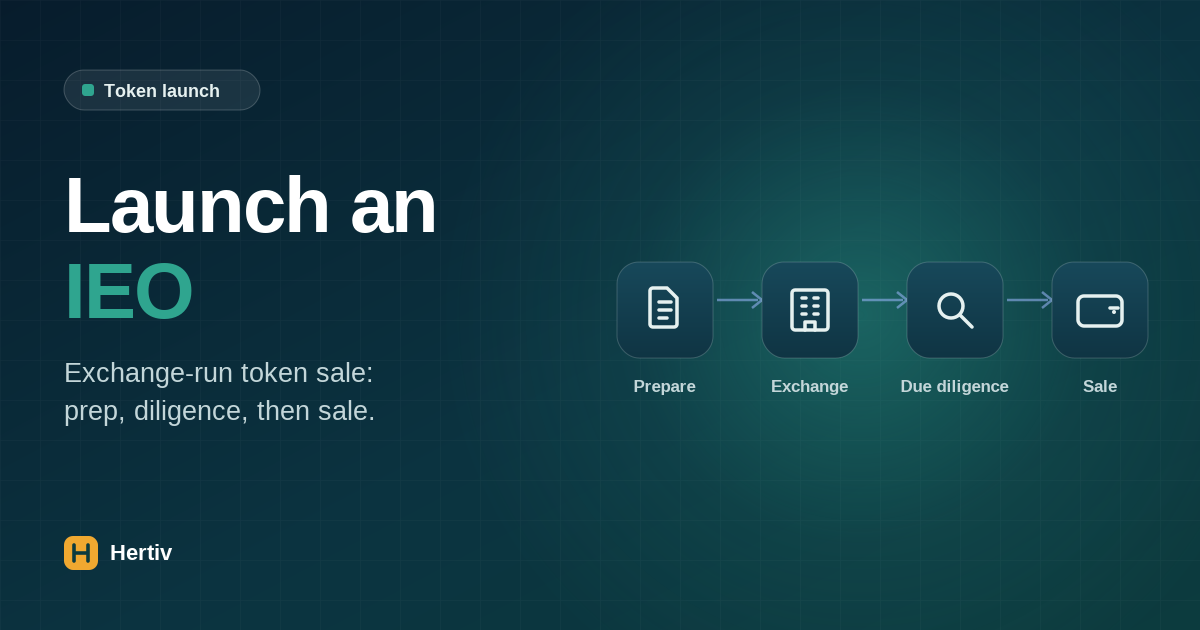
To launch an IEO, you prepare a compliant token and documentation, agree terms with a suitable exchange, pass their due diligence, then run the sale on their platform. The exchange handles KYC, payments and token distribution, but you still own legal, technical and marketing responsibility.
What is an IEO and how does it differ from an ICO?
An IEO (Initial Exchange Offering) is a token sale conducted on a cryptocurrency exchange's platform, where the exchange vets the issuer and handles KYC, payment collection and token distribution on its users' behalf.
In an ICO, the issuer runs the sale directly and manages investor onboarding, payments and compliance itself. An IEO moves those operational pieces to the exchange. The trade-off is control and cost: the exchange takes a fee, sets sale rules and may require lockups, while you get access to its verified user base and infrastructure.
Key differences:
- Who runs the sale: the exchange, not your team.
- KYC and AML: the exchange already has verified users; it applies its own checks.
- Distribution: tokens usually land in exchange wallets, so you need a clear listing plan.
- Due diligence: the exchange reviews your legal structure, token supply and smart contract before agreeing.
- Cost: a listing or participation fee, plus marketing and legal work you still fund.
An IEO is not a compliance shortcut. In most jurisdictions your token is still a financial product or a security unless it clearly is not, and you remain responsible for how it was offered. Treat the exchange as a distribution partner, not a legal shield. For a structured view of the legal and technical groundwork, see blockchain consulting.
What should you prepare before approaching an exchange?
Before you talk to any exchange, finish the token design, the legal position and the documentation. Exchanges reject projects that arrive with unfinished economics or no legal opinion, and a second application after a rejection is harder.
Work through these in order:
- Token utility and supply. Decide total supply, allocation across team, treasury, investors and sale, vesting schedules and lockups. Exchanges ask for this in detail.
- Legal opinion. Get a written assessment for the jurisdictions you plan to sell in. Most exchanges ask for one, and the answer shapes what you can promise buyers.
- Smart contract and audit. Deploy the token contract on a testnet, then get an independent audit. A signed audit report is standard due-diligence material.
- Corporate structure. Have a registered entity, a clean cap table and clear ownership of the token rights.
- Documentation pack. Whitepaper or litepaper, tokenomics table, pitch deck, team bios, roadmap and the audit.
- Marketing plan. Exchanges want to see how demand reaches their user base; "we will post on X" is not a plan.
A pre-launch readiness review, the same way you would test a payments product before going live, catches gaps early. The article on evaluating an LLM application before launch covers a similar discipline of testing before exposing a system to the public.
How do you choose the right launch exchange?
Match the exchange to your buyers, not to its name recognition. A smaller regional exchange with real users in your market can outperform a global one where your token disappears among hundreds of listings.
Compare candidates on these dimensions:
- User base and geography. Where are its verified users, and does that match your target market?
- Jurisdiction and licensing. Which regulators does it answer to, and does that fit your legal opinion?
- Recent IEO track record. Look at how past sales performed after listing, not just at launch day.
- Liquidity for similar tokens. Check whether comparable tokens keep trading volume after the first week.
- Requirements. Minimum raise, lockup terms, market-making obligations, reporting duties.
- Fees. Participation or listing fees, plus any share of the raise. These vary widely by scope.
Example (hypothetical): a team plans a $2 million raise. With a 5% exchange participation fee that is $100,000; legal work might add $40,000, smart contract audit $25,000 and marketing $150,000, for roughly $315,000 in launch costs against the raise. The numbers are illustrative only and change with jurisdiction and exchange.
Run parallel conversations with two or three exchanges so you have a fallback. Expect each to apply its own due diligence on your structure and contract.
What does the IEO application process look like?
The application is a sequence of reviews, not a single form. Each stage can end the conversation, so prepare the materials before you start.
Typical stages:
- Initial submission. Project summary, tokenomics, team, legal entity and links to the audit and whitepaper.
- Screening call. The exchange's listing team asks about utility, revenue model and target market.
- Due diligence. They check corporate documents, beneficial ownership, smart contract code and the legal opinion. This is where most delays happen.
- Commercial terms. Negotiate the fee, sale size, token price, lockups, allocation to their users and market-making expectations.
- Integration. Your engineers connect with their listing team on token contract details, decimals, wallet support and any staking or claim mechanics.
- Announcement and sale. Marketing runs to a schedule; the exchange publishes terms and runs KYC and payment.
- Distribution and listing. Tokens are delivered to buyers and trading opens, often with a market maker in place.
Expect diligence to focus on the smart contract and the cap table. A messy cap table or an unaudited contract is the most common reason for delay. Have your smart contract audit ready rather than promised.
What are the costs and risks of an IEO?
IEO costs are real money before you raise anything, and the main risks are legal, reputational and market-driven. Budget conservatively and treat the raise as uncertain until it closes.
Cost lines to plan for:
- Exchange participation or listing fee, sometimes a share of the raise.
- Legal opinion and entity setup in the relevant jurisdictions.
- Smart contract development and audit.
- Marketing, community and market-making.
- Integration engineering and post-listing support.
Typical ranges vary widely by exchange tier, jurisdiction and raise size, so get written quotes rather than planning from averages.
Risks to weigh:
- Regulatory. Rules differ by country and change; your legal opinion can age quickly.
- Unsold allocation. A weak sale leaves tokens unsold and signals low demand.
- Price pressure after listing. Buyers often sell into the first days; without a market maker, price can fall sharply.
- Dependency. The exchange controls timing, terms and user communication.
- Reputational. A failed or poorly run sale is public and hard to undo.
How do you run the sale and the period after listing?
The sale itself is mostly the exchange's job; your job is communication, monitoring and being ready for the weeks after listing. Plan the post-listing period before the sale opens.
During the sale:
- Publish clear terms: price, caps, lockups, claim dates.
- Keep support channels staffed; the exchange will route questions to you.
- Track subscriptions and be ready to adjust if demand is below or above the cap.
After listing:
- Market making. Agree who provides liquidity and on what terms; thin books invite volatility.
- Vesting execution. Run team and investor unlocks on schedule; early unlocks erode trust.
- Reporting. Publish regular updates on treasury, roadmap and token metrics.
- Governance and utility. Ship the product features that give the token a reason to exist.
A staged sale with a first tranche and a follow-on reduces the risk of an unsold allocation. If your token needs a working product behind it, build that before the sale rather than after. Hertiv's blockchain development team builds token contracts, staking and wallet integrations that hold up under exchange review.
How to prioritise your IEO launch steps
Move in the order that removes the biggest blockers first. Legal and token design decisions constrain everything else, so they come before exchange outreach.
- Settle the token and legal position. Finalise supply, allocation and vesting, and get a written legal opinion for target markets.
- Audit the contract. Deploy on testnet and complete an independent audit; this is the most requested document.
- Build the documentation pack. Whitepaper, tokenomics, team, roadmap and audit in one folder.
- Shortlist exchanges and start conversations in parallel. Compare jurisdiction, users, track record and terms.
- Negotiate terms and integration plan. Confirm fee, sale size, lockups, market-making and technical contacts.
- Prepare marketing and post-listing operations. Community, support, reporting and vesting schedule.
Getting the legal and technical foundation right early saves rework later. For teams that also want an exchange, wallet or payment layer, enterprise blockchain development covers that scope.
Key takeaways
- An IEO shifts KYC, payment handling and sale mechanics to the exchange, not your legal obligations.
- Token design and legal opinion come before exchange conversations, not after.
- Exchange due diligence reviews your cap table, smart contract and jurisdiction.
- Budget for listing, legal, marketing and technical integration as separate line items.
- A tiered or staged sale reduces the risk of an unsold allocation.
- Post-sale market making and reporting matter as much as the launch itself.
Frequently asked questions
Is an IEO legal in the US and EU?
It depends on the token and the jurisdiction. In the US, tokens sold to the public are often assessed as securities; in the EU, MiCA rules apply to crypto-asset offerings. Get a written legal opinion for each market before approaching an exchange, and expect the exchange to ask for it.
How long does an IEO take from start to listing?
Most teams need several months. Legal work and the audit usually take the longest, followed by exchange due diligence and integration. The exchange's own review queue also adds time, so start the legal and technical work well before the first exchange conversation.
How much does an IEO cost?
Costs vary widely by exchange tier, jurisdiction and raise size. Expect exchange fees, legal opinions, a smart contract audit, marketing and market-making as separate line items. Get written quotes for each rather than planning from averages.
Do I need an audit before an IEO?
In practice, yes. Exchanges usually ask for an independent smart contract audit as part of due diligence, and buyers expect one too. An audit also catches issues in token logic, vesting and access control before real funds are involved.
What happens if the IEO does not sell out?
Unsold tokens stay with you, and the market reads a weak sale as low demand. A staged or tiered sale, realistic caps and a solid marketing plan reduce the risk. Some exchanges require a minimum raise, so confirm the terms before signing.
Can I run an IEO and a private sale at the same time?
Usually yes, but the terms must be consistent and disclosed. Exchanges often ask about prior allocations, discounts and lockups, because they affect the public sale price and buyer trust. Disclose everything up front.


