Is an ICO the Right Way for Your Business to Raise Funds?
An ICO can raise funds fast by selling tokens, but it only fits businesses with a real product need for a token, a clear legal path and informed investors.
On this page
Short answer
An initial coin offering, or ICO, is a way for a business to raise funds by selling newly created digital tokens to the public. It can work when the token has a genuine use inside a product, the team can meet the legal rules in each market where it sells, and the business is ready for public scrutiny. For many businesses, a security token offering or traditional funding fits better.
What is an ICO, and how does it raise funds?
An initial coin offering is a fundraising method in which a business creates a digital token and sells it to buyers, usually in exchange for an established cryptocurrency such as ether or a stablecoin. The buyers receive tokens that may give access to a product, a share of future revenue, or voting rights, depending on how the token is designed. The business receives the funds to build or grow the product.
The token is usually issued on an existing blockchain, most often Ethereum, using a standard such as ERC-20. A smart contract handles the sale: it accepts payment, records who bought how many tokens, and releases the tokens when the sale closes. This makes the mechanics simple, but the simplicity is also a risk, because a token can be launched before the product exists.
An ICO differs from selling shares. Token buyers do not automatically own part of the company, and their rights depend entirely on the token design and the sale terms. That is why the legal treatment of the token matters so much, and why regulators in many countries treat some tokens as securities.
When does an ICO make sense for a business?
An ICO makes sense when the token is essential to the product, not an afterthought. If the product is a network, a marketplace or a protocol where users need the token to pay, vote or access a service, a token sale can fund development and seed the first users at the same time. If the token adds nothing to the product, the sale is hard to justify.
| Factor | Good sign | Warning sign |
|---|---|---|
| Token use | Needed to use the product | Token has no role in the product |
| Community | An existing audience wants the product | No audience yet |
| Legal position | Advice taken in each sale market | No legal review |
| Product stage | Working prototype or pilot | Idea only |
| Team | Public team with relevant experience | Anonymous team |
Timing matters too. A sale works best after the product is demonstrable, because buyers can judge something real. Sales launched on a slide deck alone tend to raise less and attract more scepticism, and they leave the team with a public promise to deliver against a deadline it may not control.
What does ICO development actually involve?
ICO development covers the token, the sale mechanics and the legal and communications work around them. The token contract defines supply, distribution and any vesting schedule. The sale contract sets the price, the sale window, caps and refund rules. A website and white paper explain the product, the token economics and the team.
- Decide the token's role. Define exactly what the token does in the product and who needs it.
- Get legal advice. Check how the token is treated in every market where it will be sold.
- Build and audit the contracts. Write the token and sale contracts, then have them reviewed by an independent auditor.
- Publish the terms. Release the white paper, sale terms and team details in full.
- Run the sale with clear reporting. Publish how much was raised and how tokens were distributed.
- Deliver the product milestones. Ship what the white paper promised, on the schedule it set.
The audit step deserves emphasis. A smart contract bug can freeze or drain sale funds, and several high-profile sales have failed this way. An independent smart contract audit before the sale is a basic expectation for serious buyers, and the audit report should be public.
ICO vs other ways to raise funds
An ICO is one of several fundraising routes, and the right choice depends on who you want to reach and what you can offer them. The table compares the main options at a glance.
| Method | What investors get | Who it suits | Main constraint |
|---|---|---|---|
| ICO | Utility or governance tokens | Product teams with a token need | Legal uncertainty in some markets |
| STO | Regulated security tokens | Teams offering asset-backed returns | Securities rules apply |
| IEO | Tokens sold through an exchange | Teams wanting exchange vetting | Exchange fees and listing rules |
| Venture capital | Equity in the company | Teams wanting advice and networks | Dilution and long diligence |
Many teams combine routes: a private round from venture investors first, then a public token sale once the product is live. This gives the team funding to build and a working product to show the public, which is a stronger position than launching a sale from a white paper alone. A guide to how to launch an ICO covers the practical sequence in more detail.
What are the risks and costs?
The main risks are regulatory, technical and reputational. A token later classed as a security can bring enforcement action, fines and forced refunds in the markets where it was sold. A contract bug can lose funds. And a public sale that fails to hit its target, or a token price that falls after listing, damages the team's standing with users and future investors.
Costs are easy to underestimate. Legal advice, contract audits, a sale platform, marketing and exchange listings all add up, and the team also needs reserves for the months after the sale. Before committing, list every cost line and compare the total with the amount the sale is likely to raise, not the amount you hope it raises. A guide to the cost of launching an ICO breaks down the main budget lines.
There is also an ongoing cost: token holders expect updates, support and a working product. A team that treats the sale as the finish line usually disappoints its buyers. The sale is the start of a public relationship, and the product roadmap must be ready before the first token is sold. Building on a proven stack helps, which is where blockchain development support matters.
Example (hypothetical): a software company weighing an ICO
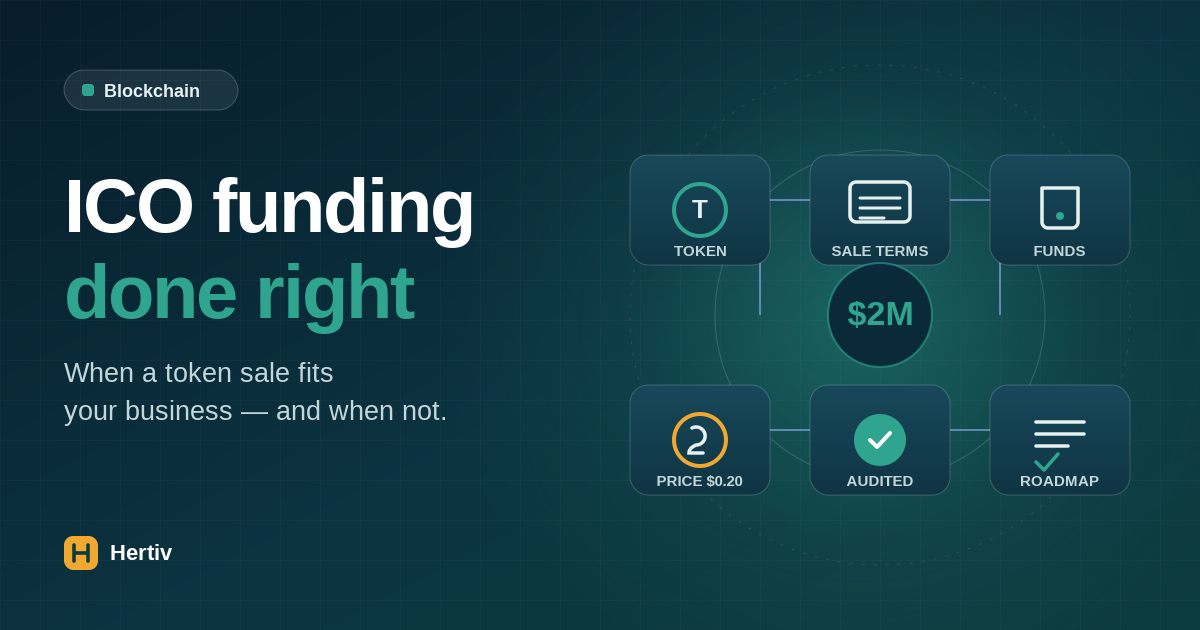
Example (hypothetical): a software company is building a marketplace for freelance design work and considers an ICO to fund it. The token would pay for listings and reward reviewers, so it has a genuine role in the product. The team sets a target of $2,000,000 and prices the token at $0.20, which means selling 10,000,000 tokens.
The budget lists $60,000 for legal advice, $40,000 for a contract audit, $80,000 for marketing and $20,000 for the sale platform, a total of $200,000. If the sale hits its target, the team keeps $1,800,000 after those costs. If it raises only half, $1,000,000, the same $200,000 leaves $800,000, which may not cover a year of development.
The team decides to raise a smaller private round first and delay the public sale until the marketplace has paying users. That way the token sale funds growth, not survival, and buyers can judge a product that already works.
What are the common mistakes?
The most common ICO mistakes are launching a token the product does not need, skipping legal advice, and treating the sale as the end of the work.
- Launching a token the product does not need. If the product works the same without a token, buyers will notice.
- Skipping legal advice. Selling in markets without checking the rules invites enforcement later.
- No cap or refund rule. An uncapped sale or no refund path destroys trust if the target is missed.
- Publishing unaudited contracts. Buyers expect an independent audit report before they send funds.
- Promising returns or price growth. Promises about token value attract regulators and disappoint buyers.
- Treating the sale as the finish line. The product still has to ship, and token holders will be watching.
Key takeaways
- An ICO sells tokens to the public; it is not the same as selling shares
- A token sale fits only when the token is essential to the product
- Legal advice, a contract audit and a capped sale with refund rules are the minimum
- Compare ICO, STO, IEO and venture funding before choosing a route
- Budget for the months after the sale, not just the launch
Frequently asked questions
What is the difference between an ICO and an STO?
An ICO sells tokens that usually give access to a product or a vote in its governance, while an STO sells tokens that are regulated as securities and represent an investment, such as a share of revenue or an asset. STOs follow securities rules in each market, which adds compliance work but gives investors clearer legal protection.
How much does it cost to run an ICO?
Costs vary with the legal work, contract audit, sale platform, marketing and exchange listings, and they are easy to underestimate. List every cost line before committing and compare the total with a realistic raise, not the best case. A detailed breakdown is covered in the cost guide linked in the article.
Do ICO tokens have to be listed on an exchange?
No, but most buyers expect a way to trade or use the token after the sale. Listing on a decentralised exchange is the simplest route, while a centralised exchange listing usually requires an application, fees and compliance checks. Plan the listing path before the sale, not after it.
Can a business run an ICO without a working product?
It can, but it is harder to raise and riskier for everyone involved. Buyers can only judge a white paper, and the team carries a public promise with nothing shipped. A working prototype or pilot gives buyers something real to evaluate and gives the team a stronger position.
What happens if an ICO does not reach its target?
It depends on the sale terms. A sale with a refund rule returns the funds to buyers, while a sale without one may keep what it raised. Clear terms published before the sale, including a minimum cap and a refund path, are what buyers expect from a serious team.
Is an ICO legal?
It depends on the token design and the market where it is sold. Some tokens are treated as securities and must follow securities rules, while others are treated as utility tokens. The answer varies by country, so take legal advice in each market before selling, rather than assuming one opinion covers everywhere.


