Hybrid Exchange Development Trends Worth Watching
Hybrid exchanges combine centralised order books with on-chain settlement. Six trends, from MPC custody to cross-chain routing, shape the next builds.
On this page
Short answer
Hybrid exchanges combine a centralised order book with on-chain settlement and custody, and the development trends that matter most are the ones that cut the trade-off between speed and self-custody: faster matching, safer key management, shared liquidity, and compliance built into the build rather than added later.
Which hybrid exchange trends matter for builders?
The hybrid exchange trends that matter are the ones that solve the original problem: centralised exchanges are fast but hold your funds, while decentralised exchanges keep your funds but are slower and harder to use. Hybrid designs try to keep the speed and remove the custody risk.
Use this comparison to decide where to invest build effort. Each trend is rated for what it changes and what it costs to build.
| Trend | What it changes | Build effort | Who it helps |
|---|---|---|---|
| Hybrid order books | Fast matching, on-chain settlement | High | Active traders |
| Cross-chain liquidity | One book across chains | High | Multi-chain users |
| MPC custody | No single key to steal | Medium | All users |
| Compliance-first design | KYC and screening built in | Medium | Regulated markets |
| On-chain settlement | Trades provable on chain | Medium | Trust and audits |
| AI risk checks | Faster fraud and abuse detection | Medium | Operations teams |
Do not build all six at once. Pick the trend that fixes your biggest weakness — usually custody or liquidity — and ship that first.
Hybrid order books
1. Hybrid order books: best for fast matching without giving up settlement
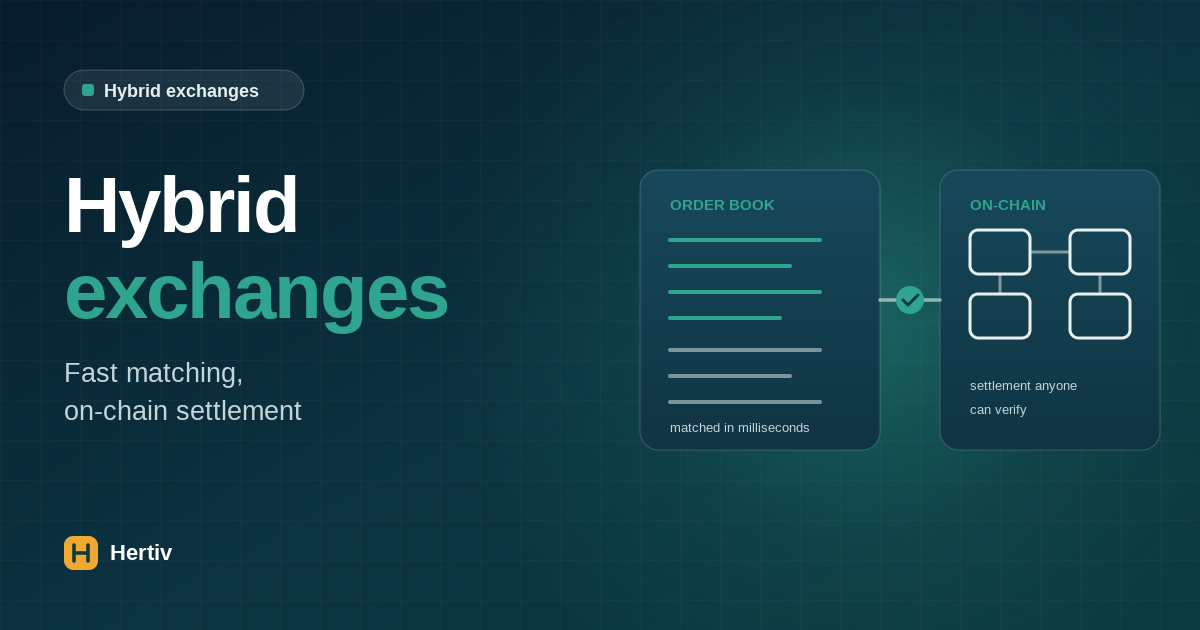
A hybrid order book matches trades off-chain for speed, then settles them on-chain so the result is verifiable. Traders get centralised-exchange speed, while the exchange cannot quietly change the outcome of a trade.
Building one means keeping two systems in sync: the fast matching engine and the slower chain. The hard part is handling failures between them, such as a match that never settles. Teams that get this right usually settle in batches and give traders a clear view of each trade's state.
- Pros: centralised speed with verifiable settlement, familiar trading experience
- Cons: complex failure handling, batching adds settlement delay
Cross-chain liquidity routing
2. Cross-chain liquidity routing: best for one book across chains
Cross-chain routing lets a trader on one chain fill orders from liquidity on another, so the exchange does not need a separate order book per chain. Bridges, intent-based routing and shared settlement layers move the assets between chains behind the scenes.
The build challenge is trust: moving assets across chains is where most exchange losses have happened. Teams are moving toward designs where routing is done by independent solvers competing on price, and settlement is checked on-chain, so no single bridge holds the funds.
- Pros: deeper liquidity, one trading experience across chains
- Cons: bridge risk, complex routing logic, slower in some cases
MPC custody
3. MPC custody: best for removing the single key to steal
Multi-party computation splits a private key into shares held by different parties, so no one party can move funds alone. A hybrid exchange can use it to let users keep control of their assets while the exchange helps sign trades.
For builders, MPC replaces the old choice between holding user funds in a hot wallet and forcing users to manage keys themselves. The trade-off is operational: key shares must be backed up, rotated and recovered, and the signing flow must stay fast enough that traders do not notice it.
- Pros: no single point of theft, users keep control, smoother than hardware wallets
- Cons: complex key recovery, signing adds latency, needs careful operations
Compliance-first design
4. Compliance-first design: best for regulated markets
Compliance-first design means building identity checks, transaction screening and record-keeping into the exchange from the start, instead of adding them after launch. It is becoming the default where exchanges serve customers in regulated markets.
The practical work is in the details: which users need full identity checks, which transactions get screened, how records are stored, and how the exchange responds when a check fails. Building these flows early is cheaper than rebuilding the onboarding and trading flows later, and it is often what partners and banks ask about first.
- Pros: easier to launch in regulated markets, partners and banks trust the product sooner
- Cons: slower onboarding, more data to protect, rules differ by country
On-chain settlement
5. On-chain settlement: best for trades anyone can verify
On-chain settlement records the final result of trades on a public ledger, so users and auditors can check that the exchange did what it said. Some designs settle every trade; others settle netted batches to keep fees low.
The decision for builders is how often to settle. Settling every trade is the most transparent but costs the most in fees and time. Batching trades and settling the net result is cheaper and usually fast enough, as long as users can see the state of their own trades while they wait.
- Pros: verifiable results, easier audits, builds user trust
- Cons: chain fees, settlement delay, batching adds complexity
AI-assisted risk checks
6. AI-assisted risk checks: best for faster fraud and abuse detection
AI-assisted risk checks watch trading patterns, deposits and withdrawals for signs of fraud, market abuse or account takeover, and flag them for review in minutes rather than days. They sit alongside the rules-based checks most exchanges already run.
The build work is in the data: the checks need labelled examples of good and bad behaviour, and a review loop where analysts correct the flags so the system improves. The risk is over-blocking real users, so the best designs start with alerts to a human team and only automate blocks after the false-positive rate is low.
- Pros: faster detection, catches patterns rules miss, scales with volume
- Cons: needs labelled data, false positives can block real users
How to choose which trend to build first
Choose by the weakness that costs you most: lost users, lost funds, or blocked launches. One trend, shipped well, beats three half-built ones.
- List your biggest risk: custody, liquidity, speed, compliance or fraud.
- Match it to the trend that fixes it directly.
- Check what it needs: new infrastructure, new partners, or new data.
- Ship a small version to real traders and measure the result.
- Add the next trend only after the first one is stable in production.
Talk to traders before you build. The trend that looks impressive in a demo may not be the one that keeps users trading. If you are scoping the build, crypto exchange development covers the architecture.
DEX development covers the on-chain side of the design.
Common mistakes in hybrid exchange development
Most hybrid exchange failures come from treating the hybrid part as marketing, underestimating the matching-settlement gap, and skipping compliance until launch.
- Marketing a hybrid that is not one. If the exchange holds funds and settles off-chain, it is centralised, whatever the website says.
- Ignoring the settlement gap. A match that never settles is a lost trade; design for it from day one.
- Trusting one bridge. Cross-chain routing needs fallback paths and on-chain checks.
- Compliance as an afterthought. Rebuilding onboarding and screening after launch costs more than building it in.
- Automating blocks too early. AI risk checks should alert humans first until false positives are low.
Regulation shapes every one of these choices. What the MiCA regulation covers is the place to start if your exchange serves customers in Europe.
For the token side of the same build, how to create a cryptocurrency covers the steps.
Key takeaways
- Hybrid means fast matching plus on-chain settlement — build both halves, not just the label
- MPC custody removes the single key to steal, but needs careful recovery and rotation
- Cross-chain liquidity is powerful and risky: never trust one bridge with the funds
- Compliance built in early is cheaper than rebuilding onboarding after launch
- Ship one trend to real traders before adding the next
Frequently asked questions
What is a hybrid exchange?
A hybrid exchange matches trades off-chain for speed and settles them on-chain so the result is verifiable. It tries to keep the speed of a centralised exchange while removing the need to trust the exchange with your funds.
How is a hybrid exchange different from a DEX?
A DEX matches and settles on-chain, which is transparent but slower and often more expensive per trade. A hybrid matches off-chain for speed and settles on-chain, so traders get faster fills while the final result stays verifiable.
Is MPC custody safe?
MPC custody removes the single private key that attackers usually target, because key shares are split across parties. It is safer than a single hot wallet, but it needs careful backup, rotation and recovery procedures, and the signing flow must stay fast for traders.
Do hybrid exchanges need KYC?
It depends on the market and the product. Exchanges serving customers in regulated markets usually need identity checks and transaction screening, and building them in early is cheaper than adding them later. Rules differ by country, so check the rules for each market you serve.
What is the hardest part of building a hybrid exchange?
Keeping the fast matching engine and the slower chain in sync, especially when a match fails to settle. The design must handle that gap clearly, with batching, visible trade states and a fallback path, or traders lose trust quickly.
Can a small team build a hybrid exchange?
Yes, by starting narrow: one chain, one asset pair, and one trend such as MPC custody or on-chain settlement. Use hosted infrastructure where it fits, and add cross-chain routing and AI risk checks only after the core trading loop is stable.


