How Tokenization Secures SaaS Platforms
Tokenization replaces card numbers and other sensitive values in a SaaS platform with tokens that are useless if stolen. Here is how it works and where it helps.
On this page
Short answer
Tokenization protects a SaaS platform by replacing sensitive values such as card numbers with random tokens that carry no meaning on their own. The real values stay in a secure vault, so a breach of the application database exposes tokens instead of payment details, which lowers risk and builds customer trust.
What is tokenization in a SaaS platform?
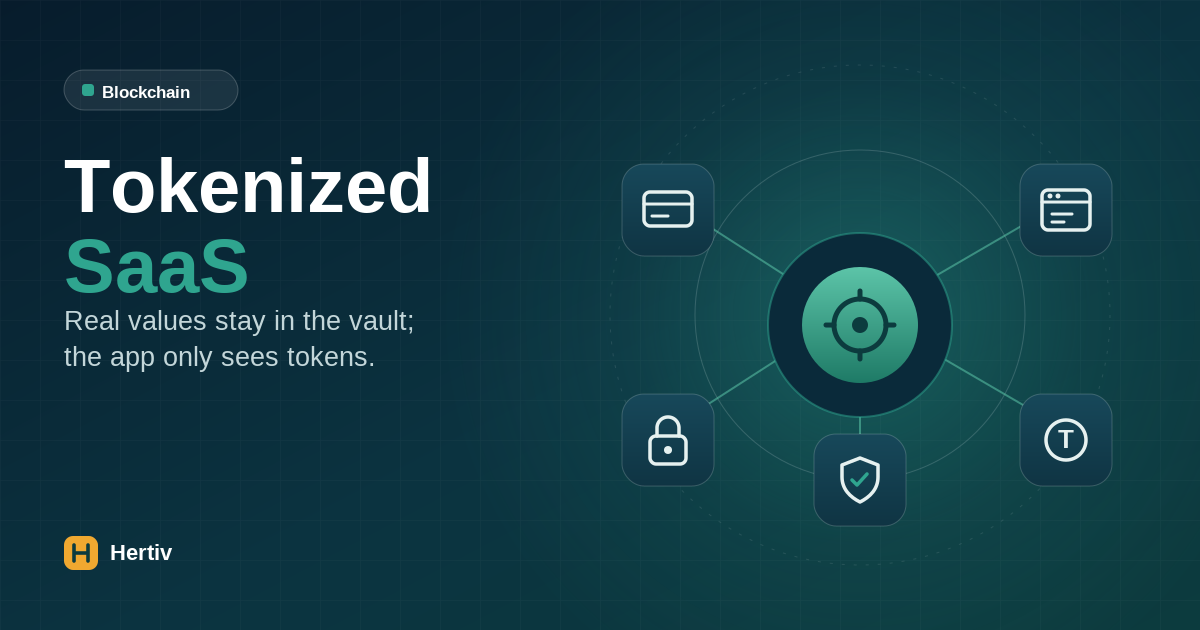
Tokenization in a SaaS platform is a way of protecting sensitive data by replacing values such as card numbers with random tokens that keep their shape but carry no meaning on their own. The real values stay in a secure vault, and the application works with the tokens instead.
A token looks like the value it replaces: a 16-digit card number becomes a different 16-digit number, and an email address becomes a different string of the same shape. That matters, because the rest of the system, from search to receipts, can keep working without ever seeing the real value.
The values a SaaS platform usually tokenizes are:
| Data | Why it is tokenized | What the token replaces |
|---|---|---|
| Card numbers | Payment data is the main target of theft | The card number in orders and receipts |
| Bank details | Needed for payouts, risky to store | Account numbers in payout records |
| Personal identifiers | Names and IDs link records to people | IDs in logs and support tickets |
| API keys and secrets | Keys in logs can be copied and reused | Keys stored in configuration and logs |
| Health and tax data | Strict rules on how it is stored | Values in reports and exports |
Tokenization is not the same as encryption. An encrypted value can be turned back into the original with a key, while a token has no mathematical link to the original at all; only the vault knows the pairing. For the general picture, how tokenization works explains the vault, the token and the lookup in plain terms.
How does the token flow work?
The token flow in a SaaS platform has four steps: the user enters a sensitive value, the platform sends it to the vault, the vault returns a token, and the platform stores and uses only the token. The real value never reaches the application database.
- Capture. The customer types a card number into a payment form, or the platform receives a bank account number for a payout.
- Send to the vault. The value travels straight to the token vault over an encrypted connection, and the application never writes it to disk.
- Receive the token. The vault stores the real value and returns a token of the same shape, which the application saves in place of the original.
- Use the token. Orders, receipts, searches and support screens all use the token, and the vault is asked for the real value only when a payment or payout actually runs.
When a payment is due, the platform sends the token to the payment processor, which asks the vault for the real card number behind it. The card number is used once, inside the processor, and never returns to the SaaS platform.
That separation is the whole point. A thief who copies the application database gets tokens, and tokens on their own cannot be used to pay for anything, because no payment system accepts them without the vault.
Where does tokenization help most?
Tokenization helps most where a SaaS platform stores payment data, shows customer details to support staff, or keeps sensitive values in logs and backups. Those are the places where a single breach does the most damage.
Payments are the clearest case. A billing platform that stores card numbers for repeat charges holds exactly the data thieves want. Tokenizing those numbers means the database no longer holds anything worth stealing, and the platform's own security review becomes far simpler.
Support screens are the second case. Support staff often need to find a customer and see their recent orders, but they do not need the full card number or bank details. Tokens let the screen show enough to identify the order, such as the last four digits, while the full value stays in the vault.
Logs and backups are the third case, and the one teams forget. A card number that slips into an error log, or a database backup stored in a second location, is as exposed as the live database. Tokens in logs and backups keep those copies safe too, because the copies hold tokens instead of real values.
How does it build customer trust?
Tokenization builds customer trust by shrinking what a breach can expose, by making the platform's security story easy to explain, and by giving customers control over their own data. Trust grows when customers can see that their details are handled with care.
The breach argument is the strongest. Customers know that breaches happen, and they judge a service by what would leak if it did. A platform that can honestly say it does not store card numbers is in a different position from one that stores them behind a password, because the first has nothing to lose and the second only has a wall to defend.
Clear explanations help too. A short page that says what is tokenized, where the real values live, and who can ask for them back is worth more than a long security policy. Customers do not read policies, but they do notice when a company can explain its data handling in plain language.
Control is the third piece. Letting customers delete their stored payment details, see which of their values are tokenized, and revoke a token when they stop using a service shows that the platform treats their data as theirs. For the wider tokenization picture, real-world asset tokenization use cases shows how the same idea is used outside payments.
Example (hypothetical): a billing platform tokenizes card data
Example (hypothetical): a billing platform has 5,000 customers who pay by card each month. The platform stores all 5,000 card numbers in its own database, so that it can charge them without asking the customer to type the number in again.
The team decides to tokenize. The vault is set up, and over one weekend the platform sends each stored card number to the vault and replaces it with a token. After the change, the database holds 5,000 tokens and zero card numbers.
Three months later, an attacker copies the database. The stolen copy holds 5,000 tokens, and none of them can be used to pay for anything, because the payment processor only accepts a token when it comes with the vault's approval. The team still has to tell customers, change passwords and review the breach, but no card numbers leak.
The monthly cost of the vault is less than the cost of one lost customer in ten who leaves after a breach. The team counts the saving as 5,000 customers kept, at an average of $40 a month each, which is $200,000 a month of revenue that stays instead of walking away after a card leak.
What are the risks and limits?
The risks and limits of tokenization are that the vault becomes the target, that tokens can leak in places the team forgot, and that tokenization does not fix every security problem. It is one layer, not a whole security plan.
The vault is the first risk. All the real values live in one place, so that place must be defended well: strong access controls, audit logs of every lookup, and no way for one stolen credential to empty it. A vault with weak access is worse than no vault at all, because it gathers every secret in one spot.
Leaks in forgotten places are the second risk. Tokens are safe in the database, but a real card number can still slip into an error log, a support ticket or a test database if the token flow is not applied everywhere. The flow must cover every path a value can take, not just the main payment form.
The limit is that tokenization protects stored data, not everything else. It does not stop a fake login page, a stolen staff password or a bad software update. Teams that treat it as a fix for all security problems stop looking at the other risks, which is why it should sit beside the rest of the security work, not instead of it.
What are the common mistakes?
The most common mistakes are tokenizing only the main payment form, treating the vault as an afterthought, and telling customers the platform is safe when the rest of the security work is weak. All three come from treating tokenization as a box to tick rather than a change to how data flows.
- Tokenizing only the checkout. Card numbers also appear in refunds, support tickets and exports; every path needs the same treatment.
- Weak vault access. A vault that any service can query without a check is a single point of failure for every secret at once.
- Forgetting logs and backups. A real value in an error log or an old backup is as exposed as one in the live database.
- Claiming more than it does. Tokenization protects stored values; it does not stop phishing, stolen passwords or bad updates.
- No plan for the vault going down. If the vault is unreachable, payments stop, so the team needs a tested fallback.
For the build side of the question, SaaS development covers how these platforms are put together, including where data protection fits in the build.
Key takeaways
- Tokenization replaces sensitive values with tokens that are useless on their own
- The real values live in a vault and are used only when a payment or payout runs
- Payments, support screens, logs and backups are where tokenization helps most
- A platform that stores no card numbers is in a far stronger position after a breach
- Tokenization is one layer of security, not a fix for every risk
Frequently asked questions
What is tokenization in a SaaS platform?
It is the practice of replacing sensitive values such as card numbers, bank details and personal identifiers with random tokens of the same shape. The real values are stored in a secure vault, and the application works with the tokens, so a stolen database copy holds nothing that can be used to pay for anything.
Is tokenization the same as encryption?
No. Encryption turns a value into scrambled text that can be turned back with a key, while a token has no mathematical link to the original value at all. Only the vault knows which token belongs to which real value, so a token on its own reveals nothing.
Does tokenization make a platform fully secure?
No. It protects stored data, but it does not stop phishing, stolen staff passwords or bad software updates. It should sit beside the rest of the security work, such as access controls, monitoring and staff training, not instead of it.
What happens if the token vault goes down?
Payments and payouts that need the real values will stop until the vault is back, because the platform only holds tokens. That is why the team needs a tested fallback plan and a vault service with a clear uptime promise before going live.
How does tokenization build customer trust?
Customers judge a service by what would leak in a breach. A platform that can honestly say it does not store card numbers, that explains its data handling in plain language, and that lets customers delete their stored details shows that it treats their data as theirs.
How much does tokenization cost?
Costs vary by vault provider, number of tokens and transaction volume, so check the vendor's own pricing page or ask for a quote; see vendor site. The cost is usually small next to the cost of a breach, which can include refunds, fines and customers who leave.


