How to Write an AI Agent Development RFP
An AI agent development RFP should describe the job, the data, the success measures and the budget range. This guide covers each section and how vendors are scored.
On this page
Short answer
An AI agent development RFP is a document that asks vendors to propose an AI agent for a specific job, with enough detail for each vendor to price the work and show how it would build it. A good RFP describes the task, the data, the limits and the measures of success, so the team can compare proposals on the same basis.
What is an AI agent development RFP?
An AI agent development RFP, or request for proposal, is a written brief a company sends to vendors when it wants an AI agent built. It explains the business problem, the job the agent must do, the systems it must connect to and the budget range, then asks each vendor to explain its approach, team, timeline and price.
The RFP matters because AI agent work is easy to misunderstand. One vendor may propose a simple chatbot while another proposes an agent that takes actions in your systems, and both may call their proposal an AI agent. A clear RFP makes the proposals comparable, because every vendor answers the same questions about the same job.
The document is usually 8 to 15 pages. Shorter RFPs leave too much open to interpretation, and longer ones bury the important details. The sections below cover what belongs in it and what to leave out. For the wider decision of whether to build at all, see how to build an AI proof of concept.
What should the RFP contain?
An AI agent RFP needs six parts: the problem, the scope, the data, the limits, the timeline and the budget range. Each part answers a question the vendor needs before it can price the work honestly.
The problem section states the job in plain language: who does it today, how long it takes and what goes wrong. The scope section lists what the agent must do in its first version and what it must not do, so vendors do not price different jobs. The data section lists the systems and records the agent will read and write, and who owns each one.
The limits section is the part teams most often skip. It should state what the agent may never do on its own, such as refunding money, changing a contract or contacting a customer without a human check. The timeline section gives the decision date and the launch date, and the budget section gives a range, so vendors know whether to propose a small pilot or a full build.
How do you define scope and success measures?
Scope and success measures are the two parts of the RFP that decide whether the project works. Scope says what the agent does; success measures say how the team will know it works. Both must be written before vendors reply, because changing them later changes the price.
Write scope as a list of tasks with a clear end point. "Answer customer questions" is too vague; "draft replies to the 20 most common support questions, with a human approving each reply before it is sent" is a scope a vendor can build and price. List the tasks that are out of scope too, such as phone calls or refunds, so vendors do not assume them.
Success measures should be numbers the team can check. The table below shows measures that work for common agent jobs, with a realistic way to set the target.
| Agent job | Success measure | How to set the target |
|---|---|---|
| Support replies | Share of drafts approved unchanged | Measure the current manual reply time first |
| Document review | Share of documents checked correctly | Test on a sample of past documents |
| Data entry | Error rate per 100 records | Count current errors over two weeks |
| Lead triage | Share of leads routed correctly | Score a sample of past leads by hand |
| Internal search | Share of questions answered from docs | Ask staff for their 50 hardest questions |
Set each target from a baseline measured before the project starts. A target with no baseline is a guess, and vendors cannot be held to a guess. For typical cost ranges, see the cost of implementing AI.
How do you write the RFP step by step?
Writing the RFP is a short project of its own. The steps below take a team from a vague idea to a document vendors can price, in about two weeks of part-time work.
- Name the owner. One person owns the RFP, answers vendor questions and chairs the scoring. Without an owner, questions go unanswered and proposals arrive late.
- Interview the people who do the job today. Ask what the job involves, where it goes wrong and what a good result looks like. Their answers become the scope.
- List the systems and data. Write down every system the agent must read or write, who owns it and whether access is already possible.
- Write the limits. State what the agent may never do alone, such as moving money or contacting customers without approval.
- Set the success measures. Pick two or three measures with baselines, and state the target for the first version.
- Set the budget range and dates. Give a range, not a single number, and state the decision date and the launch date.
- Write the scoring rules. State how proposals will be scored and what weight each part carries, so vendors know what matters.
Share a draft with two or three vendors before sending it widely. Their questions will show which parts of the RFP are unclear, and fixing those parts now saves a round of confused proposals.
How should vendors be scored?
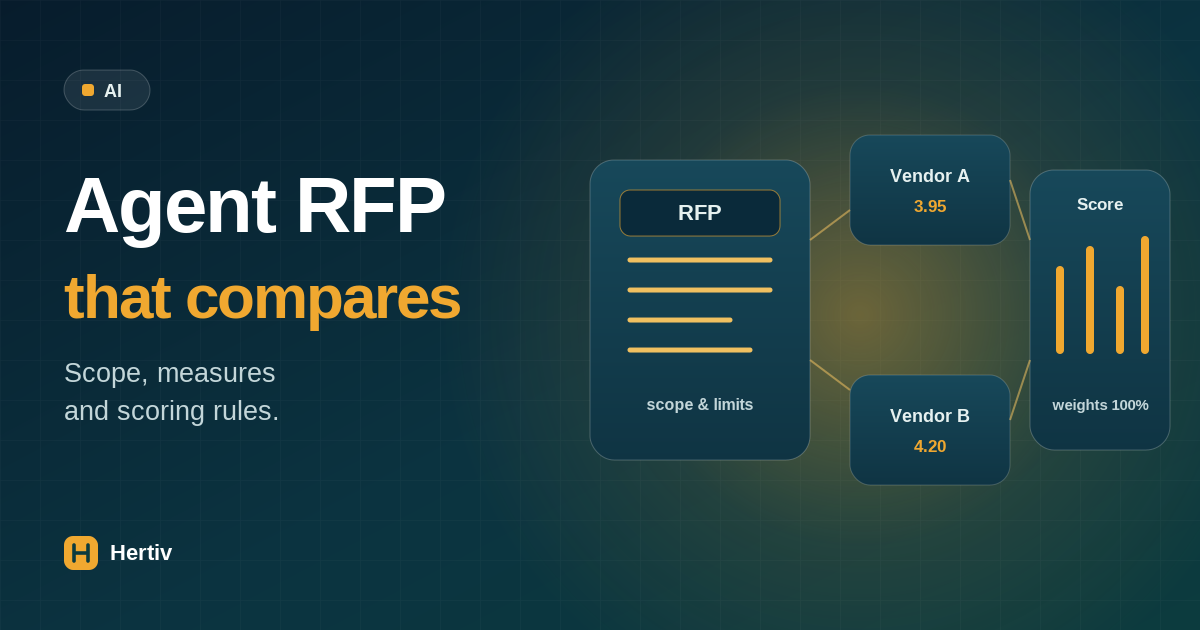
Vendor scoring should be written into the RFP, so every proposal is judged the same way. A simple scorecard with five criteria and weights that add up to 100 percent works well for most agent projects.
The criteria should cover the approach, the team, the price, the timeline and the risks. The approach is the most important part: does the vendor understand the job, and does its plan match the scope? The team matters because the people who build the agent matter more than the company name. Price matters, but the cheapest proposal is rarely the best if it leaves out half the scope.
Score each criterion from 1 to 5, multiply by its weight and add the results. The table below shows a workable scorecard for a first agent project.
| Criterion | Weight | What to look for |
|---|---|---|
| Approach | 30% | Plan matches the scope and the limits |
| Team | 25% | Named people with relevant shipped work |
| Price | 20% | Price covers the full scope, not part of it |
| Timeline | 15% | Dates with milestones, not only a launch date |
| Risks | 10% | Honest risks with a plan for each |
Ask each vendor for a short demo or a worked example using your own data. A vendor that cannot show its agent working on a real task from your business is a vendor to be careful about, however polished the proposal looks.
Example (hypothetical): scoring four vendors
A retailer wants an agent that drafts replies to the 20 most common support questions. Four vendors reply, and the team scores each one from 1 to 5 on the five criteria above, with the weights 30, 25, 20, 15 and 10 percent.
Vendor A scores 4 on approach, 3 on team, 5 on price, 4 on timeline and 4 on risks. Its weighted score is 4 times 0.30, plus 3 times 0.25, plus 5 times 0.20, plus 4 times 0.15, plus 4 times 0.10, which is 1.20 plus 0.75 plus 1.00 plus 0.60 plus 0.40, or 3.95 out of 5.
Vendor B scores 5, 4, 3, 4 and 5, which works out to 1.50 plus 1.00 plus 0.60 plus 0.60 plus 0.50, or 4.20. Vendor C scores 3, 5, 4, 3 and 3, which is 0.90 plus 1.25 plus 0.80 plus 0.45 plus 0.30, or 3.70. Vendor D scores 4, 4, 4, 5 and 4, which is 1.20 plus 1.00 plus 0.80 plus 0.75 plus 0.40, or 4.15.
Vendor B wins on the numbers, but the team checks the detail before deciding: Vendor B's price is higher, and its approach score of 5 needs a check against the scope. The team invites B and D to a short demo with real support tickets, then decides. The scorecard narrows the field; the demo makes the decision.
Common mistakes in AI agent RFPs
The most common RFP mistakes are vague scope, no success measures and scoring that is written after the proposals arrive. Each one makes the proposals hard to compare and the project hard to judge.
- Writing a vague scope. "Build us an AI agent" invites four different projects at four different prices, and none of them matches what the team wanted.
- Skipping success measures. Without measures and baselines, the team cannot tell whether the agent works, and the vendor cannot be held to a result.
- Scoring after the proposals arrive. Scoring rules written after reading the proposals tend to favour the proposal the team already likes.
- Hiding the budget. Vendors that do not know the range propose either a tiny pilot or a huge build, and both waste a round of questions.
- Forgetting the limits. An RFP that never states what the agent may not do leaves the most important safety decisions to the vendor.
Before sending the RFP, ask one person who does the job today to read it. If they cannot tell what the agent will do and what it will not do, the vendors will not be able to either. For a sense of what the build costs, see AI app development cost.
Key takeaways
- An AI agent RFP describes the job, the data, the limits and the success measures in one document
- Scope should list tasks with clear end points, plus what is out of scope
- Success measures need a baseline measured before the project starts
- Score vendors on approach, team, price, timeline and risks with weights that add to 100 percent
- A short demo on your own data is the final check before choosing
Frequently asked questions
How long should an AI agent RFP be?
About 8 to 15 pages is enough for most first agent projects. Shorter RFPs leave too much open to interpretation, and longer ones bury the scope and the success measures that vendors need to price the work.
Should the RFP include a budget?
Yes, give a range rather than a single number. A range tells vendors whether to propose a small pilot or a full build, and it stops vendors from guessing the budget from the company name.
How many vendors should receive the RFP?
Four to six vendors is a good number. Fewer gives the team too little to compare, and more turns the scoring into a long exercise that delays the decision by weeks.
What if vendors ask questions during the process?
Answer every question in writing and share the answers with all vendors, so no vendor gets an advantage. Set a single deadline for questions and a single date for answers.
Should the RFP ask for a fixed price?
A fixed price works when the scope is clear and the data is ready. If the scope is still uncertain, ask for a price for a pilot with clear milestones, then agree the full price after the pilot.
Can the RFP ask vendors to sign an NDA?
Yes, and most teams do so before sharing internal data or example tickets. Send the NDA with the RFP so vendors can sign it and start reading the data without delay.


