How to Use Blockchain Technology for KYC Checks
Blockchain technology can make KYC faster by letting customers prove identity once and share a verified credential. Learn how it works and what to build first.
On this page
Short answer
Blockchain technology supports KYC by storing verified identity credentials that a customer controls and shares with each new service, instead of repeating document checks every time. A bank or exchange verifies the documents once, issues a credential, and other services check that credential on-chain without seeing the underlying documents.
What is blockchain-based KYC?
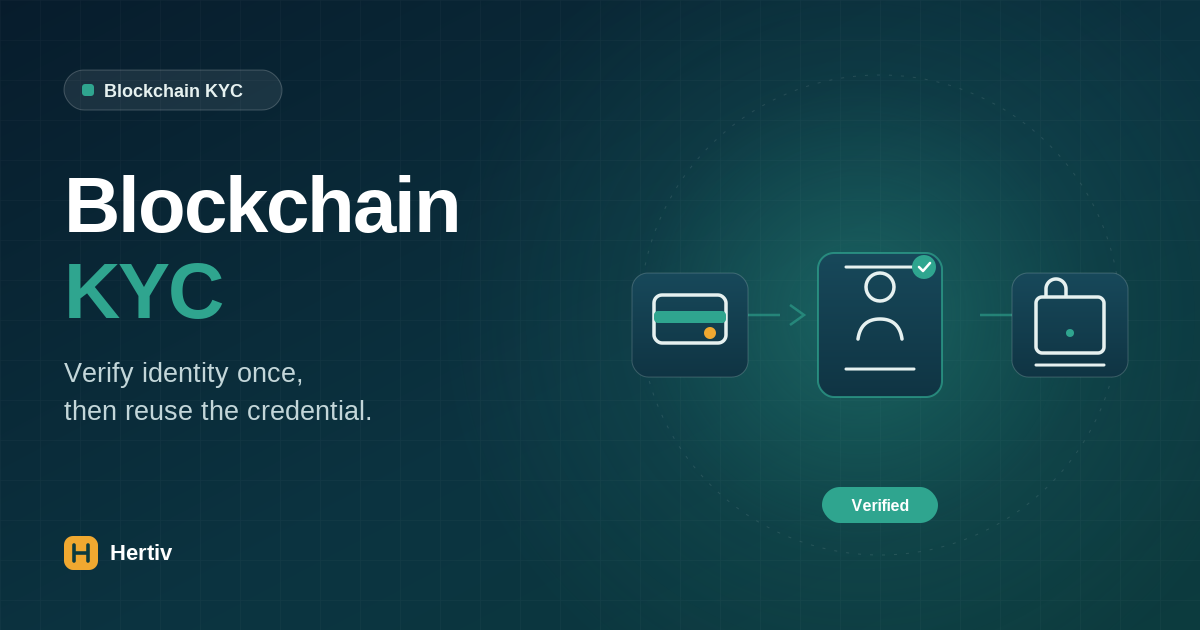
Blockchain-based KYC is an identity-checking approach where a verified credential is issued once and then reused across services, with the blockchain acting as a shared record that the credential is valid. The customer holds the credential in a wallet and shares it when a new service asks for proof of identity.
In traditional KYC, every bank, exchange or platform asks for the same passport and proof of address, then stores copies of those documents. That repeats work for the customer and creates many copies of sensitive data. With a blockchain approach, the verification happens once, and later checks confirm the credential rather than re-collecting documents.
The model rests on three parts:
- Verifiable credentials. A signed statement that an identity check passed, held by the customer, not the bank.
- A shared registry. A blockchain record that lets a service confirm the credential is genuine and has not been revoked.
- Selective disclosure. The customer shares only what is needed, such as "over 18" or "verified", without handing over the full document.
This is not the same as putting personal data on a public chain. Good designs keep documents off-chain and store only hashes or revocation status on-chain. For the wider identity picture, see KYC automation benefits and use cases.
How does blockchain KYC work in practice?
Blockchain KYC works through a short flow: a trusted verifier checks the customer's documents, issues a signed credential, and the customer presents that credential to each new service, which checks it against the shared registry.
A typical flow looks like this:
- The customer submits identity documents to a licensed verifier, such as a bank or a regulated KYC provider.
- The verifier runs its normal checks: document authenticity, sanctions screening and liveness.
- The verifier issues a verifiable credential to the customer's wallet and records a hash or revocation pointer on-chain.
- When the customer opens an account elsewhere, they present the credential instead of uploading documents again.
- The new service checks the credential signature and revocation status, then completes its own risk assessment.
The new service still owns its compliance decision. The credential proves that a check happened; it does not replace the service's duty to screen the customer against its own policies. That distinction matters to regulators and to auditors.
| Approach | What is stored on-chain | Who controls the data | Best fit |
|---|---|---|---|
| Verifiable credentials | Hashes and revocation status | The customer | Banks, exchanges, fintech |
| Shared KYC registry | Consent and check status | Consortium members | Banking groups |
| On-chain attestations | Attestation records | The attester | DeFi and Web3 onboarding |
| Zero-knowledge proofs | Proofs, not data | The customer | Privacy-sensitive checks |
Where does blockchain KYC fit best?
Blockchain KYC fits best where the same customer is checked many times by different services, such as banking groups, crypto exchanges, and cross-border onboarding.
Exchanges and wallets benefit because a user verified once can open accounts on partner platforms without repeating document uploads. Banking groups benefit because a customer verified by one member bank can be recognised by another, with consent. Cross-border services benefit because a credential travels with the customer instead of being tied to one country's database.
It fits less well where a single check is enough, or where regulators require the full document set to be held by each service. In those cases, the shared-credential model adds complexity without saving much work. A blockchain development partner can help judge whether the model fits your regulatory setting.
How do you build a blockchain KYC system?
You build a blockchain KYC system by starting with the legal and compliance design, then adding the credential flow, and only then choosing the chain and the wallet.
- Confirm the legal basis. Check with counsel whether a shared credential satisfies your jurisdiction's KYC rules and what records you must keep.
- Pick the verifier model. Decide who verifies documents and issues credentials: your own team, a regulated partner, or a consortium.
- Choose the credential standard. Use an open standard for verifiable credentials so wallets and verifiers can work together.
- Design data handling. Keep documents and personal data off-chain; store only hashes, signatures and revocation status on-chain.
- Build the wallet flow. Make it simple for a customer to receive, store and present a credential from a phone.
- Plan revocation and renewal. Define how a credential is revoked when documents expire or risk changes, and how renewal works.
Test the flow with a small group before opening it to all customers. Wallet setup is where most users drop off, so the onboarding screens deserve as much attention as the chain itself.
Example: a regional exchange pilots reusable KYC
Example (hypothetical): a regional crypto exchange onboards 1,000 new users a month. Each user uploads documents, waits for review, and often abandons the process halfway. The exchange decides to pilot reusable credentials with two partner platforms.
The exchange partners with a licensed KYC provider that verifies documents and issues a credential to each user's wallet. A user verified once can then open an account on either partner platform by presenting the credential, with consent, instead of uploading documents again.
The numbers are simple: if 1,000 users a month each save 20 minutes of document handling, that is about 333 hours of customer time saved per month. If 200 of those users would otherwise have abandoned onboarding, the pilot recovers a large share of them. The exchange still runs its own sanctions screening on every account, because the credential proves identity, not risk appetite.
After three months, the pilot shows fewer abandoned sign-ups and faster onboarding, so the exchange expands the credential to a third partner. The lesson is that the win comes from removing repeated document uploads, not from the chain itself.
What are the common mistakes?
The most common mistakes are storing personal data on-chain, skipping the legal review, and building a wallet flow that ordinary customers cannot use.
- Personal data on-chain. Documents and personal details should never sit on a public ledger. Store hashes and revocation status only.
- Skipping legal review. KYC rules vary by jurisdiction, and a shared credential may not satisfy every regulator.
- Treating the credential as a decision. A credential proves a check happened. Each service must still apply its own risk policy.
- Ignoring revocation. If a credential cannot be revoked quickly, a stolen wallet becomes a lasting problem.
- A confusing wallet flow. If customers cannot set up the wallet, the whole system fails at the first step.
What should you check before you start?
Before you start, check three things: whether your regulator accepts shared credentials, whether your customers will use a wallet, and whether the repeated-check problem is big enough to justify the build.
Ask your compliance team to confirm the legal basis in writing. Run a small user test of the wallet flow with real customers, not just staff. And measure how often the same customer is checked twice today: if the answer is rarely, a simpler automation project will deliver more value.
If the checks pass, a pilot with one verifier and one partner service is the right scope. It proves the flow, the legal basis and the user experience before you invest in a wider network. For the smart contract and audit side of the build, smart contract audit covers what to review before launch.
Key takeaways
- Blockchain KYC reuses one verified credential across services instead of repeating document checks
- Personal data stays off-chain; only hashes, signatures and revocation status go on-chain
- The credential proves a check happened, but each service still applies its own risk policy
- Start with legal review, a credential standard and a simple wallet flow
- A pilot with one verifier and one partner proves the model before a wider rollout
Frequently asked questions
Is blockchain KYC legal?
It depends on the jurisdiction and the design. Many regulators accept shared credentials if the verifier is licensed and each service keeps its own records. Get written confirmation from counsel before building, and design the system so each service can show its own audit trail.
Does blockchain KYC store my passport on the blockchain?
No, not in a well-designed system. Documents stay with the verifier or the customer, and the chain holds only a hash or a revocation pointer. If a design proposes putting personal data on-chain, treat that as a red flag.
What is a verifiable credential?
It is a signed digital statement that an identity check passed, held in the customer's wallet. A service can check the signature and the revocation status without seeing the underlying documents, and the customer chooses what to share.
Can blockchain KYC replace sanctions screening?
No. A credential proves identity, not risk. Each service must still screen customers against sanctions lists and apply its own risk policy. The credential removes repeated document collection, not compliance duties.
What happens if a credential is stolen or revoked?
The wallet owner can revoke the credential, and the revocation status is published so verifiers reject it. That is why revocation design matters: a credential that cannot be revoked quickly becomes a lasting risk.
Which businesses benefit most from blockchain KYC?
Banking groups, crypto exchanges and cross-border services where the same customer is checked many times. If a customer is checked once and never again, the shared-credential model adds complexity without much benefit.


