How to Implement a Multisig Wallet Step by Step
A multisig wallet needs several keys to approve a transaction, so no single person can move funds alone. Here is how to pick a setup and test it safely.
On this page
Short answer
To implement a multisig wallet, pick a threshold such as 2-of-3 or 3-of-5, choose signers who hold separate keys, create the wallet on a chain that supports it, fund it with a small test amount, and run a full signing and recovery test before moving real funds. Keep keys apart and record who holds each one.
What is a multisig wallet?
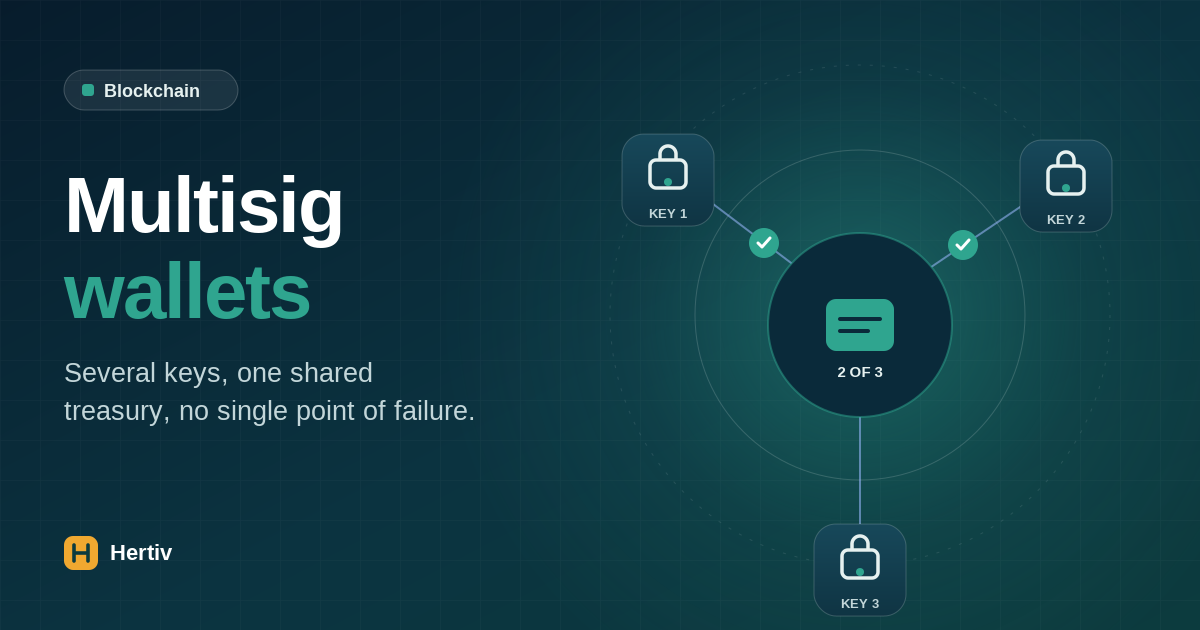
A multisig wallet is a wallet that needs more than one private key to approve a transaction. Instead of one key controlling the funds, the wallet is set up with a threshold, such as 2-of-3, which means any two of the three named keys must sign before funds can move.
The point is shared control. A company treasury, a fund or a family can hold crypto so that no single person can drain it, and a lost key does not lock the funds forever. The wallet address itself is derived from the set of keys and the threshold, so the rules are enforced by the chain, not by a promise between people.
Multisig is different from a shared password or a shared seed phrase. With a shared seed, anyone who has it controls everything. With multisig, each signer holds a separate key, and the threshold decides how many must agree. For a basic definition of the wallet type, see what is a multisig wallet.
How does a multisig wallet work?
A multisig wallet works by checking signatures against its threshold before a transaction is accepted. When someone starts a payment, the wallet records a proposal. Each signer reviews it and adds a signature with their own key. Once the number of signatures reaches the threshold, the transaction can be executed on chain.
The threshold is the key design choice. A low threshold is easy to operate but weaker if keys are stolen. A high threshold is safer but can block payments if a signer is away or loses a key. Common setups balance these two risks.
| Setup | Signers needed | Best for | Main risk |
|---|---|---|---|
| 2-of-3 | 2 of 3 | Small teams, founders | One lost key leaves little margin |
| 3-of-5 | 3 of 5 | Company treasuries | Slower approvals |
| 2-of-2 | Both | Two-party escrow | One lost key freezes funds |
| 3-of-3 | All 3 | Joint custody | No spare key if one is lost |
Some chains support multisig natively, while others need a smart contract wallet. The signing flow is the same either way: propose, review, collect signatures, execute.
Which multisig setup should you choose?
Choose the setup by counting how many people must approve a payment and how often payments happen. A treasury that pays suppliers weekly needs a threshold its signers can meet without delay. A cold vault that moves funds twice a year can use a stricter threshold.
There are three broad options. Native multisig on chains such as Bitcoin uses the chain's own scripting. Smart contract wallets on chains such as Ethereum add features such as spending limits and batched transactions. Hosted signing services manage the software but still leave keys with the signers. Each option trades control for convenience.
For most teams, a smart contract wallet or a well-tested native setup is the right start. Compare it with the alternative custody model in MPC vs multisig wallets before deciding. Avoid a setup that needs all signers for every payment unless the funds move rarely, because a single unavailable signer can block the whole treasury.
How to implement a multisig wallet in 7 steps
Implementation is a short project if you plan the signers first and test before funding. Work through these steps in order and do not skip the test transaction.
- Agree the threshold and the signers. Decide the M-of-N rule and name each signer. Record who holds which key and where each key is stored.
- Pick the chain and the wallet software. Use a wallet with a long track record on that chain, and check that it supports the threshold you want.
- Create the keys separately. Each signer generates their key on their own device, ideally a hardware wallet. Never share seed phrases between signers.
- Create the multisig wallet. Enter the public keys and the threshold, then check that the wallet address matches on every signer's screen before anyone funds it.
- Fund it with a small test amount. Send a small sum first and confirm it arrives at the expected address.
- Run a test payment and a recovery test. Propose a payment, collect the required signatures, execute it, and confirm the funds arrive. Then test recovery with a spare key if your setup has one.
- Write the operating rules down. Record who approves what, how signers are replaced, and what happens if a key is lost. Store this document with the keys, not in a shared chat.
If you are building this for a product rather than a one-off treasury, crypto wallet development covers the integration work around signing and key handling.
Key management: the part most teams get wrong
Key management is where multisig setups usually fail. The wallet software is rarely the weak point; the way keys are stored and shared is. Each key should live on its own device, in its own place, held by a different person.
Good practice is simple to state and hard to keep: hardware wallets for each signer, seed phrases written on paper or metal and stored in separate secure locations, and no seed phrase ever typed into a phone, emailed or photographed. A signer who keeps their key on the same laptop as another signer removes the protection multisig was meant to give.
Plan for loss from day one. Know which keys can be replaced, how a signer is removed, and how long replacement takes. A 3-of-5 setup survives two lost keys, but only if the remaining three signers can still be reached and their keys still work.
Example (hypothetical): a three-founder treasury
Example (hypothetical): three founders hold a company treasury of 500,000 units in a stablecoin. They choose a 2-of-3 multisig wallet, so any two founders can approve a payment and one lost key does not freeze the funds.
They fund the wallet in stages. First they send 100 units and confirm the balance on all three screens. Then they run a test payment of 50 units to a supplier, signed by two founders, and check the supplier receives it. Only then do they move the remaining 499,900 units, in two transfers of 250,000 and 249,900, checking the balance after each one.
A month later one founder loses a hardware wallet. The other two signers still meet the 2-of-3 threshold, so the treasury keeps working while the lost key is replaced. The arithmetic is the point: 3 keys minus 1 lost key leaves 2 working keys, which is exactly the threshold, so the setup survives one loss but not two.
What are the common mistakes?
The most common multisig mistakes are choosing a threshold that is too strict, storing keys together, and skipping the recovery test. Each one turns a safety feature into a lockout risk.
- A threshold that needs everyone. A 3-of-3 wallet freezes if one signer is away or loses a key. Keep at least one spare key in the threshold.
- Keys stored in one place. Two keys in the same safe or the same laptop are one key for practical purposes.
- Skipping the test payment. A wallet that has never executed a transaction may have a wrong address or a signer who cannot sign. Test with a small amount first.
- No written rules. Without a record of who the signers are and how they are replaced, a team change can leave the wallet unusable.
- Funding before verifying the address. Always confirm the wallet address on every signer's device before sending funds.
Key takeaways
- A multisig wallet needs a set number of keys, such as 2-of-3, to approve a transaction
- Pick the threshold by balancing safety against how fast payments must go out
- Each signer generates and holds their own key, on their own device
- Fund with a small test amount and run a full signing and recovery test first
- Keep keys in separate places and write down the signer and replacement rules
Frequently asked questions
How many signers should a multisig wallet have?
Three to five signers suits most teams. A 2-of-3 setup works for small groups, while 3-of-5 suits a company treasury. Fewer than three signers gives little protection, and more than five makes approvals slow.
Can a multisig wallet work if one signer loses their key?
Yes, if the threshold allows it. In a 2-of-3 wallet, the other two signers can still approve payments while the lost key is replaced. In a 3-of-3 wallet, a lost key freezes the funds.
Is multisig the same as MPC?
No. Multisig uses several separate keys and a threshold on chain. MPC splits one key into shares that are never combined. Both remove single points of failure, but they work differently and suit different setups.
Which chains support multisig wallets?
Bitcoin supports native multisig, and Ethereum and other smart contract chains support it through smart contract wallets. Check that your chosen wallet software supports the chain and the threshold you need.
Do multisig transactions cost more?
Usually yes, because each signature adds data to the transaction, and smart contract wallets add a contract call. The extra fee is small compared with the protection, but it is worth checking on your chain.
Can a multisig wallet be changed after creation?
The threshold and signer set are fixed at creation for most wallets, though smart contract wallets often allow changes with a signed transaction. Changing signers usually needs the current threshold to approve, so plan the setup carefully.


