How to Implement Microservices Without Breaking Your App
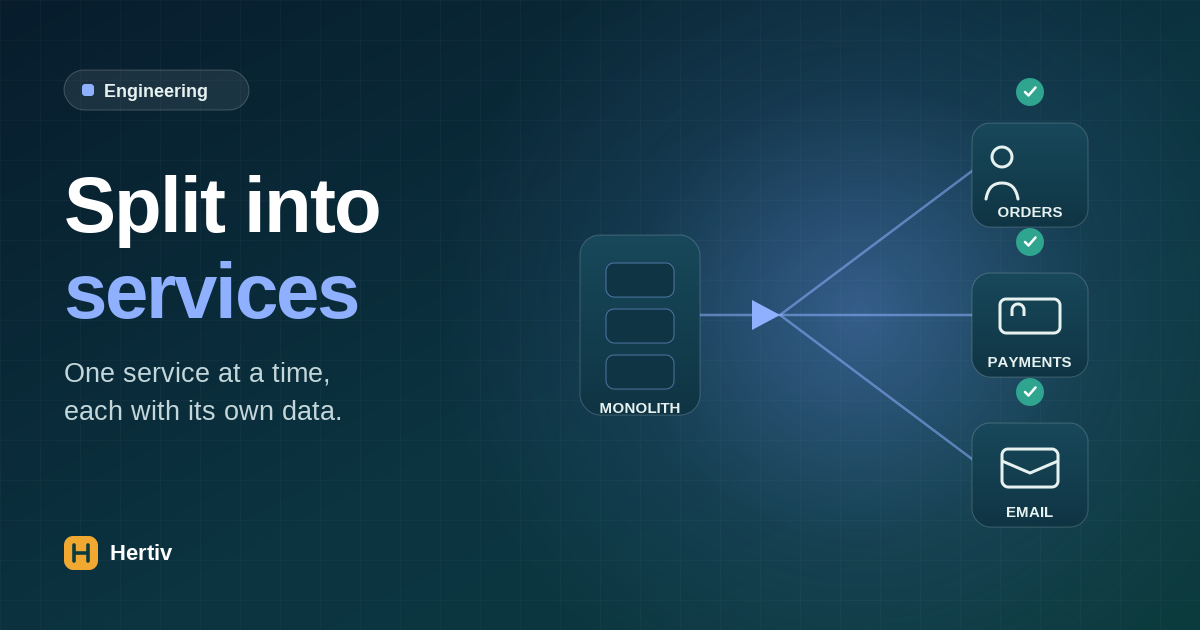
Implementing microservices means splitting one application into small services that each own one job. Move one service at a time and give each its own data.
On this page
Short answer
Implementing microservices means splitting one application into small services that each own one business job, with their own code, data and deployments. The safe path is the strangler fig pattern: build one service beside the monolith, move a slice of traffic, and retire the old code only after the new service has proved itself.
What does implementing microservices mean?
Implementing microservices means splitting one application into small services that each own one job and talk to each other over the network. Each service has its own code, its own data store and its own deployment, so teams can change one part without shipping the whole system.
The pattern fits products that have grown past the point where one codebase and one database slow every change. It is a way of organising a system around business jobs, not a goal in itself.
| Phase | What happens | Who owns it |
|---|---|---|
| Map the monolith | List jobs, data and calls | Architects and team leads |
| Carve the first service | Split one bounded job | One small team |
| Add the platform | Service discovery, logs, tracing | Platform team |
| Split the rest | One service at a time | Product teams |
| Operate | Monitor, own, improve | Each service team |
Move in small steps. A team that splits everything at once usually ends up with a distributed monolith that is harder to change than the one it replaced. Each phase ends with a check: the service runs in production, the dashboard shows its health, and the team that owns it can deploy it alone.
When do microservices fit, and when do they not?
Microservices fit when several teams ship the same product, when parts of the system need to scale on their own, or when one part changes far more often than the rest. They do not fit a small team building a first product, where the extra moving parts cost more than they save.
- Fit: three or more teams, uneven scaling needs, strict ownership per area.
- Fit: parts of the system need different technology or release cycles.
- Not a fit: a first product with one team and unclear boundaries.
- Not a fit: a system where most requests need data from every part at once.
A good test is whether you can name the boundary of the first service without an argument. If the team cannot agree on where one job ends and the next begins, the monolith is still the right home. What microservices are is the starting point for that discussion.
How to split the monolith into services
Split the monolith by business job, not by technical layer, so each service owns one clear piece of the product and the data that goes with it. A service for orders owns orders; a service for payments owns payments.
Use the strangler fig pattern: build the new service beside the old code, route one slice of traffic to it, and retire the old code only when the new service has proved itself. This keeps the product running while the split happens.
Give each service its own data store from the start. Shared databases are the fastest way to keep the coupling you were trying to remove, because a change to one table still breaks every service. Write the contract down before the code: the endpoints, the events, the error cases and the data the service owns. A contract that lives only in one developer's head will drift the first time the service changes hands.
The comparison with microservices versus monolith shows where the boundary sits.
A six-step plan to implement microservices
Implement microservices in six steps, one service at a time, so each step can be checked before the next begins.
- Map the monolith: list its jobs, data stores and the calls between them.
- Pick the first service: a job with a clear boundary and a team that owns it.
- Define the contract: the API, the events and the data the service owns.
- Build beside the old code and route a small share of traffic to the new service.
- Add the platform pieces: service discovery, central logs, tracing and alerts.
- Retire the old code for that job, then pick the next service and repeat.
Do not start step two until step one is checked. A rushed contract is the mistake that costs the most later, because every other service will be built on it.
Data, communication and failure handling
Microservices change how data and failures work, and these are the parts teams underestimate. Services talk over the network, so calls can fail, arrive twice or arrive late, and each service must handle that.
Keep data consistent with events instead of shared tables: when an order is placed, the order service publishes an event and the other services react. For reads that need data from several services, keep a small read copy rather than joining across the network.
Design for failure from the start: time out slow calls, retry with a limit, and fail in a way users can understand. A single slow service should not freeze the whole product. For the operations side, DevOps services cover the monitoring and deployment setup this needs.
Example: splitting the checkout of a small shop
Example (hypothetical): a small shop runs one application that handles the catalogue, the cart, checkout, payment and email. A full deploy takes 45 minutes and fails about 1 time in 5, so the team deploys rarely and each deploy is a big event.
The team splits checkout first. Five services each deploy in about 6 minutes, so a full round of deploys takes 5 x 6 = 30 minutes, and a failed deploy affects one service instead of the whole shop. The checkout call chain is three calls at 40 ms each, which is 3 x 40 = 120 ms, plus 30 ms of overhead, for 150 ms in total.
The team keeps the split small: one service, one month of running it in production, then a review before the next split. The review checks deploy time, error rates and the time it takes a new developer to make a first change. Microservices costs help the team budget the platform work.
What are the common mistakes?
The most common mistakes are splitting too much at once, sharing a database between services, and skipping the platform work that makes many services operable.
- Splitting by technical layer instead of by business job.
- Sharing one database across services.
- Skipping tracing, logs and alerts until something breaks.
- Making services chatty: many small calls where one would do.
- Treating the split as done when the code moves, before the team owns it.
A split is only finished when the service has an owner, a dashboard and a runbook. Until then it is a piece of code, not a service. If you are planning the move, custom software development can help map the monolith first.
Key takeaways
- Split by business job, not by technical layer
- Move one service at a time with the strangler fig pattern
- Give each service its own data store
- Add logs, tracing and alerts before the split grows
- A service is done when it has an owner, a dashboard and a runbook
Frequently asked questions
How long does it take to implement microservices?
It depends on the size of the monolith and the team. A first service usually takes a few weeks, including the platform pieces such as logging and tracing. Splitting a whole product is a programme that runs for months, one service at a time.
Do microservices make an app faster?
Not on their own. They let the parts that need it scale on their own, and they let teams deploy without waiting for each other. A single request can get slower, because it now crosses the network, so measure the calls that matter.
Should a startup use microservices?
Usually not at first. A small team with one product moves faster with a well-built monolith. Microservices pay off when several teams share the product or parts of it need to scale and change on their own.
What is the strangler fig pattern?
It is a migration pattern where the new service is built beside the old code and traffic is moved over slice by slice. The old code is retired only after the new service has proved itself in production.
Does each microservice need its own database?
Yes, in most cases. A shared database keeps the coupling that the split was meant to remove. Services share data through APIs and events instead of reading each other's tables.
What tooling do microservices need?
At minimum, service discovery, centralised logs, distributed tracing, health checks and alerts. Without those, finding a failure across ten services is guesswork. Container orchestration and a deployment pipeline come next.


