How to Implement Blockchain in Your Product Step by Step
Implementing blockchain means choosing the right approach, designing the data model, building in stages and launching with a pilot. Here is the full sequence.
On this page
Short answer
Implementing blockchain means adding a shared, tamper-evident ledger to a product or process, in stages: decide whether a chain is needed at all, choose between using an existing chain or building one, design the data and rules, build and test in stages, and launch with a pilot. Most teams should use an existing chain rather than build their own.
What does implementing blockchain mean?
Implementing blockchain means adding a shared, tamper-evident record to a product or process, so that several parties can trust the same data without trusting each other. It is not the same as building a new chain: most implementations use an existing chain and add an application on top. The background in what blockchain is explains the underlying model.
The work splits into four parts: deciding what goes on the chain and what stays off it, choosing the chain and tools, building the application and its smart contracts, and running the system once it is live.
Before any of that, the team needs a clear problem. A chain helps when several parties must share records, when the history must be hard to change, and when no single party should control the data. If one company controls everything, a database is usually simpler.
Decide whether you need a blockchain at all
You decide whether you need a blockchain by testing the problem against three questions. First, do several independent parties need to read and write the same records? Second, must the history be hard to alter after the fact? Third, is there no trusted party all sides accept?
If the answer to all three is yes, a chain is worth considering. If only one is yes, a shared database with access controls is usually cheaper and faster.
| Question | Chain fits when | Database fits when |
|---|---|---|
| Who writes the records? | Several independent parties | One company or team |
| Must history be tamper-evident? | Yes, disputes are likely | No, edits are routine |
| Is there a trusted operator? | No party is trusted by all | Yes, all sides accept one |
| How fast must writes be? | Seconds are acceptable | Milliseconds matter |
| What about private data? | Only hashes go on chain | Data lives in one place |
Run this test before choosing any technology. Teams that skip it often build a chain, then discover a database would have done the job for a tenth of the effort.
Choose your approach: use a chain or build one
Most teams should use an existing chain. Public chains offer security and tooling, while permissioned chains offer control over who can join and read. Building a new chain from scratch is rarely justified outside of research or a very specific performance need. In an enterprise setting, the programme view in how to implement enterprise blockchain covers governance and rollout.
The choice turns on four factors: who may participate, how much privacy the data needs, what the transaction fees will be at your expected volume, and what tools your team already knows. A chain your team cannot operate is a liability, however good its paper specification looks.
For an enterprise setting with known participants, a permissioned network is the usual answer; the implementation steps for that case are covered in how to implement a permissioned blockchain. For a product with open participation, a public chain with smart contracts is the usual answer.
Design the data and the rules
You design the data model by deciding what goes on the chain and what stays off it. Put hashes, identifiers and state changes on the chain; keep large files, personal data and anything that must be deleted off the chain, linked by reference.
Next, define the rules as smart contracts: who may write each record, what conditions must hold, and what happens when a rule is broken. Keep contracts small and focused, because every line is code that handles value and is hard to change once deployed.
Finally, design the identity model. Decide how users and systems prove who they are, how keys are created and recovered, and what happens when a key is lost. Key management is where most implementations fail in practice, not the chain itself.
Also decide how the chain connects to your existing systems. Most products need an integration layer that moves data between the chain and databases, queues and user interfaces. That layer, sometimes called middleware, is where most of the engineering effort goes, and it should be designed alongside the contracts rather than after them.
Build, test and launch in stages
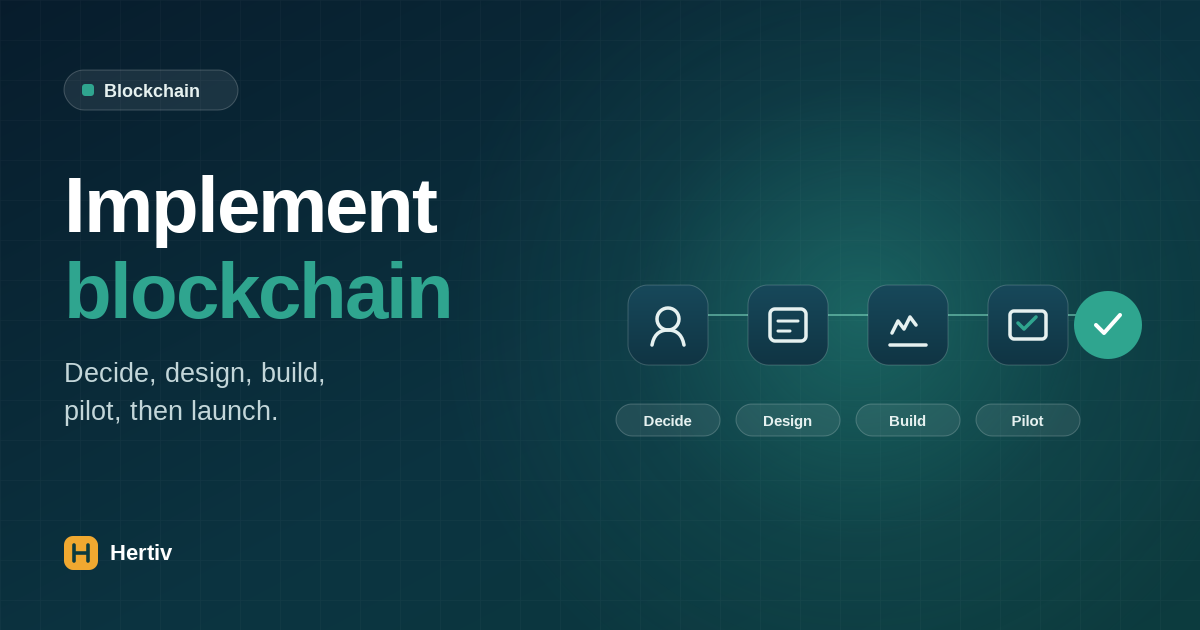
You build, test and launch blockchain in stages, starting with a local test network and moving to a shared test network before any real value is involved.
- Prototype the data model. Write the contracts and the read and write paths on a local test network.
- Test the rules. Check every rule with valid and invalid inputs, including edge cases such as duplicate writes and expired permissions.
- Audit the contracts. Have an independent review before mainnet, even for a small pilot.
- Run a pilot with real users. Start with a small group and real, low-value records.
- Launch in stages. Add users and volume gradually, with monitoring and a way to pause the contracts if something goes wrong.
Each stage should have a clear exit test. If the prototype cannot handle the expected volume, or the pilot users cannot complete the flow, fix that before moving on. A partner for blockchain development can help run the pilot and the audit.
Example: a food traceability pilot
Example (hypothetical): a food distributor wants to trace 200 shipments a week from farm to shop. Each shipment creates 4 records: harvest, packing, transport and delivery. That is 200 × 4 = 800 records a week on the chain.
Checking a shipment by phone used to take a staff member about 2 minutes per record. At 800 records a week, that is 800 × 2 = 1,600 minutes, or about 27 hours of staff time each week. With the chain, a buyer scans a code and sees the same history in seconds.
The pilot runs with 5 suppliers and 2 buyers for eight weeks. Only if the pilot users can trace a shipment without help does the team extend it to the full supplier list. The pilot's purpose is learning, not volume.
What are the common mistakes?
The most common mistakes are choosing a chain before defining the problem, putting private data on a public chain, and treating a pilot as a launch.
- Starting with the technology. Pick the problem first, then test whether a chain fits it.
- Storing private data on chain. Anything on a public chain is visible to everyone, forever.
- Skipping the audit. A contract bug found after launch is far more expensive than one found in review.
- No key recovery plan. Lost keys mean lost access, and users will lose keys.
- Launching everything at once. A staged launch with a pause mechanism limits the damage when something goes wrong.
Key takeaways
- A chain fits when several parties share records no single party should control
- Most teams should use an existing chain, not build one
- Keep private data off chain; store hashes and references instead
- Build in stages: prototype, test, audit, pilot, then launch gradually
- Key management and contract audits decide success more than the chain choice
Frequently asked questions
How long does it take to implement blockchain?
A small pilot on an existing chain typically takes a few weeks to a few months, depending on how clear the data model is. Building a new chain, or integrating with many legacy systems, takes far longer and is rarely the right first step.
Do we need our own blockchain?
Almost certainly not. Using an existing public or permissioned chain gives you security, tooling and wallets from day one. Building your own chain means running infrastructure, attracting validators and maintaining the software yourself.
What data should go on the chain?
Put hashes, identifiers and state changes on the chain, and keep large files, personal data and anything that must be deleted off the chain. Link the two with references so the chain can prove what happened without holding the data itself.
How much does blockchain implementation cost?
Cost depends on the approach: using an existing chain and a small pilot is the cheapest path, while a custom chain or deep legacy integration costs far more. The largest costs are usually design, audit and integration, not the chain itself.
What is the hardest part of implementing blockchain?
Key management and the data model. Users lose keys, contracts are hard to change once deployed, and a poor data model is expensive to fix. These deserve more attention than the choice of chain.
When should we use a permissioned chain?
Use a permissioned chain when participants are known and must be approved, when data must stay private to the group, or when regulations require control over who can join. For open participation, a public chain is usually the better fit.


