How to Run an AI Proof of Concept That Proves Something
An AI proof of concept tests one workflow against a fixed success threshold, using real data and an evaluation set. Here is how to run one in weeks, not months.
On this page
Short answer
An AI proof of concept is a small, time-boxed test that answers one question: does this AI approach work well enough on our real data and workflow to justify building it properly? It needs a single use case, a fixed evaluation set, a success threshold agreed in advance, and a decision date.
What is an AI proof of concept?
An AI proof of concept is a working test of an AI idea on real data, built to produce evidence rather than a demo. It is not a polished product, and it is not a research project. Its job is to answer a specific question, such as whether a model can draft support replies accurately enough for agents to use, with a number attached to the answer.
The test is small on purpose. One workflow, one team, a few weeks, and a fixed set of real cases with known good answers. The model reads real inputs and its output is scored against those answers, so the result is a measurement, not an impression from watching a demo.
A proof of concept differs from a prototype and from a pilot. A prototype shows that something can be built; a pilot runs a near-finished product with real users. A proof of concept sits between them: it tests whether the approach works at all, before the team spends money on the product around it. The distinction matters, because each stage needs different success criteria. See PoC vs prototype vs MVP for the full comparison.
How do you pick the right problem?
You pick a problem where the answer is measurable, the data already exists, and a human already reviews the output. If any of those three is missing, the proof of concept will produce an opinion instead of evidence.
| Test | Good sign | Warning sign |
|---|---|---|
| Measurable | Success is a number, such as accuracy or time saved | Success is described as "feels better" |
| Data ready | Real inputs and known good answers exist now | Data must be collected or cleaned first |
| Human review | Someone already checks the output | Output goes straight to customers |
| Volume | Enough cases to score, such as 50 or more | Only a handful of examples exist |
| Owner | One named person wants the result | No one owns the workflow |
Good first problems include drafting support replies, extracting fields from documents, summarising calls, and searching internal documents. Weak first problems include anything that writes to customer accounts, makes pricing decisions, or replaces a regulated judgement. Those need controls that a proof of concept should not be building yet.
How do you run the proof of concept?
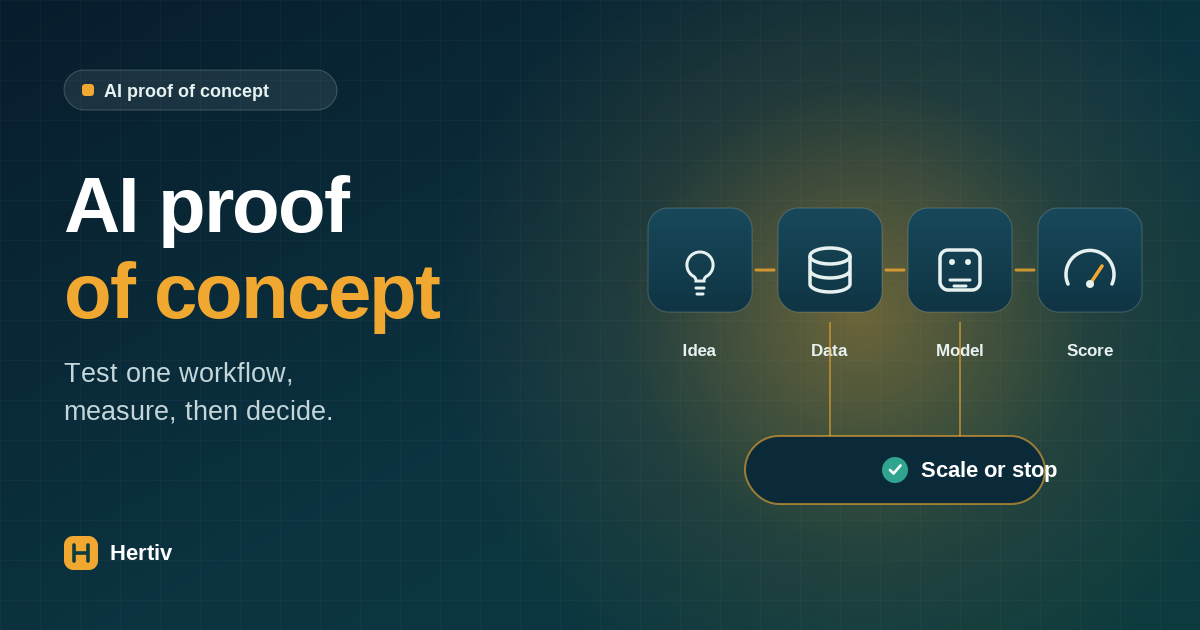
You run a proof of concept in a fixed sequence with a decision at the end. Keeping the sequence short is what stops the test from turning into an open-ended project.
- Write the question down. One sentence, such as: can a model draft replies to billing tickets that agents accept without editing, at least half the time?
- Set the success threshold. Agree the number before building. A threshold set after seeing results is not a threshold.
- Build the evaluation set. Collect 50 to 100 real cases with known good answers, including the awkward ones. This set is the test; everything else is scaffolding.
- Assemble the data. Gather the documents or records the model needs, clean duplicates and outdated versions, and check access permissions.
- Build the narrowest version. One workflow, one model call, a simple interface for reviewers. No dashboards, no admin panel, no multi-step agents.
- Score it. Run the evaluation set through the system, record the results, and have the workflow owner review the failures, not just the average.
- Decide on the date. Scale it, change the approach, or stop. Write the decision and the reasons down.
Four weeks is a realistic span for this sequence when the data is ready. If the data is not ready, the proof of concept should wait; building a model on dirty data tests the data, not the model. An AI readiness assessment can tell you whether the data and process gaps are small enough to start.
Example: a support-team proof of concept
Example (hypothetical): a software company receives 2,000 support tickets a month. Agents spend about 8 minutes on each ticket, and the team wants to know whether a model can draft replies that agents accept with little editing.
The team picks billing tickets only, because they are the most standardised. It builds an evaluation set of 80 past billing tickets with the replies agents actually sent.
The success threshold is agreed in advance: the draft must be accepted with no more than a small edit in at least 60% of cases, and it must never invent a price or a policy.
The arithmetic is straightforward. If agents handle 2,000 tickets a month at 8 minutes each, that is about 267 hours of drafting and replying time. If the model drafts 60% of tickets and each accepted draft saves 5 minutes, the saving is 1,200 tickets × 5 minutes = 6,000 minutes, or 100 hours a month.
That number is only real if the 60% threshold is met on the evaluation set, which is why the threshold comes first.
The test runs for three weeks. In week four the team scores the 80 cases, reads the 32 failures, and decides. If the threshold is met, the next step is a limited rollout with agents, not a company-wide launch.
How do you measure success?
You measure a proof of concept on the evaluation set, not on how the demo felt. The primary measure depends on the workflow: for drafting, it is the share of drafts accepted with little editing; for extraction, it is the share of fields correct against the labelled answers; for search, it is whether the right document appears in the first few results.
Always report the failures alongside the average. A system that scores 80% overall but fails every case in one category has a data problem in that category, and the owner needs to know that before scaling. Read the failures in groups: wrong source, missing information, invented detail, format errors. Each group points at a different fix.
Also measure the human side. Ask the reviewers whether the drafts saved time and whether they trusted them. A system that scores well but that reviewers refuse to use has failed, whatever the number says. Cost matters too: record what the test cost to run, including model calls and reviewer time, so the business case for scaling uses real figures. See AI proof of concept cost for the budget items to track.
When do you stop or scale it?
You scale a proof of concept when it meets the threshold on the evaluation set, the failures are understood, and the workflow owner wants to use it. Scaling means a limited rollout with real users, logging, a fallback path, and the same evaluation set run regularly. It does not mean removing the human review that made the test safe.
You change the approach when the threshold is close but the failures cluster in one fixable place, such as a missing data source or a prompt that needs grounding in specific documents. One change, then re-score on the same evaluation set. Changing three things at once makes the new score uninterpretable.
You stop when the threshold is missed by a wide margin, when the failures are spread across every category, or when the data needed does not exist and cannot be assembled cheaply. Stopping is a successful outcome: the proof of concept did its job by preventing a larger build on a weak idea. Record what was learned so the next idea starts from evidence rather than from scratch.
What are the common mistakes?
The most common proof of concept mistakes are testing on a demo instead of real data, setting the success bar after seeing results, and letting the test grow into a product before the evidence exists.
- No evaluation set. Without real cases and known good answers, quality debates are anecdotal.
- Threshold set late. A bar chosen after the results is not a test.
- Too broad a scope. Five workflows at once produce five weak results instead of one clear answer.
- Cleaned demo data. Testing on hand-picked examples hides the messy cases that decide real performance.
- No decision date. A proof of concept without an end date becomes an unowned project.
- Skipping the failure review. The average hides the pattern; the failures show what to fix.
If the test succeeds and you need help turning it into a product, AI PoC development covers the build.
How long an AI proof of concept takes sets expectations for the timeline.
Key takeaways
- A proof of concept tests one workflow against a threshold set in advance
- Pick a problem with real data, a measurable outcome and human review
- The evaluation set is the test; build it before the prompt
- Report failures in groups, not just the average score
- Stopping on weak evidence is a successful outcome
Frequently asked questions
How is a proof of concept different from a pilot?
A proof of concept tests whether an AI approach works on real data, with a small team and no real users. A pilot runs a near-finished product with real users under controlled conditions. The proof of concept comes first and decides whether a pilot is worth building.
How long should an AI proof of concept take?
Four weeks is realistic when the data is ready: one week to define the question and build the evaluation set, two weeks to build and score the narrow version, and one week to decide. If the data needs collecting or cleaning, that work comes first and the timeline extends.
How many cases should the evaluation set have?
Fifty to one hundred real cases is a practical range for a first test. Fewer than that and the score swings with a handful of cases; far more and building the set takes longer than the test itself. Include the awkward cases, not only the easy ones.
What data do we need before starting?
You need the real inputs the workflow uses and known good answers for a sample of them, plus access to the source documents or systems. If the source content is outdated or duplicated, clean it first; retrieval quality follows document quality.
Who should own the proof of concept?
The person who owns the workflow being tested, not the technology team alone. That owner defines the success threshold, reviews the failures and makes the scale-or-stop decision. Without a named owner, the result has no audience.
What happens if the proof of concept fails?
Nothing bad, if the scope was small. You record what was learned, keep the evaluation set, and either change one thing and re-test or stop and pick a different problem. A failed test that prevents a large build on a weak idea has saved money.


