PoC vs Prototype vs MVP: What to Build First
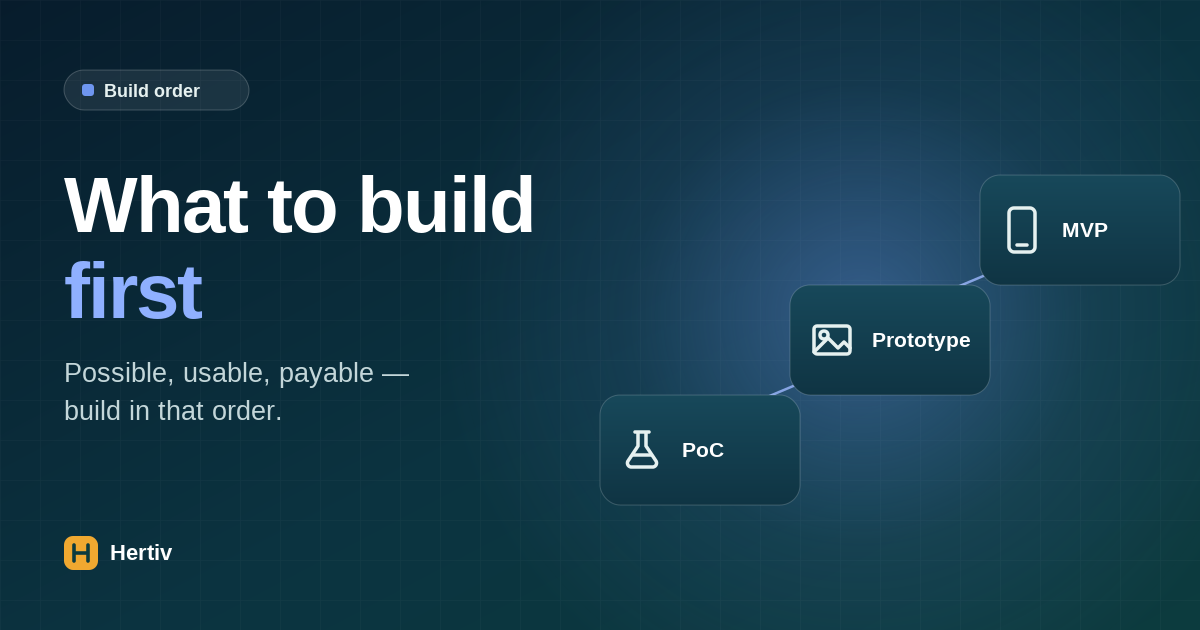
A proof of concept tests whether something is possible, a prototype tests whether it is usable, and an MVP tests whether people will pay. Build them in that order.
On this page
Short answer
A proof of concept proves a technical idea can work at all. A prototype shows what the product could look and feel like. An MVP is a real, usable product that a small group of customers can adopt and pay for. Each answers a different question, so build them only when that question is still open.
What is the difference between a PoC, a prototype and an MVP?
A proof of concept (PoC) is a small experiment that answers "can this work?". A prototype is an interactive model that answers "is this the right product?". An MVP (minimum viable product) is a released product with a narrow scope that answers "will people use and pay for this?".
The three differ in audience, fidelity and lifetime. A PoC is read by engineers and answers a technical unknown. A prototype is shown to users and stakeholders, and is often discarded. An MVP is used by real customers, sits in production, and accumulates maintenance obligations from day one.
| PoC | Prototype | MVP | |
|---|---|---|---|
| Question | Is it possible? | Is it usable and desirable? | Will people adopt and pay? |
| Audience | Engineers, technical sponsors | Users, designers, execs | Real customers |
| Production ready | No | No | Yes, narrowly |
| Typical scope | One risky technical assumption | Core screens and one user flow | One end-to-end job to be done |
| Data | Sample or synthetic | Sample | Real user data |
| Expected lifetime | Days to weeks | Days to weeks | Months, then iterated |
| Cost shape | Small, fixed | Small to medium | Medium, ongoing |
| Success signal | The assumption holds | Users complete tasks without help | Users return and pay |
Most failed products skip one of the steps. Teams either jump straight into an MVP with an unproven core (an expensive way to discover a technical dead end) or stay stuck in prototypes that never meet a real user with a credit card.
When do you actually need a proof of concept?
You need a proof of concept when a technical assumption could invalidate the entire plan, and you cannot answer it from documentation or prior experience. It is a risk-reduction tool, not a product step.
Good PoC triggers:
- A model, algorithm or integration must hit a quality bar you have not demonstrated before, such as extraction accuracy on your documents or latency on your data volume.
- A third-party API or data source may not behave the way the vendor says.
- You are choosing between two technical approaches and want evidence before committing.
- A regulator, board or investor requires evidence before funding the next phase.
A PoC can be ugly. A script, a notebook, a single endpoint or an off-the-shelf model call is enough if it isolates the unknown. Keep the scope to one question and timebox it. If your PoC runs for months, it has quietly become an MVP with none of the safeguards.
What is a prototype for, and what should it not become?
A prototype exists to make an idea concrete enough for people to react to. It is how you learn whether the flow, the screens and the value proposition make sense before engineering effort is committed.
There are two useful kinds. A low-fidelity prototype (sketches, wireframes, clickable mockups) is cheap and good for testing flows. A high-fidelity prototype uses real styling and sometimes real data or a live model behind it, which is useful when the experience depends on realistic behaviour. Neither needs authentication, error handling or a database schema you would defend in review.
The failure mode is treating prototype code as the first draft of the product. Prototypes are built for speed and exploration, so they lack the structure a production system needs. Teams that promote them without a rewrite inherit security gaps, missing tests and a data model shaped by whatever was easiest to fake.
Example (hypothetical): a team builds a clickable prototype of an internal reporting tool in a week, shows it to eight users, and finds that seven of them want a single saved view rather than the twelve dashboards planned. That feedback is worth the week, and it costs nothing compared with building the wrong dashboard set in production.
What does an MVP need that a prototype does not?
An MVP needs everything required to be genuinely used by real people: real data, authentication, permissions, error handling, basic monitoring and a support path when something breaks. Its scope is narrow, but its quality bar is production grade.
The discipline is in what you leave out, not in what you lower. An MVP should do one job end to end for one user segment. Everything that does not serve that job, including adjacent features, admin tooling you can do by hand, and integrations nobody asked for yet, can wait. The engineering quality cannot wait: if users hit broken states and no one can diagnose them, you will learn the wrong lesson from low adoption.
A practical sequence is to confirm the risky assumption with a PoC, validate the flow with a prototype, then scope the MVP around a single measurable outcome such as activated accounts or completed transactions. That scoping is where most of the value is created. A worked approach is described in how to scope an MVP you can ship in 10 weeks.
How do you decide which to build first?
Build the smallest artefact that answers your biggest open question. Work through these steps in order and stop at the first one that applies.
- List the assumptions your plan depends on: technical feasibility, user behaviour, willingness to pay, and regulatory or commercial constraints.
- Rank them by how much damage the wrong answer would cause and how uncertain you are. The highest combination goes first.
- If the top assumption is technical, run a PoC with explicit success criteria, a timebox and the sample data you will evaluate against.
- If feasibility is settled but the experience or value proposition is unclear, build a prototype and put it in front of real users.
- Once feasibility and desirability are demonstrated, scope an MVP around one job to be done with real users, production constraints and a metric that tells you it is working.
- Write the exit criteria for each phase before it starts, so the work stops when the question is answered rather than when the budget runs out.
If two assumptions are equally large, for example a hard technical unknown and an unproven market, run the cheap technical PoC first. It is usually faster to answer, and a negative result saves you the market test.
Common mistakes
Most of the waste in early product work comes from a small set of recurring errors.
- Letting a PoC become the product. Research code has no tests, no security review and no error handling. Budget for a rebuild.
- Building an MVP to answer a technical question. If you do not yet know whether the core works, the MVP will tell you nothing about demand.
- Prototyping without users. A prototype shown only to the internal team is a design exercise, not a test.
- Scope creep disguised as quality. An MVP with a full settings area, admin console and three integrations is not minimum anything.
- No defined success signal. If you cannot state before launch what number would mean "continue" and what would mean "stop", you will rationalise whatever happens.
- Skipping the risky integration. Teams often build the easy parts first and discover the hard external dependency late, when changing course is expensive.
- Confusing demo with product. A polished demo in a controlled environment does not prove durability, cost per user or reliability under real load.
How long should each phase take?
Treat these as typical ranges that vary with scope, not commitments. A PoC is usually days to a few weeks, a prototype days to a few weeks, and an MVP several weeks to a few months.
What stretches each phase:
- PoC: getting realistic data and a defensible evaluation set. Scoping to one assumption shortens it more than any tooling choice.
- Prototype: the number of user flows tested and how many rounds of feedback you run.
- MVP: integrations with systems you do not control, security and compliance review, and the depth of admin tooling you accept doing manually at first.
The pattern that keeps timelines honest is fixed scope with an explicit question per phase. When scope grows, cut features rather than extend the calendar indefinitely, because a phase without an end date stops being a test. If you need an outside team for one phase only, that is a normal arrangement; see custom software development and MVP development in about ten weeks for how those phases are usually structured.
Key takeaways
- Each artefact answers one question: feasibility, usability or demand, so never build one to answer a different question
- A proof of concept can be throwaway code, an off-the-shelf model call or a spreadsheet, and may skip the UI entirely
- A prototype is for learning and feedback, not for running a business, and usually ends up partly rewritten
- An MVP needs real users, real data and production constraints such as auth, error handling and support
- Writing down the exit criteria before you start stops a PoC from drifting into an unpaid MVP
Frequently asked questions
Is a prototype the same as an MVP?
No. A prototype is built to learn whether a design or flow works, and is usually thrown away or rewritten. An MVP is a real product released to real users with production constraints like security, data handling and support. Prototypes validate understanding; MVPs validate demand.
Can an MVP be built before a proof of concept?
It can, but it is risky when a core technical assumption is unproven. If the hard part fails, the MVP work is wasted. When feasibility is genuinely known, such as a standard web app with no unusual technical risk, going straight to an MVP is reasonable.
Does a proof of concept need a user interface?
Usually not. A PoC exists to test a technical assumption, so a script, notebook or single endpoint may be enough. Add a minimal interface only if the assumption involves the way people interact with the system, such as response quality or latency.
How do you know a PoC has succeeded?
You defined the success criteria before starting, tied to the decision the PoC informs. For a model, that might be performance on a fixed evaluation set. If results meet the bar, you proceed; if not, you change approach. Without pre-agreed criteria, results get interpreted to fit the desired answer.
Should the MVP be built by the same team as the PoC?
It helps for knowledge transfer but is not required. What matters is that the PoC findings are documented and that the MVP team understands which assumptions are proven and which are still open. Reusing PoC code is rarely worth it unless it was written with production in mind.
How much do these phases usually cost?
Costs scale with scope and vary widely by region and team, so treat any figure as a range. A PoC is typically the smallest investment, a prototype similar or slightly larger, and an MVP the largest and ongoing. The largest savings come from stopping a phase early when the answer is negative.


