How Long Does an AI Proof of Concept Take?
Most AI proofs of concept take six to eight weeks from scoping to a go or no-go decision. The timeline depends on data readiness, scope and decision speed.
On this page
Short answer
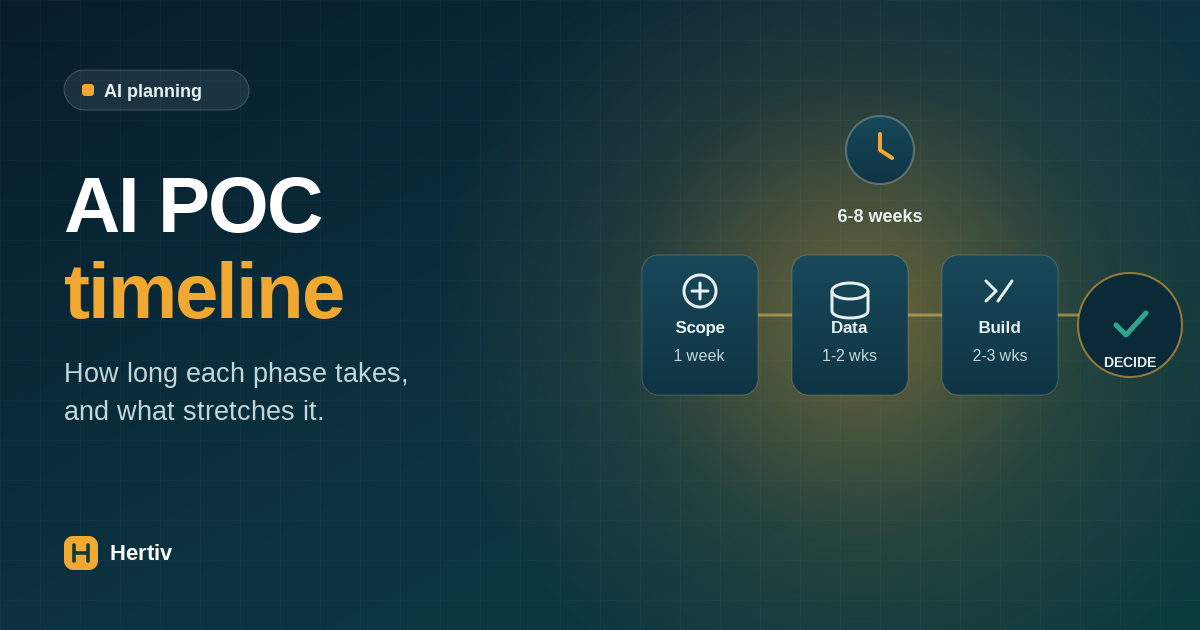
A focused AI proof of concept usually takes six to eight weeks: one week to scope, one to two weeks to prepare data, two to three weeks to build, one week to evaluate and one week to review the result and decide. Timelines stretch when data is messy, the scope keeps growing, or nobody is available to review results and make the go or no-go call.
What is an AI proof of concept?
An AI proof of concept is a small, time-boxed test that answers one question: does this AI idea work well enough on our real data to justify building it properly? It is not a product. It is a decision tool, built to produce evidence rather than to ship.
A good proof of concept has a narrow scope, a fixed evaluation set of real cases with known good answers, and a success threshold agreed before building starts. Without those three things, the project drifts into a small product build with no clear end and no clear decision.
The output of a proof of concept is a recommendation: build it, change it, or drop it. That decision is the whole point. If your team cannot name the decision the proof of concept will inform, the scope is too vague to start.
How long does each phase of an AI POC take?
Most focused AI proofs of concept follow the same five phases, and each phase has a typical length when the team is available and the data is reachable. The table below shows a common pattern for a single use case, such as a support-desk assistant or a document extraction pilot.
| Phase | Typical length | What happens |
|---|---|---|
| Scoping | 1 week | Pick the use case, define success, agree the evaluation set |
| Data preparation | 1 to 2 weeks | Gather, clean and label the sample data and documents |
| Build | 2 to 3 weeks | Connect the model, retrieval and tools; build the test interface |
| Evaluation | 1 week | Run the evaluation set, review failures, fix the worst gaps |
| Review and decision | 1 week | Present results against the threshold and decide go or no-go |
That adds up to six to eight weeks for a single use case with a small team. A proof of concept that tries to cover three use cases at once, or that needs a new data pipeline before it can start, will take longer, and the extra time usually goes to data work rather than model work.
What makes an AI POC take longer?
Data readiness is the most common cause of delay. If the documents the model needs are scattered across drives, duplicated, or out of date, cleaning them can take longer than building the model. Teams that skip the data check in scoping often discover this in week three, when the build is waiting on data that does not exist yet.
Scope growth is the second cause. A proof of concept that starts as a support assistant and grows into a support assistant plus a sales copilot plus a reporting tool is no longer a proof of concept. Each added use case needs its own evaluation set and its own success threshold, so the timeline grows with it.
The third cause is slow decisions. A proof of concept needs a sponsor who can approve data access, review results and make the go or no-go call. When that person is unavailable for weeks, the project stalls between phases even though the technical work is done. Book the review meeting at the start, not at the end.
Other delays include waiting for security review of a new vendor, building integrations to systems nobody has documented, and choosing a model before the evaluation set exists. Each of these is avoidable if scoping covers access, integrations and evaluation before the build begins.
How do you keep an AI POC to its timeline?
You keep a proof of concept on time by fixing the scope, the data and the decision date before anyone writes code. The plan below works for most single-use-case pilots.
- Fix one use case and one success threshold. Write down the metric and the number that counts as a pass, and get the sponsor to sign it off.
- Assemble the evaluation set first. Collect 20 to 50 real cases with known good answers before the build starts, so evaluation never waits on data.
- Check data access in week one. Confirm who can read the documents and systems, and what approvals are needed, while scoping is still open.
- Time-box the build. Set a hard stop date for building and move to evaluation on that date, even if the demo is rough.
- Book the decision meeting early. Put the review in the sponsor's calendar at the start so the project cannot stall waiting for a slot.
Daily stand-ups help, but they are not the point. The point is that every phase has an owner, a deadline and a visible output, so a slip is noticed in days rather than discovered at the end. If you need a structured build plan, how to build an AI proof of concept walks through the steps in order.
Example (hypothetical): a six-week support-desk POC
Example (hypothetical): a 40-person support team wants to test whether an AI assistant can draft answers from the help centre. Two engineers are assigned, each working 30 hours a week on the pilot for six weeks, which gives 360 hours in total.
The hours split across the phases: scoping takes 40 hours, data preparation takes 80 hours, the build takes 160 hours, evaluation takes 40 hours and the review and write-up take 40 hours. Added together, 40 + 80 + 160 + 40 + 40 equals 360 hours, which matches the six-week budget exactly.
The evaluation set is 50 real tickets with known good answers. The success threshold is that the assistant drafts a usable answer for at least 35 of the 50 tickets, with a source cited for each one. In week five the team runs the set, finds 38 usable drafts, and fixes the two worst failure patterns before the review.
The review meeting happens in week six, on the date booked at the start. The sponsor sees the 38-out-of-50 result, the failure review and the cost of the next step, and approves a production pilot. The proof of concept ends on time because the scope, the data and the decision date were fixed before the build began.
What are the common mistakes?
The most common mistakes are starting without a success threshold, letting scope grow, and treating the proof of concept as a product launch.
- No success threshold. Without a number agreed in advance, every result looks arguable and the decision never happens.
- Scope growth. Adding use cases mid-project turns a six-week test into a three-month build with no clear end.
- Data checked too late. Discovering in week three that the data is missing or unusable wastes the build window.
- No decision date. A proof of concept without a booked review meeting drifts after the build finishes.
- Polishing the demo. Time spent making the interface look finished is time not spent on evaluation, which is what the decision depends on.
- Skipping the failure review. Knowing that 38 of 50 tickets worked is useful; knowing why the other 12 failed is what decides whether to build it properly.
When should you extend a POC, or stop it?
You extend a proof of concept when the evidence is close but incomplete: the model works on most cases, and one more week of data work or one more evaluation round would settle the decision. Set a new hard date for the extension and name what it must prove, or the extension becomes open-ended.
You stop a proof of concept when the data does not exist, the success threshold is clearly out of reach, or the use case turns out to be less valuable than assumed. Stopping is a good outcome. It saves the cost of building a product nobody needed, and the evaluation set and lessons carry over to the next idea.
A proof of concept that is extended twice without a decision should be stopped and rescoped. The question is no longer whether the model works; it is whether the team is willing to make a decision. For help scoping the next step, AI proof of concept development covers how a pilot moves from a test into a funded build.
Key takeaways
- A focused AI proof of concept usually takes six to eight weeks, end to end
- Data preparation is the phase most likely to stretch the timeline
- Agree one use case, one evaluation set and one success threshold before building
- Book the go or no-go review meeting at the start, not at the end
- Stopping a proof of concept that fails its threshold is a good outcome
- A proof of concept extended twice without a decision should be rescoped or stopped
Frequently asked questions
Can an AI proof of concept be done in two weeks?
A very narrow test can, if the data is already clean, the evaluation set exists and the team is free. Most teams need longer because data preparation and access approvals take time. Two weeks is realistic only when scoping and data work are already done.
How long does an AI POC take if the data is messy?
Messy data usually adds one to three weeks, mostly in the data preparation phase. Cleaning documents, removing duplicates and labelling a sample cannot be skipped, because evaluation quality depends on it. Budget the extra time up front rather than discovering it mid-build.
What is the difference between a POC and a pilot?
A proof of concept tests whether an idea works on real data, usually with a small team and no production users. A pilot runs the working idea with real users in production, to test adoption and operations. A POC answers whether to build; a pilot answers whether it works in daily use.
How many people does an AI POC need?
A small team is enough: one or two engineers, a product owner who knows the workflow, and a sponsor who can approve data access and make the go or no-go decision. Larger teams do not make a proof of concept faster; they make coordination slower.
What happens after a successful AI POC?
The team presents the evaluation results against the agreed threshold and proposes the next step, usually a production pilot with real users, plus the integration, evaluation and change management work that a POC deliberately skipped. The POC evidence is what justifies that budget.
Should we build the POC ourselves or hire a team?
It depends on your team's skills and time. Building in-house teaches your team the most, but a team without AI experience will move slower and may skip evaluation. Hiring a team for the POC is common when the goal is a fast, evidence-based decision.


