How to Develop a Blockchain Application
Developing a blockchain application means choosing a chain, writing smart contracts and building the app around them. Follow these steps to ship safely.
On this page
Short answer
Developing a blockchain application means building software that reads and writes data on a blockchain, usually through smart contracts, with a normal app interface on top. The work covers choosing a chain, designing the contract, building the front end and wallet flow, testing on a test network, auditing the contract and launching with monitoring. Start with one narrow feature and a test network, not a full product.
What is a blockchain application?
A blockchain application is software that reads and writes data on a blockchain, usually through smart contracts, with a normal app interface on top. The user sees a website or a mobile app; the blockchain sits behind it, holding the records, the rules and the assets that must not depend on one company.
The blockchain part does three jobs. It stores state that anyone can check, it runs rules in smart contracts that execute the same way for everyone, and it lets users hold their own assets in a wallet instead of an account on your server. Everything else, such as the interface, the search and the notifications, is ordinary software.
Not every app needs a blockchain. If the data can live in one database and the users trust you to hold it, a normal app is simpler, faster and cheaper. A blockchain earns its place when several parties need to check the same records without trusting one operator, or when users should own their assets directly.
How do you choose the right chain?
You choose the chain by fees, speed, tooling and who your users already are. A chain with high fees makes small transactions costly, while a chain with few users means your audience must set up a new wallet before they can start.
| Chain | Fees | Speed | Tooling | Best for |
|---|---|---|---|---|
| Ethereum | Higher | Slower | Strongest | High-value apps with wide wallet support |
| Polygon | Low | Fast | Strong | Consumer apps with many small actions |
| Solana | Low | Fast | Growing | High-volume, low-price transactions |
| Base | Low | Fast | Strong | Apps for users new to wallets |
The chain decision shapes everything after it: the contract language, the wallet flow, the fees your users pay and the tools your team can use. Most teams pick a low-fee chain for their first version and keep the contract logic portable, so a move later is a rewrite of the deployment, not of the whole product.
Check the wallet picture too. If your users already hold wallets on one chain, that chain has a head start. If they are new, the chain with the simplest onboarding wins, even if another chain is more famous.
What goes into the smart contract?
The smart contract holds the rules and the state that must be shared and checkable: who owns what, what can change, and under which conditions. A contract for a loyalty app might hold points balances and the rules for earning and spending them; a contract for a marketplace might hold listings, escrow and the fee split.
Keep the contract small. Every function is a place where a bug can cost real money, and a contract that does one job well is easier to test and audit than one that does five. Put display logic, search and notifications in the app, and keep only the rules that must be enforced on-chain in the contract.
Access control deserves care. Decide which addresses can call each function, who can change the rules, and whether changes need one signature or several. A contract where one key can drain the funds is a single point of failure, however good the rest of the code is. The guide to smart contract development covers the contract side in more depth.
How do you build the app around the contract?
You build the app around the contract in layers: the front end the user sees, the wallet connection, the code that reads chain data, and the code that sends transactions. The front end is ordinary web or mobile work, and the chain part is a set of calls to the contract through a library.
Reading is cheap and easy: the app asks the contract for balances, listings or state, and shows the result. Writing is the hard part, because it needs a wallet signature, a fee and a wait for confirmation. Design the interface around that wait, with clear states for pending, confirmed and failed.
Most apps also need an indexer, a service that reads chain events and stores them in a fast database for search and lists. Asking the chain directly for every list is slow, so the indexer keeps a copy that the app can query quickly. The chain remains the source of truth, and the indexer is a cache of it.
What are the development steps?
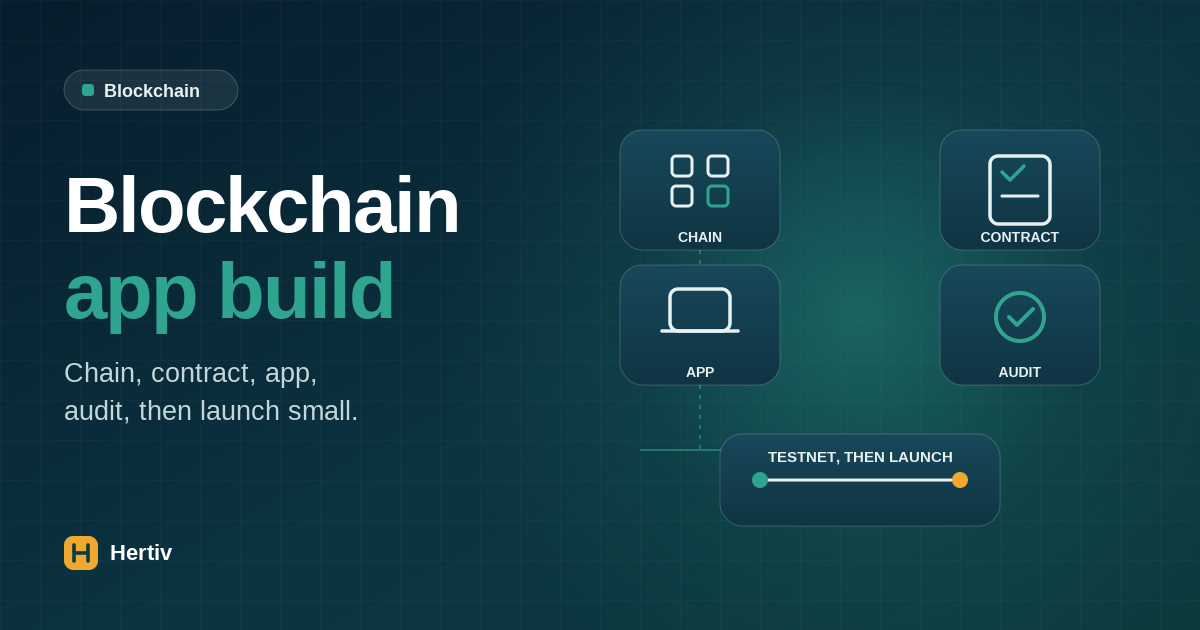
Developing a blockchain application follows a clear sequence: define the on-chain rules, build the contract, build the app, test on a test network, audit, then launch small and watch it.
- Define the rules. Write down what the contract must enforce and what can live off-chain, in plain words first.
- Build the contract. Write the contract, add unit tests for every function, and test the unhappy paths, not just the happy ones.
- Build the app. Build the front end, the wallet flow and the indexer, and test them against a local chain.
- Test on a test network. Deploy to a test network and run the full user journey with real wallets and real fees.
- Audit the contract. Get an independent review before real money touches the contract, and fix what it finds.
- Launch small. Open to a small group, watch the transactions and the errors, and expand only when the numbers look right.
Skipping a step is how most launches go wrong. A contract that was never tested on a test network will fail on the first real transaction, and a launch without monitoring will not notice until users complain. For budget planning, the guide to blockchain app development cost shows what each stage usually involves.
Example (hypothetical): a loyalty-points app
Example (hypothetical): a coffee chain with 12 shops wants a loyalty app where points live on-chain, so customers keep them even if the chain changes its app. The team builds one contract for points, a mobile app for earning and spending, and an indexer for the points history.
Suppose the build takes 3 developers working 12 weeks at 40 hours a week. That is 3 times 12 times 40, or 1,440 hours. At $70 an hour, the development cost is 1,440 times $70, or $100,800. Add a contract audit at $15,000 and design at $6,000, and the total is $121,800.
Now add a 15 percent reserve for fixes and surprises: 15 percent of $121,800 is $18,270, which brings the planned budget to $140,070. The team also budgets a small monthly amount for the indexer and the test network, and launches to one shop first, then to all 12 once the points flow works without errors.
The launch order matters. The team deploys the contract to the test network, runs the full journey with staff phones, gets the audit, and only then moves to the main network. A loyalty app that loses points on day one loses the trust it was built to create.
How do you test and audit before launch?
You test a blockchain application at three levels: the contract, the app and the whole journey. Contract tests check every function, including the ones that should fail. App tests check the wallet flow, the pending states and the error messages. Journey tests run the full path a user takes, from signing up to completing the first transaction.
The audit is a separate step, done by people who did not write the code. An auditor reads the contract line by line, checks the access control, and tries to break it. The audit report lists the issues by severity, and the team fixes the serious ones and re-tests before launch.
After launch, monitoring never stops. Watch for failed transactions, unusual contract calls and error rates in the app, and set alerts so the team knows before users do. A contract bug found by monitoring is bad; the same bug found by a user is worse.
What are the common mistakes?
The most common mistakes in blockchain application development are putting too much on-chain, skipping the audit, and designing for crypto users instead of ordinary ones.
- Too much on-chain. Storing display data and search indexes on-chain is slow and costly; keep them in the app.
- Skipping the audit. A contract that was never reviewed by an independent eye will carry a bug into production.
- Crypto-only design. If the app only works for people who already hold a wallet, most of your audience cannot start.
- No pending states. A transaction takes time to confirm; an interface that hides that wait confuses users.
- One key controls everything. A single admin key that can change the rules or move funds is a risk, not a convenience.
If the app is a decentralised app rather than a general blockchain product, the guide to how to create Web3 dApps walks through the same steps with a dApp focus.
Key takeaways
- A blockchain earns its place when records must be checkable or users must own their assets
- Keep the contract small: only the rules that must be enforced on-chain belong there
- Reading chain data is cheap; writing needs a signature, a fee and a wait for confirmation
- Test on a test network, audit the contract, then launch small and watch it
- Design the wallet flow for ordinary users, not only for people who already hold crypto
Frequently asked questions
Do I need a blockchain for my app?
Not always. If the data can live in one database and your users trust you to hold it, a normal app is simpler, faster and cheaper. A blockchain is worth it when several parties need to check the same records without trusting one operator, or when users should own their assets directly.
Which chain should I build on first?
Pick by fees, speed, tooling and where your users already are. Low-fee chains suit consumer apps with many small actions, while widely used chains suit high-value apps where buyers already have wallets. Keep the contract logic portable so a move later is a redeployment, not a rebuild.
What is the difference between a dApp and a blockchain application?
A dApp is one kind of blockchain application: an app whose core logic runs in smart contracts and is open to anyone. A blockchain application is the broader term, covering any app that reads or writes chain data, including apps where only part of the product touches the chain.
How long does blockchain app development take?
A small first version with one contract and a simple app can be ready in weeks, while a product with several contracts, an indexer and a full wallet flow takes months. The audit and the test-network stage usually take more calendar time than the contract code itself.
What does a smart contract audit cost?
It depends on the size and complexity of the contract, and on the auditor. Prices are given by the auditor after reading the code, so get quotes early and check the vendor's own site. Budget for the audit and for the fixes it finds, not just for the review.
Can I change a smart contract after launch?
Usually not directly, because a deployed contract is fixed. Teams plan for change with upgrade patterns, such as a proxy that points to a new version, or by deploying a new contract and moving users. Decide the upgrade plan before launch, not after a bug appears.


