What Does a Blockchain App Cost to Build?
A blockchain app's cost depends on the smart contracts, the wallet flow, the chain and the audit. Learn the main drivers and rough ranges by app type.
On this page
Short answer
A blockchain app is an application that stores data or moves value on a blockchain, using smart contracts for its core logic. Its cost depends on the contracts, the wallet and signing flow, the chain and its fees, and the security audit.
What is a blockchain app?
A blockchain app is an application that stores data or moves value on a blockchain, using smart contracts for its core logic. The user sees normal screens, but behind them the app reads from a chain, writes transactions to it, and often connects a wallet for signing.
Common examples are token and payment apps, marketplaces for digital goods, supply chain trackers and voting or identity tools. The blockchain part is usually a small share of the code: most of the work is the app itself, the wallet flow, the backend that reads chain data, and the testing.
The cost question has no single answer, because a simple token app and a full exchange are different projects. The drivers are the chain, the smart contract work, the wallet and key handling, and the audit. A team that plans those four areas first can price the rest with far less guesswork. For the build itself, blockchain development partners usually quote the contract work and the app work separately.
What drives the cost of a blockchain app?
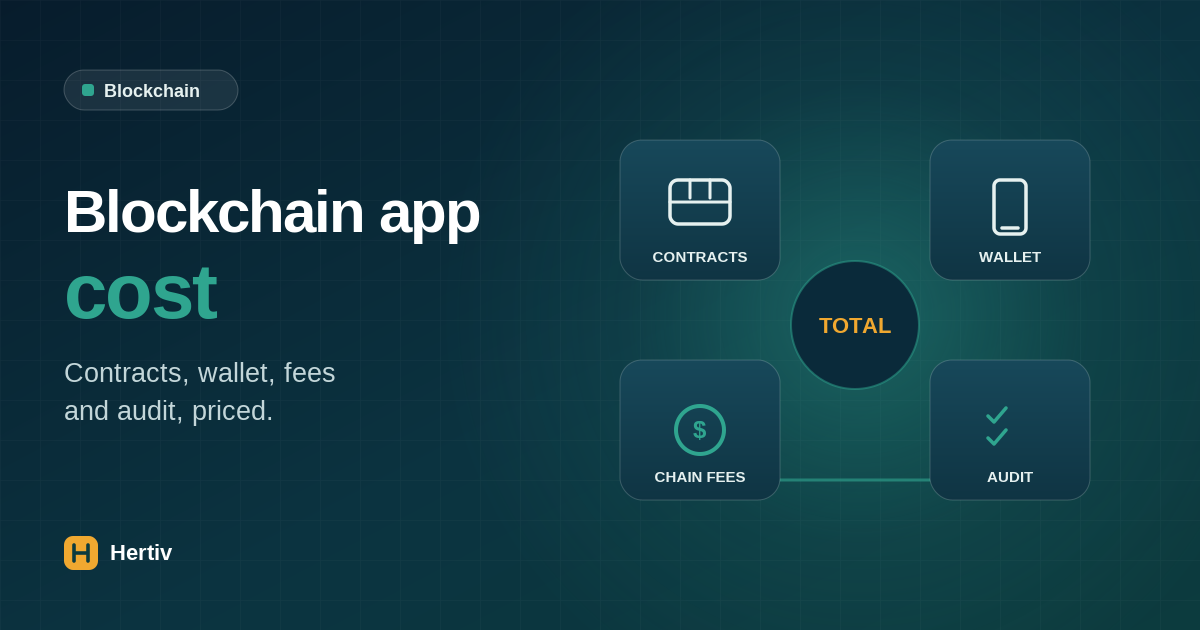
Four things drive most of the cost: the smart contracts, the wallet and signing flow, the chain and its fees, and the security audit. Each one can double the budget if it is left vague at the start.
| Cost driver | What it covers | Cost effect | How to control it |
|---|---|---|---|
| Smart contracts | Token, staking or marketplace logic | High | Keep the contract small and simple |
| Wallet and signing | Connect, sign, recover | Medium | Use a proven wallet library |
| Chain and fees | Gas, node and indexing costs | Medium | Pick the chain before you build |
| Security audit | Outside review of contracts | High | Budget it from day one |
| App and backend | Screens, API, admin panel | High | Cut the feature list to the core |
Smart contracts are the riskiest line item. A contract that holds user funds needs careful design, tests and an outside audit, and each of those takes time. A contract that only records data, such as a supply chain tracker, is cheaper because a bug cannot drain money.
Chain choice affects running costs more than build costs. A chain with high transaction fees makes every user action expensive, so teams often pick a cheaper chain or a layer 2 for apps with many small transactions.
How much do different blockchain apps cost?
Rough planning ranges help at the start, but treat them as ranges, not quotes. A simple token app with a wallet and a basic admin panel is the cheapest shape. A marketplace or a lending app costs more, because it needs more contracts, more screens and a stronger audit.
| App type | Typical scope | Rough range | Main cost |
|---|---|---|---|
| Simple token app | Token, wallet, balance view | Low | Contract and wallet |
| NFT marketplace | Mint, list, buy, royalties | Medium | Contracts and search |
| Payment app | Send, receive, history | Medium | Compliance and wallet |
| DeFi app | Swap, stake, lend | High | Contracts and audit |
| Supply chain tracker | Record, verify, report | Medium | Integrations |
The ranges above are planning guides, not prices. A real quote depends on the chain, the contract size, the platforms and the audit scope. Ask for a quote that splits the contract work, the app work and the audit, so you can see which part is driving the total.
One cost that surprises teams is the audit. A serious audit of contracts that hold funds takes weeks and costs a large share of the contract budget. It is not optional for a money app, and it should be booked early because good auditors have waiting lists.
What does the team and timeline look like?
A small blockchain app usually needs a smart contract developer, one or two app developers, a designer and a tester, for three to six months. A larger app adds a backend developer, a DevOps engineer and a product manager, and the timeline stretches to nine months or more.
The contract work comes first in the schedule, because the app screens depend on what the contracts can do. A common shape is four to six weeks for contract design and build, then eight to twelve weeks for the app and backend, with the audit running in parallel near the end.
Testing takes longer than for a normal app. Contracts need unit tests, tests on a test network, and checks for the ways a contract can fail, such as a failed transaction or a price feed that stops updating. The team should plan for at least two full test rounds before launch.
If your team is new to this stack, compare the plan with what smart contract development involves before you commit to a date.
What are the running costs?
Running costs for a blockchain app are the chain fees, the node or indexing service, hosting, monitoring and support. Chain fees are the unusual part: every write to the chain costs gas, and the price moves with network demand.
Most teams pay for a node provider or an indexing service instead of running their own nodes, which trades a monthly fee for reliability. Hosting and the backend cost about the same as for a normal app. Monitoring matters more here, because a stuck transaction or a failed price feed can block users until someone notices.
Support costs also run higher than for a normal app. Users lose wallet access, send tokens to the wrong address, or get confused by gas fees, and each of those needs a human answer. A clear help centre and a recovery flow for lost wallets cut the support load a lot.
Budget for at least a year of running costs before the app earns. A token app that depends on trading fees needs real volume to cover its chain and hosting bills, and volume takes time to build.
Example (hypothetical): an NFT marketplace app
Example (hypothetical): a team builds an NFT marketplace with minting, listings, buying and royalties on one chain. The team is one contract developer, two app developers and one designer, working for 20 weeks at 40 hours a week.
The arithmetic: 4 people × 20 weeks × 40 hours = 3,200 hours. At $65 an hour that is $208,000. Add a smart contract audit at $25,000, chain and node services at $800 a month for the first year ($9,600), and design tools and hosting at $3,000. The total is $245,600, and the team adds a 15% reserve of $36,840, giving a budget of $282,440.
After launch, the marketplace charges a 2.5% fee on sales. If monthly sales reach $200,000, the fee income is $5,000 a month, which covers the $800 node bill and part of the hosting. The team can see from these numbers that the app needs roughly $400,000 in monthly sales to cover its full running costs, so the launch plan focuses on sellers, not on new features.
What are the common mistakes?
The most common mistakes when costing a blockchain app are forgetting the audit, picking the chain late, and treating gas fees as a detail.
- Forgetting the audit. An unaudited contract that holds funds is a risk no launch should take.
- Picking the chain late. Switching chains mid-build means rewriting contracts and wallet code.
- Ignoring gas fees. High fees can make small transactions pointless and drive users away.
- Overbuilding the first version. A marketplace with ten features costs far more than one with minting, listing and buying.
- Skipping the recovery flow. Users who lose wallet access will contact support, so plan the recovery path early.
Key takeaways
- Smart contracts, wallet flow, chain fees and audit drive most of the cost
- A simple token app costs far less than a DeFi app or a marketplace
- Book the security audit early; it is a large share of the contract budget
- Chain choice affects running costs more than build costs
- Budget for a year of running costs, including gas and node services
Frequently asked questions
How much does a simple blockchain app cost?
A simple token app with a wallet and a balance view is the cheapest shape, because it needs one small contract and few screens. A marketplace or DeFi app costs much more, because it needs more contracts, more screens and a stronger audit. Ask for a quote that splits contract work, app work and audit.
Why are smart contract audits so expensive?
An audit is a manual review of contract code by specialists, plus testing for attack paths that automated tools miss. Contracts that hold user funds need the deepest review, and good auditors have waiting lists. The cost is a large share of the contract budget, so book it early.
Which chain should I build on?
Pick the chain before you build, based on fees, speed, wallet support and where your users already are. A chain with high fees makes small transactions pointless. Switching chains mid-build means rewriting contracts and wallet code, so the choice should be made at the design stage.
Do I need a wallet in my blockchain app?
Yes, if users sign transactions or hold tokens. Most apps connect an existing wallet rather than building one, using a proven wallet library. The signing flow, the recovery path for lost wallets and the handling of failed transactions are the parts that need the most design care.
What are the monthly running costs?
Running costs are chain fees, a node or indexing service, hosting, monitoring and support. Chain fees move with network demand, so they are the hardest to predict. Most teams pay a node provider a monthly fee instead of running their own nodes.
Can I build a blockchain app without smart contracts?
Yes, if the app only reads chain data, such as a tracker that shows token balances or supply chain records. You still need a backend that reads the chain and a way to show the data, but you avoid the contract build, the audit and most of the risk.


