How to Create an NFT Marketplace on Polygon
A Polygon NFT marketplace lets creators mint and trade NFTs with fees of a fraction of a cent. Here are the contracts, the build steps and the costs to expect.
On this page
Short answer
An NFT marketplace on Polygon is a trading platform built on Polygon PoS, an EVM-compatible chain where minting and trading an NFT usually costs less than one cent in gas. You build it with ERC-721 or ERC-1155 contracts, a listing system based on signed orders, wallets, storage and an indexer, and you pay for gas in POL, the chain's native token.
What is an NFT marketplace on Polygon?
An NFT marketplace on Polygon is a trading platform where people mint, list, buy and sell non-fungible tokens on Polygon PoS. It works like a marketplace on Ethereum, but the trades settle on Polygon, where fees are a fraction of a cent and blocks arrive about every two seconds.
Polygon PoS is an EVM-compatible proof-of-stake chain that runs the same Solidity contracts, ERC-721 and ERC-1155 tokens, and wallets such as MetaMask as Ethereum, with no changes to the code. The gas token is POL: in September 2024 POL replaced MATIC at a one-to-one rate, so a marketplace interface should say POL, not MATIC.
Large marketplaces already serve the chain. OpenSea lists Polygon among its supported chains and settles Polygon trades through its Seaport protocol, and Rarible lists Polygon with live status. One chain to avoid is Polygon zkEVM, whose sequencer was shut down on 1 July 2026, so a new marketplace means a marketplace on Polygon PoS.
Why build an NFT marketplace on Polygon?
Teams pick Polygon for three reasons: fees, speed and tooling. A mint or a transfer usually costs less than one cent, so free claims, loyalty NFTs and editions of thousands of tokens stay affordable at that price. A buyer does not have to weigh a fee that is larger than the item itself.
The table below compares Polygon with the two chains teams usually weigh it against.
| Factor | Polygon PoS | Ethereum | Solana |
|---|---|---|---|
| Fee per NFT sale | About half a cent | Higher and variable with demand | Under one cent |
| Block time | About 2 seconds | About 12 seconds | Under 1 second |
| Contracts | Solidity, ERC-721 and ERC-1155 | Solidity, ERC-721 and ERC-1155 | Rust or Anchor programs |
| Wallets and tooling | MetaMask, Hardhat, Foundry | MetaMask, Hardhat, Foundry | Phantom, Anchor |
| Security model | Own validators, checkpoints to Ethereum | Native Ethereum security | Own validators |
The trade-off is that a rollup posts its data to Ethereum and inherits Ethereum's security, while Polygon PoS is a separate proof-of-stake chain with its own validators that submits checkpoints to Ethereum. For most NFT use cases — art, collectibles, tickets, loyalty tokens — the fee and speed gain is worth that difference, which is why the chain still hosts live trading.
Fees are low but they change with demand, and gas prices have spiked during popular mints and spam waves. A marketplace should read current prices through a gas station API or the eth_feeHistory call, and the team should test the mint flow at ten times the normal gas price.
What does a Polygon NFT marketplace need?
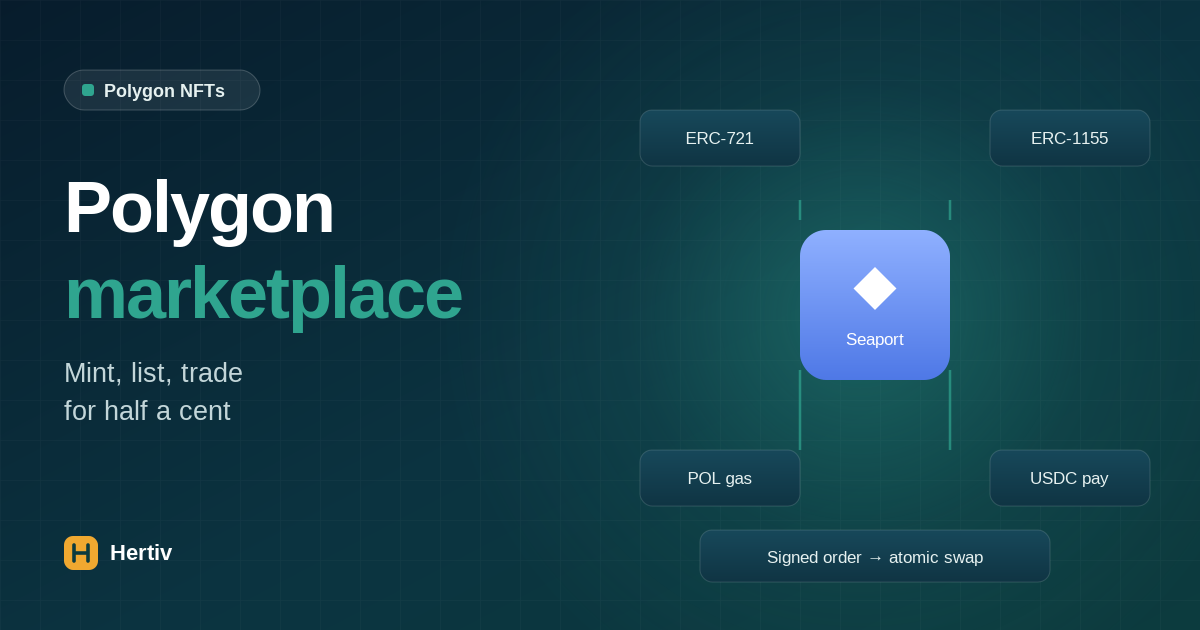
A marketplace has six parts, and each one can be built or bought separately. The contracts are the core; the rest is the interface, the data and the money flow around them.
| Part | What it does | Common choice on Polygon |
|---|---|---|
| NFT contracts | Mint and hold the tokens | ERC-721A or ERC-1155, with EIP-2981 royalty info |
| Marketplace contract | Swaps the NFT and the payment in one trade | Seaport, or a custom escrow contract |
| Listings | Lets sellers offer NFTs without paying gas | EIP-712 signed orders stored off-chain |
| Payments | Takes payment in a currency buyers understand | POL, WETH on Polygon, or USDC |
| Metadata and media | Stores the image and traits | IPFS or Arweave, pinned and backed up |
| Indexer and search | Finds listings, sales and owners fast | A subgraph or a hosted indexer |
Royalties need a decision early. The EIP-2981 interface lets a contract report a royalty amount and receiver, but enforcement depends on the marketplace: OpenSea enforces creator earnings only for ERC721-C and ERC1155-C style collections, and its older operator filter was disabled in August 2023. A collection that expects royalties on every sale should say so plainly, because not every venue will pay them.
Gas sponsorship is worth planning too. Low fees let the marketplace pay gas for its users through an ERC-4337 paymaster or a relayer, so a first-time buyer can claim an NFT without holding POL first. That removes the hardest step for a non-crypto buyer.
How to create an NFT marketplace on Polygon, step by step
Building a marketplace takes a team through seven steps, from scope to launch. The contract work comes first, because the interface and the indexer both depend on what the contracts expose.
- Pick the scope. Decide the niche, the token types and whether the marketplace is open to anyone or curated. A general marketplace and a single-collection shop are different builds.
- Choose the contracts. Use audited, standard implementations for ERC-721 or ERC-1155 and EIP-2981, and decide between Seaport and a custom escrow contract for settlement. Extending Seaport is the safer choice for most teams.
- Write and test the contracts. Cover minting, listing, buying, cancelling and delisting, plus royalty splits and fee logic. Test on Amoy, the Polygon testnet, before any mainnet deployment.
- Add listings and settlement. Build the signed-order flow so sellers list by signing a free message, and settle trades atomically so the NFT and the payment move in one step.
- Build the frontend and wallets. Connect MetaMask and other wallets, show listings, sales history and ownership, and let buyers pay in POL or USDC.
- Add storage and indexing. Pin metadata and media so they survive, and index on-chain events so search and activity pages stay fast.
- Audit and launch. Get an independent audit of the contracts, fix what it finds, then launch with one collection and a small trading limit before opening up.
For the generic version of the same build, see how to develop an NFT marketplace.
For the cost side, see NFT marketplace development cost.
For the chain-specific view, see Polygon development.
Example (hypothetical): a 1,000-edition drop
Example (hypothetical): an artist releases 1,000 editions of a digital print at $25 each on a Polygon marketplace. Gross sales are 1,000 x $25 = $25,000 if every edition sells.
The marketplace takes a 2.5% platform fee, which is $25,000 x 2.5% = $625, and the artist's own royalty on the primary sale is set at 5%, which is $25,000 x 5% = $1,250. Gas is about $0.005 per sale, so 1,000 sales cost about $5 in total.
The artist receives $25,000 - $625 - $1,250 = $23,125, and the gas cost of $5 is small enough to ignore in the split. On Ethereum the same drop would pay far more in gas, and on a chain with higher fees the artist would either raise the price or accept a smaller share.
The lesson is that Polygon's fees change the maths for low-priced editions. A $25 edition keeps about 92% of its price after fees and royalty on Polygon, which is what makes editions of thousands of tokens worth doing.
What does it cost to build, and how long does it take?
Cost depends on whether the team buys a white-label build or writes a custom one. A white-label build usually lands in the $10,000–$30,000 range and can go live in 4 to 6 weeks, while a custom build usually lands in the $50,000–$250,000 range with an MVP timeline of 3 to 6 months. These are indicative ranges reported by development firms, not fixed prices.
The table below shows where the money goes in a custom build.
| Work | Share of a custom build | What drives it |
|---|---|---|
| Smart contracts | Largest single share | Custom logic, royalty rules, auction types |
| Frontend and wallets | Large share | Design quality, wallet count, mobile support |
| Indexer and search | Medium share | Collection count, filters, activity feeds |
| Audit | Medium share | Contract size and auditor rates |
| Storage and hosting | Small share | Media volume, pinning service |
The audit is the line teams most often cut, and the one they regret cutting. A marketplace contract holds other people's NFTs and money, so an unaudited contract is a risk the team carries on behalf of every user. Budget for the audit from the start, not from what is left over.
What are the common mistakes?
The most common mistakes teams make with a Polygon NFT marketplace are building on the wrong chain, skipping the audit, and promising royalties they cannot enforce.
- Building on zkEVM. Polygon zkEVM shut down on 1 July 2026. Build on Polygon PoS, and check that every tutorial you follow names PoS, not zkEVM or the old Mumbai testnet.
- Calling the token MATIC. The gas token is POL now. An interface that says MATIC confuses new users and marks the product as out of date.
- Skipping the audit. A custom escrow contract that holds NFTs and payments needs an independent audit before launch, not after the first incident.
- Promising royalties everywhere. Royalties are enforced only on venues that support them. Say which venues pay them, and do not promise them on sales elsewhere.
- No cancel or delist path. A listing without a way to cancel it leaves sellers stuck when a price moves or a buyer disappears.
- Centralised metadata. Media on a single server that goes down takes the NFTs' images with it. Pin metadata and keep a backup.
Key takeaways
- Polygon PoS is the chain to build on
- POL is the gas token, not MATIC
- Seaport beats a custom escrow for most teams
- Royalties are enforced only on supporting venues
- Audit before launch, not after the first incident
Frequently asked questions
Do I need my own token to build a Polygon NFT marketplace?
No. Buyers pay in POL, WETH on Polygon or USDC, and the marketplace takes its fee in the same currency. A platform token is a separate product with its own legal and design questions, and most marketplaces launch without one.
Can I use the same contracts as on Ethereum?
Yes. Polygon PoS is EVM-compatible, so the same Solidity code, ERC-721 and ERC-1155 contracts and wallets such as MetaMask work with no changes. The difference is the network settings, the gas token and the fee level, not the code.
How much does it cost to mint an NFT on Polygon?
A mint or a transfer usually costs less than one cent in gas, and a single NFT sale costs about half a cent. Fees change with demand, so the marketplace should read current prices rather than hard-code a figure.
Which marketplaces already support Polygon?
OpenSea lists Polygon among its supported chains and settles Polygon trades through Seaport, and Rarible lists Polygon with live status. Magic Eden reportedly closed its EVM marketplace, including Polygon, in early 2026 and kept Solana.
Do creators still earn royalties on Polygon?
It depends on the venue. EIP-2981 lets a contract report a royalty amount, but enforcement sits with the marketplace. OpenSea enforces creator earnings only for ERC721-C and ERC1155-C style collections, so a collection should state where royalties apply.
What is the difference between Polygon PoS and a rollup?
A rollup posts its data to Ethereum and inherits Ethereum's security. Polygon PoS is a separate proof-of-stake chain with its own validators that submits checkpoints to Ethereum. It is cheaper and faster for most NFT use cases, with a different security trade-off.


