How to Build an Ethereum Trading Bot, Step by Step
An Ethereum trading bot reads prices, places orders and manages risk on its own. Here is how to build one safely, from strategy to testnet.
On this page
Short answer
An Ethereum trading bot is software that watches token prices on Ethereum and places trades by itself, following rules you set in advance. It connects to a wallet and a trading venue, reads market data, and sends transactions when its rules say to buy or sell, so it can act while you are away.
What is an Ethereum trading bot?
An Ethereum trading bot is a program that trades tokens on Ethereum without a person clicking buy or sell for each trade. It follows a set of rules, such as buying when a price falls below a level or selling when it rises above one, and it runs those rules again and again while it is switched on.
The bot does not hold your funds in the way a person does. It signs transactions with a wallet key, and the funds move through smart contracts on Ethereum or through a trading venue that settles on Ethereum. That means the bot needs the same care as any program that can move money: a bug or a leaked key can empty a wallet in minutes.
People build these bots for three reasons. The first is speed: a bot reacts to a price move in seconds, while a person may need minutes. The second is discipline: a bot follows its rules even when the market is falling fast. The third is coverage: a bot can watch many tokens at once, day and night.
How does an Ethereum trading bot work?
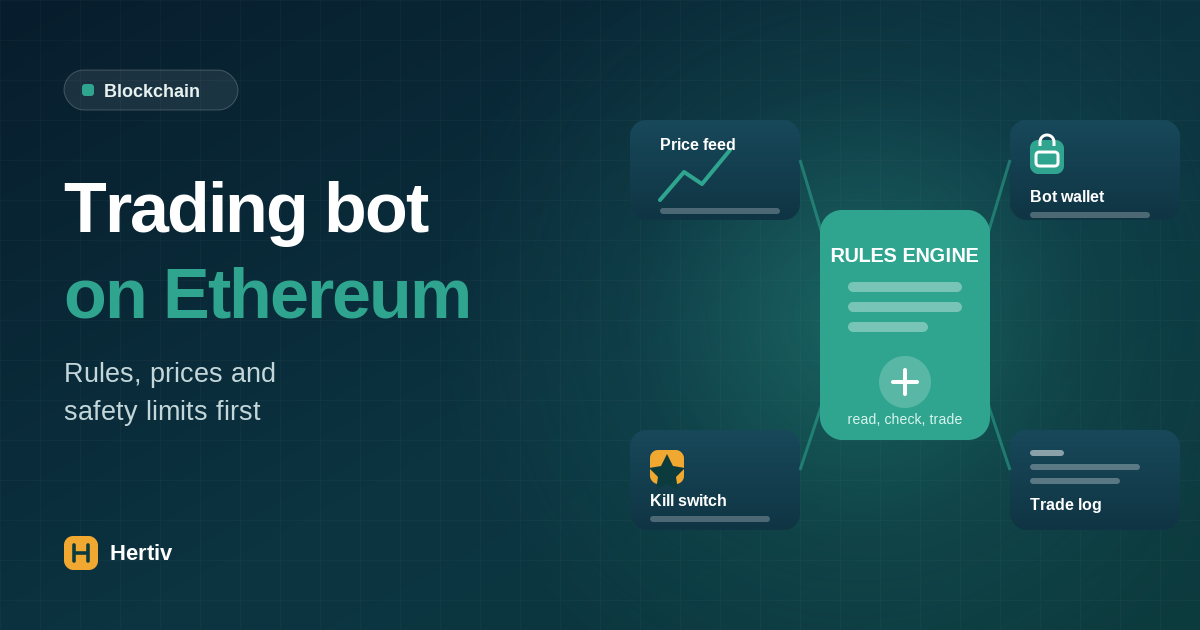
An Ethereum trading bot works in a loop: it reads prices, checks its rules, and sends a transaction when a rule is met. The loop repeats every few seconds, and each pass takes in fresh prices before deciding anything.
| Strategy | How it trades | Main risk |
|---|---|---|
| Market making | Quotes buy and sell prices around the market price | Losing money when the price moves fast |
| Trend following | Buys when the price rises, sells when it falls | Buying at the top of a short rally |
| Arbitrage | Buys cheap on one venue, sells dear on another | Gas fees eating the price gap |
| Grid trading | Places buy and sell orders at set price steps | Price leaving the grid range |
| Mean reversion | Buys after a fall, sells after a rise | A fall that keeps falling |
The bot needs a price feed, a way to send transactions, and a record of what it holds. The price feed usually comes from a decentralised exchange or an oracle. The transactions go through a wallet, and the record is the wallet balance plus a log the bot keeps itself.
For the basics of the network itself, see what Ethereum is and how it works.
For how trading venues differ, see decentralised exchanges compared with centralised ones.
What do you need before you build one?
Before you build an Ethereum trading bot you need a strategy written down, a wallet that holds only trading funds, a connection to the network, and a test environment. Skipping any of these is how most first bots lose money.
The strategy should fit on one page: which tokens, what triggers a buy, what triggers a sell, how much each trade risks, and when the bot stops. If you cannot write the rules down, the bot has no rules, and it will trade on noise instead.
The wallet should be a fresh one that holds only the funds you are willing to trade with. Never give a bot the keys to a wallet that holds your savings. The network connection usually comes from a node provider, which gives the bot an endpoint to read prices and send transactions. For the build itself, see Ethereum development on mainnet and L2s.
The test environment is a testnet or a paper-trading mode, where the bot trades with fake funds. Every bot should run there for at least a week, through calm and choppy prices, before it touches real funds.
How to build an Ethereum trading bot, step by step
Building an Ethereum trading bot takes a team through seven steps, from the strategy to the first live trade. The safety work comes early, because a bot that can move money needs limits before it needs speed.
- Write the strategy down. Name the tokens, the buy and sell rules, the size of each trade, and the point where the bot stops for the day.
- Pick the venue. Choose where the bot trades, such as a decentralised exchange with deep liquidity for your tokens, and check its fees and slippage.
- Set up the wallet. Create a fresh wallet for the bot, fund it with trading money only, and store its key in a secrets manager, never in the code.
- Connect to the network. Use a node provider endpoint to read prices and send transactions, and add a fallback endpoint in case the first one fails.
- Write the trading loop. Code the read-check-trade loop, with a pause between passes and a log entry for every decision the bot makes.
- Add the safety limits. Cap the size of each trade, cap the daily loss, and add a kill switch that stops the bot with one command.
- Test, then go live small. Run the bot on a testnet for a week, fix what breaks, then start live with a small amount and raise it slowly.
The kill switch matters more than any strategy. A bot that is losing money and cannot be stopped is worse than no bot at all, so test the stop command before the first live trade.
How to keep a trading bot safe
Keeping a trading bot safe means limiting what it can do and watching what it does. A bot with no limits and no watch is a risk, however good its strategy is.
Key safety starts with the wallet. The bot wallet should hold only trading funds, and the key should live in a secrets manager or a hardware-backed store, never in a file the code can read by accident. If the bot only needs to trade one token pair, give it approval for that pair only, not for your whole wallet.
Trade limits are the second layer. A daily loss limit stops the bot after a bad day, a per-trade cap stops one bad trade from taking a large share of the funds, and a slippage limit stops the bot from buying at a price far from the one it expected. For code that touches money, a review helps too; see smart contract audit and security review.
Watching is the third layer. The bot should log every trade, and someone should read the log each day. Set up an alert for the first trade of the day, for any trade larger than the cap, and for any error that stops the loop.
Example (hypothetical): a first week on a testnet
Example (hypothetical): a trader builds a grid bot for a token and runs it on a testnet with a paper balance of 10 ETH. The bot is set to make at most 20 trades in the week, buying and selling 0.1 ETH at a time.
By the end of the week the bot has made 20 trades. Twelve of them win 0.02 ETH each, which is 12 x 0.02 = 0.24 ETH gained. Eight of them lose 0.02 ETH each, which is 8 x 0.02 = 0.16 ETH lost. The trading gain is 0.24 - 0.16 = 0.08 ETH.
Gas costs 0.002 ETH per trade, so 20 trades cost 20 x 0.002 = 0.04 ETH. The net result is 0.08 - 0.04 = 0.04 ETH on a 10 ETH balance, or 0.4% for the week. The trader notes that gas took half the gross gain, so the bot needs fewer, larger trades or a cheaper venue before it goes live.
The lesson is to measure the net result after gas, not the gross gain. A bot that looks profitable before fees can lose money after them, and the testnet week is where that shows up for free.
What are the common mistakes?
The most common mistakes people make with an Ethereum trading bot are trading with the wrong wallet, skipping the testnet, and trusting a strategy that was never written down.
- Using the main wallet. A bot with the keys to a wallet that holds savings can drain it. Use a fresh wallet with trading funds only.
- Skipping the testnet. A bot that has never run through choppy prices will meet them for the first time with real money. Test for at least a week.
- No written strategy. A bot built from a vague idea trades on noise. Write the rules on one page first.
- Ignoring gas. On Ethereum, gas is part of every trade. A strategy that works on paper can fail once gas is counted.
- No kill switch. A bot that cannot be stopped in one command will keep trading while you look for the off switch.
- Trusting backtests alone. A strategy that won in the past may fail in the present. Treat a backtest as a hint, not a promise.
Key takeaways
- An Ethereum trading bot follows rules you write, not hunches
- The wallet should hold trading funds only, never savings
- Gas is part of every trade, so measure profit after fees
- A kill switch and a daily loss limit come before going live
- Test on a testnet for at least a week before real funds
Frequently asked questions
What is an Ethereum trading bot?
An Ethereum trading bot is software that trades tokens on Ethereum by itself, following rules you set in advance. It reads prices, checks its rules, and sends transactions to buy or sell, so it can act while you are away.
Do I need to know how to code to build one?
Yes, for a bot you build yourself. You need to write the trading loop, connect to a node provider, and handle wallet keys safely. No-code bot platforms exist, but they still need a written strategy and limits.
How much money do I need to start?
Start with an amount you can afford to lose, and test on a testnet first. Gas fees and slippage take a larger share of small trades, so very small funds leave little room for profit after costs.
Can a trading bot guarantee a profit?
No. A bot follows rules, and rules can lose money when the market changes. Backtests show how a strategy would have done in the past, not how it will do next week.
What is the biggest risk with a trading bot?
A leaked wallet key or a bug that sends bad trades. Keep the bot wallet separate, store keys in a secrets manager, cap trade sizes, and set a daily loss limit.
Should I run a bot on mainnet or a testnet first?
Always start on a testnet or in paper-trading mode. Run it for at least a week through calm and choppy prices, fix what breaks, then go live with a small amount.


