DEX vs CEX: How They Differ and Which to Use
A DEX lets you trade from your own wallet, while a CEX holds your funds and matches trades for you. The difference is custody, and it shapes fees, speed and risk.
On this page
Short answer
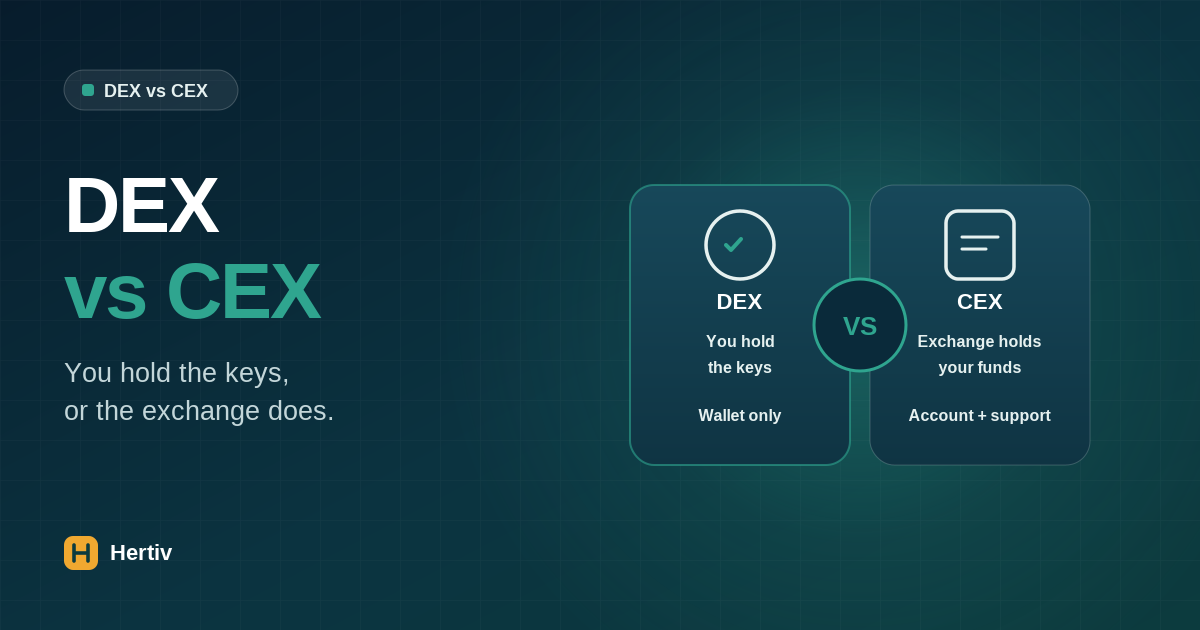
The difference between a DEX and a CEX is custody. On a decentralized exchange, you trade from your own wallet and keep control of your funds, settled by smart contracts. On a centralized exchange, the company holds your funds, matches orders and handles support and fiat payments. A DEX gives you control but no help if you make a mistake, while a CEX is easier but adds counterparty risk.
What is the difference between a DEX and a CEX?
The difference between a DEX and a CEX is who holds your funds when you trade. A DEX, or decentralized exchange, lets you trade directly from your own wallet, with smart contracts settling each trade. A CEX, or centralized exchange, holds your funds in its own accounts and matches your orders on its own systems.
On a DEX, you connect a wallet, approve a trade and keep your assets until the moment of the swap. On a CEX, you deposit funds first, trade against the exchange's order book, and withdraw when you are done. The trade itself may look similar, but the custody, the risk and the help available are very different.
Neither model is better for everyone. A DEX suits people who value control and privacy and can manage their own wallet. A CEX suits people who want fiat payments, customer support and a familiar trading screen. Most active traders use both, for different jobs.
What is a DEX?
A DEX is a decentralized exchange: a set of smart contracts that lets people trade crypto without handing funds to a company. Instead of an order book run by one firm, most DEXs use liquidity pools, where users deposit pairs of assets and traders swap against the pool.
To use a DEX you need a wallet and the network's native token for fees. You connect the wallet, pick the assets to swap, check the price and slippage, and confirm. The contract executes the swap and the new asset lands in your wallet. There is no account, no password and no support desk.
DEXs list new tokens fast, because anyone can create a pool, and they work around the clock without a company in the middle. The trade-off is that you are responsible for your wallet, your approvals and your mistakes. A short guide to what is a DEX covers the main designs and how liquidity pools work.
What is a CEX?
A CEX is a centralized exchange: a company that runs a trading platform, holds customer funds and matches buy and sell orders. You create an account, complete identity checks, deposit money or crypto, and trade on the exchange's order book.
The company sets the rules, runs the matching engine, stores the funds and handles support. If you forget a password or a deposit goes missing, you can contact support. The exchange also handles fiat payments, so you can buy crypto with a card or bank transfer and sell back to cash.
That convenience comes with counterparty risk: your funds sit with the company, and if it fails, is hacked or freezes withdrawals, your money is at risk. Regulators in many countries now require CEXs to hold licences, keep reserves and publish audits, which reduces but does not remove the risk.
DEX vs CEX: the key differences
The table below compares a DEX and a CEX on the points that matter most when you choose where to trade. Custody is the first row because it shapes every other row.
| Factor | DEX | CEX |
|---|---|---|
| Custody | You hold your funds | Exchange holds your funds |
| Account needed | No, wallet only | Yes, with identity checks |
| Fiat on-ramp | Usually none | Card and bank transfer |
| Token choice | Very wide, new tokens fast | Curated, slower listings |
| Fees | Network fee plus swap fee | Trading fee, often lower |
| Speed | Block time per trade | Near instant off-chain |
| Support | None, you are on your own | Support desk and recovery |
| Main risk | Wallet mistakes, bad contracts | Exchange failure or freeze |
Fees deserve a closer look. A DEX charges a network fee for each trade plus a swap fee to the liquidity pool, and the network fee can be high when the chain is busy. A CEX usually charges a smaller trading fee and no network fee until you withdraw. For small, frequent trades a CEX is often cheaper; for large trades the difference narrows.
Which is safer: a DEX or a CEX?
Which is safer depends on what you are afraid of. A DEX removes the risk that an exchange fails or freezes your funds, but it adds the risk that you lose your keys, approve a bad contract or fall for a fake token. A CEX removes the wallet risk but adds the risk that the company itself is the problem.
On a DEX, the main protections are your own habits: keep your seed phrase offline, check contract addresses, set a slippage limit, and never approve unlimited spending for a contract you do not know. A liquidity pool also carries its own risks, which a guide to what is a liquidity pool explains in plain terms.
On a CEX, the protections are the company's: licences, audits, cold storage and insurance where offered. Check whether the exchange publishes proof of reserves, holds a licence in your country and has a clear record on withdrawals. No exchange is risk-free, so many traders keep only trading funds on a CEX and move the rest to a wallet they control.
When should you use each one?
Use a CEX when you are buying crypto with fiat, trading often, or learning the basics. The account, the support desk and the familiar screen make the first steps far easier, and withdrawing to your own wallet later is simple.
Use a DEX when you want a token the CEX does not list, when you want to keep custody of your funds, or when you are using DeFi products such as lending and staking that only work on-chain. A DEX is also the only option when no licensed CEX serves your country.
Many traders split the job: buy on a CEX, move funds to a wallet, then use a DEX for tokens and DeFi. The split keeps the easy on-ramp and the control of self-custody, at the cost of one extra transfer and its fee. If you are building an exchange rather than using one, a guide to how to build a DEX covers the design choices involved.
Example (hypothetical): trading $5,000 on each
Example (hypothetical): a trader has $5,000 and wants to buy a token. On a CEX, they deposit $5,000 by bank transfer, pay no deposit fee, and buy the token at a 0.1% trading fee, which is $5. The token sits in the exchange account, and withdrawing it to a wallet costs a $10 network fee, so the total cost is $15.
On a DEX, the trader already holds $5,000 in stablecoins in a wallet. The swap charges a 0.3% pool fee, which is $15, plus a network fee of $8 while the chain is busy, so the total cost is $23. The token lands in the wallet at once, with no withdrawal step.
The CEX is $8 cheaper in this example, but the comparison changes with the token and the day. If the token is not listed on the CEX, the DEX is the only option. If the network is quiet, the DEX network fee may fall to $1, making the DEX cheaper overall. Cost is a reason to compare, not a reason to pick one model for every trade.
What are the common mistakes?
The most common mistakes are leaving large sums on a CEX, approving unlimited spending on a DEX, and trading a token without checking it first.
- Leaving everything on a CEX. An exchange is a trading venue, not a vault; move funds you are not trading to a wallet you control.
- Unlimited approvals on a DEX. Approving a contract to spend without limit means a bad contract can drain the wallet; set a limit per trade.
- Buying a fake token. Anyone can create a token with a familiar name, so check the contract address from a trusted source before swapping.
- Ignoring slippage. A trade on a thin pool can move the price against you; set a slippage limit and check the price before confirming.
- Forgetting the network fee. A small trade on a busy chain can cost more in fees than the trade is worth.
Start with a CEX for your first buys, learn how wallets work with a small amount, and try a DEX only when you understand approvals and fees. If your team is building a trading product, a DEX development partner can scope the custody and liquidity design first.
Key takeaways
- The core difference is custody: a DEX leaves funds in your wallet, a CEX holds them for you
- A CEX is easier for fiat buys, support and frequent trading; a DEX offers wider tokens and self-custody
- DEX costs are network fees plus swap fees; CEX costs are trading fees plus withdrawal fees
- DEX risk is wallet mistakes and bad contracts; CEX risk is the exchange itself failing or freezing funds
- Many traders use both: buy on a CEX, hold in a wallet, trade niche tokens on a DEX
Frequently asked questions
Is a DEX safer than a CEX?
It depends on the risk you mean. A DEX removes exchange failure risk but puts wallet security on you, while a CEX offers support and recovery but holds your funds. Many traders split the difference by trading on a CEX and holding long-term funds in their own wallet.
Can I buy crypto on a DEX with a bank card?
Usually not. Most DEXs only swap crypto for crypto, so you buy crypto on a CEX or an on-ramp first, move it to a wallet, and then use the DEX. Some wallets now bundle a card on-ramp, but the swap itself stays on-chain.
Why are DEX fees sometimes higher than CEX fees?
A DEX trade pays a network fee for the on-chain transaction plus a fee to the liquidity pool, and network fees rise when the chain is busy. A CEX matches trades off-chain, so it charges only a small trading fee until you withdraw.
Do I need an account to use a DEX?
No. A DEX needs only a wallet, so there is no account, password or identity check. That is also why there is no support desk: if you send funds to the wrong address, no one can reverse it.
What is slippage on a DEX?
Slippage is the gap between the price you see and the price you get, caused by the trade moving the pool price. Small trades on deep pools slip little; large trades on thin pools slip more. Set a slippage limit before confirming any swap.
Can a CEX freeze my funds?
Yes. A CEX can freeze withdrawals for compliance checks, technical problems or legal orders, and in a failure you may wait months or lose funds. That is why traders keep only what they plan to trade on an exchange.


