How to Choose a Computer Vision Company That Delivers
Choosing a computer vision company means testing vendors on your own images, checking live deployments and agreeing a pass mark before you sign.
On this page
Short answer
A computer vision company is worth hiring when it can prove accuracy on your own images, in your own setting, with a labelled test set and a clear plan for keeping the system accurate after launch.
How do you choose a computer vision company?
A computer vision company is a vendor that designs, builds and runs software that reads images and video and turns what it sees into decisions, counts, alerts or records. Choosing one means judging whether it can do that job on your images, in your setting, with your data, not whether its demo looks good.
The right choice starts with your own use case. A company that is strong at factory inspection may be weak at retail shelf reading, because the cameras, lighting, object types and failure costs are different. Write down the task, the images you already have, and what a wrong answer costs you before you talk to any vendor.
| What to check | Good sign | Warning sign |
|---|---|---|
| Past work | Live deployments in your setting | Only demos and slide decks |
| Your data | Tests on your images before you sign | Refuses a small paid pilot |
| Accuracy | Measured on a labelled test set | One headline number, no detail |
| Edge cases | Handles poor light and occlusions | Only works on clean lab images |
| Running costs | Clear pricing for cameras and compute | Vague totals, see vendor site |
| Support | Named owner and response times | No plan for when the model drifts |
Use the table as a scorecard in every vendor meeting. If a company cannot show evidence for a row, treat that row as a risk, not as a detail to sort out later. For a broader view of what these systems can do, real-world computer vision examples show the range of tasks that already work in production.
What should the company prove before you sign?
Before you sign, the company should prove it can handle your images, your volume and your failure modes. A sales demo on the vendor's own footage proves nothing about your warehouse, clinic or shop floor.
Ask for three things. First, a reference deployment in a setting like yours, with a contact you can speak to. Second, a test on a sample of your own images, labelled by your team, with the results broken down by the cases that matter to you. Third, a written plan for what happens when accuracy drops after launch, because lighting, stock and camera angles all change over time.
Also check who owns the model and the data. You should keep ownership of your labelled images and be able to take the trained model or its outputs with you if the contract ends. If the vendor keeps both, switching later becomes expensive.
Pricing for the build and for ongoing support should be in writing. Where a figure is not public, the honest answer is to check the vendor site rather than accept a verbal estimate.
How do you test a vendor on your own images?
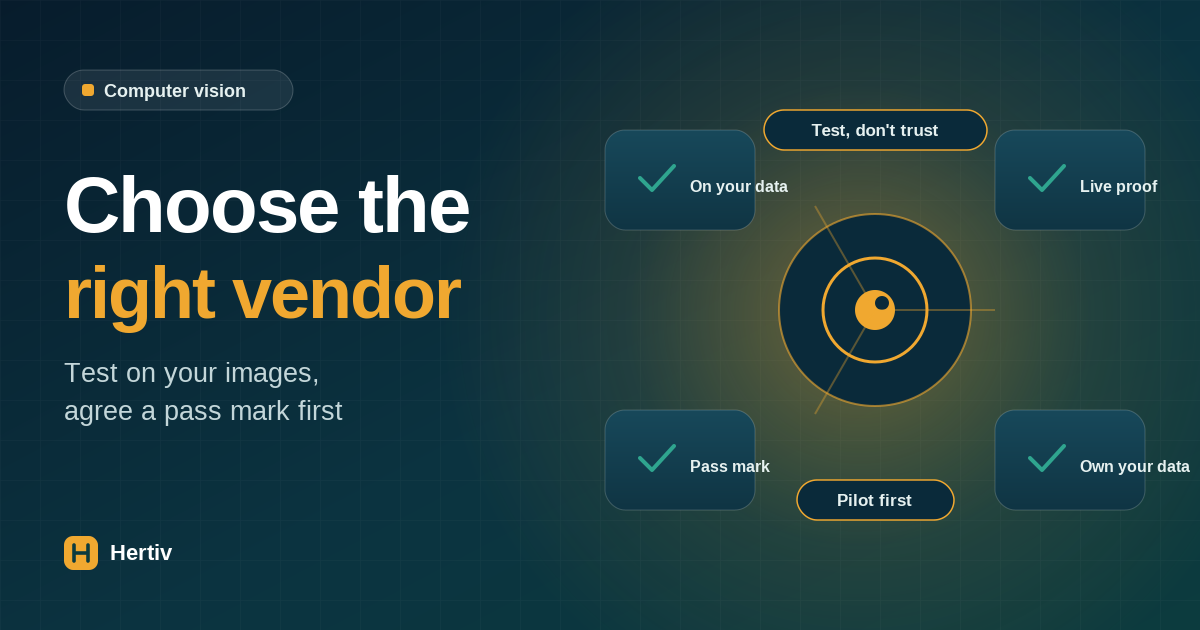
You test a vendor on your own images by running a small paid pilot with a fixed test set and a clear pass mark agreed before the work starts. The pilot should use images from your real setting, not a curated sample.
- Collect a test set. Gather 200 to 500 images that cover normal cases, hard cases and the failures you already know about.
- Label the answers. Have your own staff label what the correct answer is for each image, so the vendor cannot grade its own work.
- Agree the pass mark. Write down the accuracy and the error types that matter, for example missed items versus false alarms.
- Run the pilot. Give the vendor the images and a fixed time window, then score the results against your labels.
- Review the failures. Look at every wrong answer together and ask what would fix it: more data, better light, or a different camera angle.
A pilot that takes two to four weeks is normal. A vendor that will not run one is telling you something about its confidence. The same discipline applies to any AI build, which is why how to test AI models is worth reading before you agree the test plan.
What drives the cost of a computer vision project?
The cost of a computer vision project is driven by data preparation, model work, hardware and the effort of keeping the system accurate after launch. The model itself is often the smallest part of the bill.
Data preparation takes the most time. Images must be collected, labelled and checked, and the hard cases are the ones that need the most labels. Hardware is the next driver: cameras, lighting, edge devices and the compute to run the model all add up, and a system that needs real-time answers costs more than one that can wait.
Integration is the third driver. The vision system must talk to your existing software, raise alerts where your staff already work, and log its decisions so failures can be traced. Maintenance is the fourth: models drift as conditions change, so budget for retraining and for someone to watch accuracy month by month. If a vendor quotes a single flat figure with no breakdown, ask for the parts separately before you compare offers.
Example (hypothetical): a warehouse counting pilot
Example (hypothetical): a warehouse team counts pallets by hand. Three staff spend 2 hours each per day, which is 6 hours a day, or 30 hours in a 5-day week. The team wants a camera system to count pallets as forklifts move them.
The pilot uses 300 labelled images from the warehouse floor, including dim corners and stacked pallets. The vendor's model gets 294 of the 300 right, which is 98 in 100. Of the 6 misses, 4 are pallets hidden behind a forklift and 2 are pallets in a dark corner.
The team fixes the two lighting problems with one extra light, which leaves 4 misses in 300, or about 1 in 75. At that rate, a day with 600 pallets would see about 8 miscounts, which the team catches in a daily spot check that takes 20 minutes.
The pilot cost is agreed in advance, the test set belongs to the warehouse, and the contract says the vendor retrains the model if accuracy falls below 95 in 100 on the monthly check.
What are the common mistakes?
The most common mistakes when choosing a computer vision company are trusting a demo, skipping the pilot, and buying hardware before the software is proven.
- Judging by the demo. A polished demo on the vendor's footage says nothing about your lighting, angles and clutter.
- Skipping the labelled test set. Without your own labels, you cannot measure accuracy or compare vendors fairly.
- Buying cameras first. Camera placement and lighting should follow the pilot, not precede it.
- Ignoring the failure modes. A system that is right 98 times in 100 still fails twice in 100, and you need a plan for those two.
- No drift plan. Accuracy falls as conditions change, so the contract must cover retraining and monitoring.
- Unclear data ownership. If the vendor owns your labelled data, leaving later means starting over.
How do you run the first 90 days?
You run the first 90 days by shipping one narrow use case, measuring it every week, and only then deciding whether to expand. A small live system teaches you more than a long selection process.
- Weeks 1 to 2. Finalise the test set, the pass mark and the camera positions from the pilot.
- Weeks 3 to 6. Run the system in parallel with the manual process, and log every disagreement between the two.
- Weeks 7 to 10. Fix the top failure causes, usually lighting, camera angle or missing labels, and re-test.
- Weeks 11 to 13. Decide on expansion using the measured accuracy and the time actually saved, not the sales estimate.
Keep one person responsible for the accuracy numbers through this period. If no one owns the metric, it will not be measured, and the system will quietly drift. A shortlist of firms to compare is a useful starting point, and top computer vision companies lists vendors with live deployments you can check against your own criteria.
Key takeaways
- Test vendors on your own labelled images, not on their demo footage
- Ask for a live reference in a setting like yours before you sign
- Agree a pass mark and failure plan in writing before the pilot
- Budget for data, hardware, integration and retraining, not just the model
- Keep ownership of your labelled data so you can switch vendors later
Frequently asked questions
How much does a computer vision project cost?
There is no standard price, because cost depends on data preparation, hardware, integration and ongoing retraining. Ask each vendor for a written breakdown of those four parts and compare the parts, not a single flat figure.
How long does a pilot take?
A small pilot on your own images usually takes two to four weeks, including labelling the test set and scoring the results. If a vendor needs much longer for a narrow task, ask what is slowing it down.
How many labelled images do I need?
A pilot test set of 200 to 500 images is usually enough to compare vendors and find the main failure modes. Full training sets are larger, and the vendor should tell you how many labels each new case needs.
Can a computer vision system work in poor light?
It can, but only if the pilot includes poor-light images and the camera and lighting setup is designed for them. Systems tested only on clean images often fail in dim corners and at night.
Should I buy cameras before choosing a vendor?
No. Run the pilot first with borrowed or rented cameras, then buy the setup the pilot proves you need. Buying hardware first often locks you into the wrong angles and lenses.
What happens when accuracy drops after launch?
Accuracy drops as lighting, stock and layouts change, so the contract should cover regular checks and retraining. Agree a threshold, such as 95 in 100 on a monthly check, and what the vendor does when it is missed.


