How to Build a DEX Like WardenSwap, Step by Step
WardenSwap is a DEX aggregator on BNB Chain that routes trades across pools for a better price. Here is how to build one like it, from routing to launch.
On this page
Short answer
A DEX like WardenSwap is a decentralised exchange aggregator that compares prices across many liquidity pools and routes each trade to the best path, sometimes splitting it across pools. To build one, you need a routing engine, pool data, a smart contract for swaps, a wallet connection, and a clear fee and safety model, all running on a low-fee chain such as BNB Chain.
What is a DEX like WardenSwap?
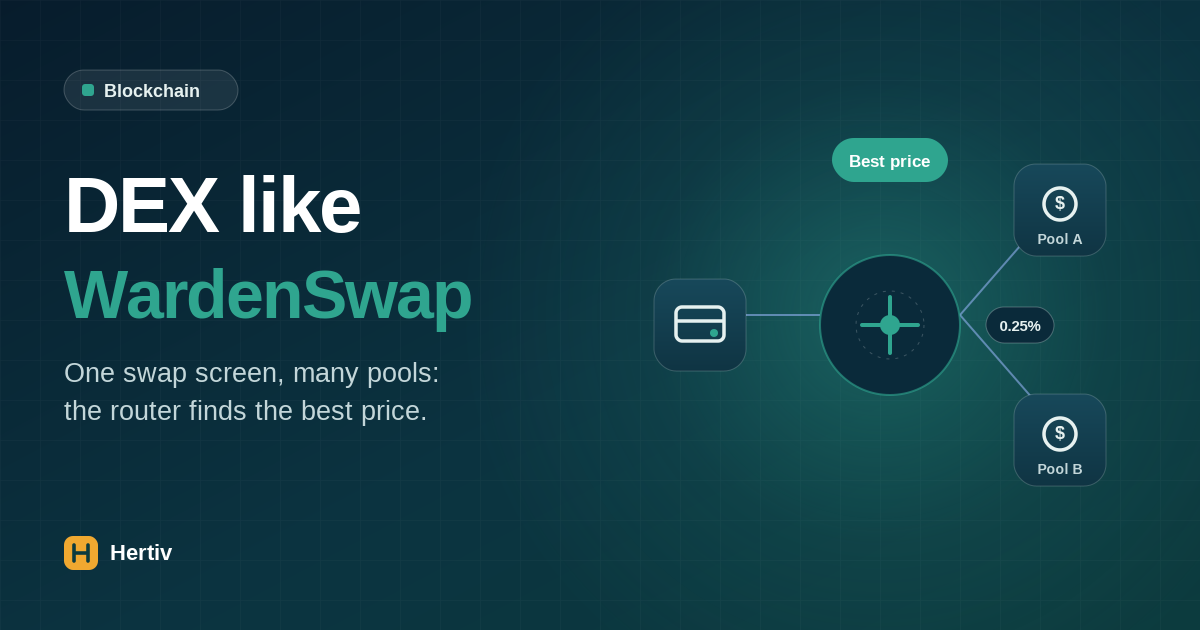
A DEX like WardenSwap is a decentralised exchange aggregator: instead of trading against one pool, it scans many pools across decentralised exchanges and picks the route that gives the trader the most tokens back. The user sees one swap screen, while the aggregator does the price comparison behind it.
WardenSwap runs on BNB Chain, a network known for low fees and fast blocks, which makes frequent routing affordable. It is not a single pool or a single order book. It is a routing layer that sits on top of existing liquidity from automated market makers such as PancakeSwap and other BNB Chain exchanges.
The idea matters because liquidity on any one exchange is limited. A large trade on a small pool moves the price against the trader, a problem called slippage. By splitting a trade across pools, an aggregator can reduce that price impact. For the basics, see what a DEX is.
How does a DEX aggregator find the best price?
A DEX aggregator finds the best price by reading the reserves of many pools, simulating the trade on each route, and comparing the output. It checks direct routes, routes through an intermediate token, and split routes that divide the trade between two or more pools.
The router weighs three costs: the price the trader gets, the swap fee charged by each pool, and the network gas for each step in the route. A route with a slightly worse price can still win if it uses fewer steps and less gas. The router repeats this check for every trade, because pool reserves change with every swap.
Most aggregators also check that the route is still valid at execution time. If the price moves too far between the quote and the swap, the trade fails rather than executing at a bad price. That protection is set by the trader as a slippage limit, usually a small percentage.
What parts does the exchange need?
A DEX like WardenSwap has five main parts, and each one must work before the exchange can take real trades.
| Part | What it does | Notes |
|---|---|---|
| Routing engine | Compares pool prices and builds the best route | Runs off-chain for speed, verified on-chain |
| Swap contract | Executes the trade and moves tokens | Audited; holds no user funds between trades |
| Pool data feed | Reads reserves and prices from exchanges | Indexer or direct chain reads |
| Wallet connection | Lets users sign trades from their own wallet | No accounts or deposits |
| Frontend | Search, quotes, slippage settings and history | Simple swap screen first |
The swap contract is the only part that touches user funds, and it should hold them only for the seconds a trade takes. Everything else is reading data and building routes. That split keeps the attack surface small. A general build guide is how to build a DEX.
How to build a DEX like WardenSwap
You build a DEX like WardenSwap in this order, testing each step on a test network before real funds are involved.
- Pick the chain and pools. Start on BNB Chain and list the largest pools for the tokens you will support.
- Build the price feed. Index pool reserves and prices so the router can compare routes in milliseconds.
- Write the router. Code the logic that simulates direct, intermediate and split routes and picks the best output.
- Write and audit the swap contract. The contract takes tokens, executes the route, and returns the output in one transaction.
- Connect wallets. Add wallet support so users sign trades themselves and keep custody of their funds.
- Build the swap screen. Keep it to token choice, amount, quote, slippage setting and a clear fee line.
- Test on testnet, then launch small. Run the full flow with test tokens, fix what breaks, then open with a few pairs.
Keep the first version small: one chain, a handful of pools and a simple swap screen. Extra chains and features can wait until the core route works. The Polygon build shows the same pattern on another chain: how to build a DEX on Polygon.
How do liquidity and fees work?
An aggregator does not need its own liquidity, because it borrows liquidity from the pools it routes through. That is its main advantage over a new standalone exchange, which must attract liquidity providers from nothing.
Fees come from two places: the swap fee of each pool on the route, and the network gas for the transaction. Pool fees on BNB Chain exchanges are commonly a fraction of a percent per swap, and gas is usually a few cents, which is why routing is practical there.
Your own fee, if you charge one, is usually a small share of the trade or a fixed part of the pool fee, and it must be shown before the user confirms.
Slippage is the other cost. A trade that is large next to a pool's reserves moves the price, so the router splits it or picks a deeper pool. A DEX versus a centralised exchange comparison explains why these costs differ from exchange fees.
Example: a first trade through your aggregator
Example (hypothetical): a trader wants to swap 2,000 USDC for BNB on your aggregator. The router finds two routes: a direct pool with 200,000 USDC of liquidity, and a split route across two pools.
On the direct route, the pool charges a 0.25% fee, which is 5 USDC on a 2,000 USDC trade, leaving 1,995 USDC to buy BNB. At a pool price of 2,000 USDC per BNB, that buys about 0.9975 BNB before price impact. The split route returns 0.9981 BNB, so the router picks the split and the trader gains about 0.0006 BNB, a small but real improvement.
The numbers are small on one trade, but they add up across thousands of trades a day. That is the whole case for an aggregator: it earns its place by finding the better route every time, not by holding the trader's funds.
What are the common mistakes?
The most common mistakes in building a DEX aggregator are trusting unaudited routing contracts, ignoring slippage, and launching with too few pools to route through.
- Skipping the audit. A routing contract moves user funds, so it needs a professional audit before mainnet.
- Routing through one pool. With a single source, there is no price comparison and no reason to use the aggregator.
- Ignoring failed trades. Quotes go stale fast, so handle failed swaps with a clear message and a fresh quote.
- Hiding fees. If the fee is not visible before confirmation, users will not come back.
- Launching with no support. A stuck swap needs a human answer quickly, or the user moves on.
Key takeaways
- A DEX aggregator routes trades across many pools to find the best price
- WardenSwap-style exchanges run on BNB Chain, where low fees make routing affordable
- The swap contract is the only part that touches user funds, and only during the trade
- Fees come from pool swap fees and network gas, plus any fee you charge
- Launch small on testnet first, with one chain and a few pools
- An audit, honest fees and slippage protection are what keep users coming back
Frequently asked questions
Do I need my own liquidity to build a DEX aggregator?
No. An aggregator routes through existing pools on other exchanges, so it does not need its own liquidity providers. That is the main advantage over a standalone exchange, which must attract liquidity from nothing before it can offer good prices.
How is a DEX aggregator different from a normal DEX?
A normal DEX trades against its own pools, while an aggregator compares prices across many pools and exchanges, then routes each trade to the best path. The user sees one swap screen, and the aggregator does the comparison behind it.
Why build on BNB Chain?
BNB Chain has low transaction fees and fast blocks, which makes it cheap to simulate routes and execute multi-step swaps. Those low costs matter for an aggregator, because every extra step in a route adds gas. Other low-fee chains can work too.
What does the swap contract do?
The swap contract takes the trader's tokens, executes each step of the route in one transaction, and returns the output to the trader. It holds funds only for the seconds the trade takes, and it should be audited before it handles real funds.
How do aggregators make money?
Most aggregators take a small share of the trade, either as a fixed fee or as part of the pool fee on the route. Some take no fee at all and earn from referrals or related services. Whatever the model, the fee must be shown before the user confirms.
What is slippage in a DEX trade?
Slippage is the gap between the quoted price and the executed price, caused by the trade moving the pool's reserves or by other trades landing first. Aggregators reduce it by splitting trades across pools, and traders set a slippage limit so a trade fails rather than executing at a bad price.


