How to Build an AI Team That Actually Ships
An AI team needs more than data scientists: product sense, engineering, data and design. Here is how to hire, structure and run a team that ships working AI.
On this page
Short answer
Building an AI team means hiring or growing the roles that take a model from an idea to a working product: data scientists, machine learning engineers, data engineers, a product manager and a designer. The team also needs clear ownership, clean data and a way to test and deploy models, or the work stays in notebooks, so start small with one product and grow around what ships.
What is an AI team?
An AI team is a small group of people with the combined skills to take an AI idea from a problem statement to a working product: someone who understands the data, someone who builds the model, someone who ships it, and someone who owns the product decision.
The most common failure in AI is not the model, it is the team shape. A group of data scientists without an engineer will build models that never reach users. A group of engineers without a data scientist will build a product that uses AI badly. And a team without a product owner will build impressive demos that nobody asked for.
That is why the team matters more than any single hire. The roles need to fit together, the ownership needs to be clear, and the team needs a real problem to solve, not a mandate to "do AI". A team that ships one useful product teaches the company more than a team that demos ten prototypes.
The size is smaller than most companies expect. A team of five or six people with the right mix can ship a first product, and that product is the evidence that justifies growing the team. Starting with twenty people and no product is the expensive way to learn the same lesson.
Which roles does an AI team need?
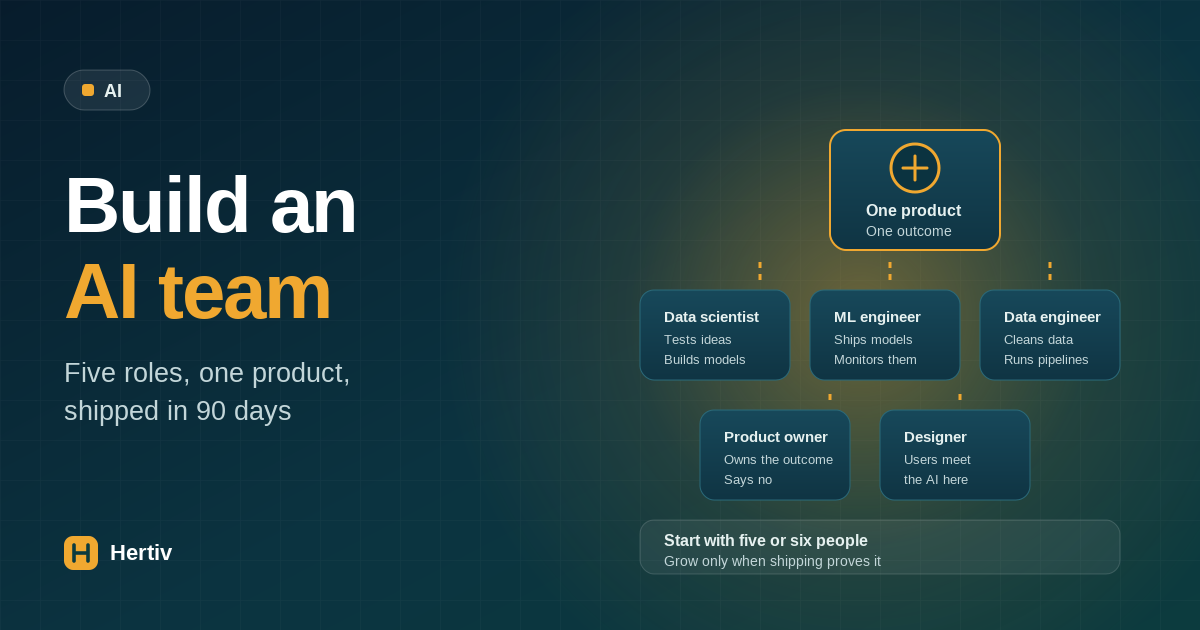
An AI team needs five kinds of skill: data science, machine learning engineering, data engineering, product ownership and design. One person can cover more than one, but no kind can be missing.
| Role | What they do | When you need them |
|---|---|---|
| Data scientist | Tests ideas, builds models, measures results | From day one |
| ML engineer | Ships models, builds pipelines, monitors them | Before the first launch |
| Data engineer | Moves and cleans data, runs the warehouse | As soon as data matters |
| Product manager | Owns the problem, the users and the roadmap | From day one |
| Designer | Designs how users meet the AI | When users see the output |
The product manager is the role teams skip most often, and it is the one they miss most. Without someone who owns the problem and can say no to a clever model that solves nothing, the team drifts towards demos. The designer is the second most skipped, and the result is an AI feature users do not trust or understand.
In a small team, one person may hold two roles, such as a data scientist who also does ML engineering. That works when the product is simple, but it breaks as the product grows, because each role is a full job once the model is live.
Should you hire, train or buy an AI team?
You can hire an AI team, train your own people, or buy the capability from a partner, and the right answer depends on how fast you need to ship and how much AI knowledge you need to keep.
Hiring is the slowest route and the most lasting. It takes months to find good people, and longer for them to learn your product and data, but the knowledge stays in the company. It fits companies that plan to build AI products for years.
Training your own people is cheaper and faster than hiring, and it works when you already have strong engineers and analysts. An engineer who learns ML engineering, or an analyst who learns data science, brings product knowledge a new hire cannot match. The trade-off is time: learning takes months, and the first projects will be slower.
Buying from a partner is the fastest route to a first product. A partner team can ship in weeks what a new hire would take months to start, and it brings patterns from other projects. The trade-off is that the knowledge leaves with the partner unless your own people work alongside them, so pair every partner with an internal owner.
For hiring help, see hiring AI engineers.
For outside help, AI consulting usually starts with a small product, not a large team.
How do you build an AI team step by step?
You build an AI team by starting with one product and one problem, hiring the smallest team that can ship it, and growing only when the product proves itself.
- Pick the problem. Choose one product and one measurable outcome, such as cutting support time or improving a search, and write it down in one sentence.
- Name the owner. Put one product manager in charge of the outcome, with the authority to say no to work that does not serve it.
- Hire the core three. Start with a data scientist, an ML engineer and a data engineer, or the closest mix your company already has.
- Fix the data first. Give the team a few weeks to check the data: is it labelled, is it clean, does it cover the cases the product must handle?
- Ship a small version. Put a simple model in front of real users within weeks, even if it only handles part of the problem.
- Measure and learn. Track whether the outcome moved, and whether users trust the result, then decide what to improve next.
- Grow around what ships. Add roles only when a missing skill is blocking the next release, not because the plan says so.
The order matters. Teams that hire first and pick a problem later spend months looking for work, while teams that pick a problem first hire with a clear brief. For how to check whether a model is ready, see how to test AI models.
Example (hypothetical): a six-person team ships in three months
Example (hypothetical): a mid-size retailer wants an AI assistant that answers routine support questions. The team is one product manager, one data scientist, one ML engineer, one data engineer, one designer and one support specialist who knows the questions customers actually ask.
In the first month, the team checks the data: 2,000 past support chats, of which 1,200 have clear answers and 800 are messy or out of date. They clean the 1,200 and set the rest aside, which gives the model a solid base to learn from.
In the second month, the data scientist builds a first version that drafts answers, and the ML engineer puts it behind an internal tool where support staff can check each draft before it goes to a customer. The designer builds the review screen, and the support specialist tests it on real chats.
In the third month, the team ships to a small group of customers. The assistant drafts answers for 200 questions a week, staff approve about 150 of them, and the rest go back to humans. That is 3 out of 4 drafts accepted, which is enough to keep going, and the team now knows exactly what to improve next. The numbers are invented to show the arithmetic, not a real result.
What are the common mistakes?
The most common mistakes in building an AI team are hiring for credentials instead of fit, skipping the product owner, and growing the team before the first product ships.
- Hiring for credentials alone. A long publication list does not mean someone can ship a product, and a strong engineer with product sense often beats a famous researcher.
- No product owner. Without someone who owns the outcome, the team builds what is interesting instead of what is useful.
- Growing before shipping. A team of twenty with no product is slower than a team of six with one, because coordination replaces delivery.
- Skipping data work. Models need clean, labelled data, and a team that starts modelling before the data is ready will rebuild its work.
- Measuring demos, not outcomes. A good demo proves the model runs; it does not prove users want it or that it saves time.
Most of these mistakes come from treating AI as a hiring problem rather than a product problem. The team is the means, and the product is the end, so judge the team by what ships, not by who is on it.
What should the first 90 days look like?
The first 90 days of an AI team should end with a small product in front of real users, not with a plan, a hire or a demo.
The first month is for the problem and the data. The team picks one outcome, checks the data that exists, and writes down what success looks like in numbers a non-technical person can understand. If the data is not there, the team says so early, before anyone has built a model.
The second month is for the first version. A simple model, a simple interface, and a way for users to check the result. The team should resist the urge to build the full product, because the full product is built from what the first version teaches.
The third month is for users. The team ships to a small group, watches how they use it, and fixes the worst problems first. At the end of 90 days, the team should be able to say what the product does, who uses it, and what it will do next.
If it cannot, the problem was wrong, the team was wrong, or the data was wrong, and any of those is cheaper to learn in 90 days than in a year. For how agents fit into a team, see AI agent use cases.
Key takeaways
- An AI team needs data science, ML engineering, data engineering, product and design
- The product owner is the role teams skip most and miss most
- Start with one product and one problem, and grow only when it ships
- Fix the data before you build the model, or you will rebuild the work
- Judge the team by what ships in 90 days, not by demos or headcount
Frequently asked questions
How many people do you need for an AI team?
A first team of five or six people with the right mix can ship a real product. One data scientist, one ML engineer, one data engineer, one product manager and one designer, plus a domain expert from the business, is a common starting shape. Grow only when a missing skill blocks the next release.
Do I need a PhD on my AI team?
Usually not. Most product AI work needs strong engineering, good data practice and product sense, not research. A PhD helps for hard research problems, but for most products a data scientist with shipping experience is more useful than a researcher without it.
Should the AI team sit in engineering or in the business?
It should sit close to the product it serves, with a clear owner, rather than in a separate lab. Teams that sit far from users build demos; teams that sit with the product build things people use. A small central team can share patterns, but the product team owns the outcome.
How do you keep AI talent once you hire them?
Give them real problems, real users and time to learn. Good AI people leave when they spend months on demos that never ship, or when they have no say in what the team builds. Shipping, ownership and learning matter more than perks.
Can a small company build an AI team?
Yes, by starting small and using partners for the gaps. A team of three or four, plus a partner for the first product, can ship something useful, and the company learns what it needs before it hires more. The mistake is trying to hire a large team before the first product proves itself.
What is the hardest part of building an AI team?
Keeping the team focused on one problem and one product. AI attracts interesting side projects, new models and new tools, and each one pulls the team away from shipping. A strong product owner who can say no is the main defence.


