How Much Does It Cost to Develop an App?
App development cost depends on scope, design, integrations and team setup. Here is what drives the price and how to budget for it.
On this page
Short answer
App development cost is the total price of taking an app from an idea to a working product in users' hands, covering design, building, testing and launch. The price varies widely because no two apps have the same features, and the main drivers are scope, design quality, integrations and who builds it.
What does app development cost cover?
App development cost is the total price of taking an app from an idea to a working product in users' hands, covering design, building, testing and launch. It is not one number: it is the sum of several kinds of work that happen in order.
The work usually breaks into four parts. Design covers screens, flows and how the app feels to use. Building covers the app itself and the server behind it. Testing covers checking that it works on real devices. Launch covers store listings, accounts and the first fixes after release.
Most quotes also include a period of fixes after launch, because the first weeks always surface small problems. Ask what is included in the price, and what counts as extra, before you compare two quotes.
What drives the cost?
Scope drives cost more than anything else. Each feature adds design, building and testing time, and features that look small, such as a chat or a map, can take weeks once the details are counted.
| Driver | How it raises cost | What to do |
|---|---|---|
| Number of features | Each feature needs design, code and tests | Cut the list to the first version |
| Design quality | Custom screens cost more than templates | Use standard patterns where they fit |
| Integrations | Payments, maps and logins each need work | Count each integration separately |
| Platforms | iOS and Android double some work | Start with one platform if you can |
| Team location | Rates differ by market | Compare like-for-like quotes |
Design quality and integrations are the two drivers teams underestimate most. A payment flow is not one feature: it is checkout, refunds, receipts and error handling. Count those parts when you budget, or they will appear later as extra work.
Cost by app type
Simple apps cost less because they have few screens and no server of their own. A booking app, a marketplace or a social app costs more because it needs accounts, payments, search and a server that keeps everything in sync.
| App type | Typical shape | Main cost driver |
|---|---|---|
| Simple content app | Reads and shows content | Design and content |
| Booking app | Accounts, slots, payments | Payments and scheduling |
| Marketplace app | Buyers, sellers, chat, reviews | Two-sided features |
| Social app | Feeds, follows, media, chat | Scale and moderation |
Use the table as a guide to shape, not as a price list. Two booking apps can cost very different amounts if one needs payments and the other does not. The honest way to price your app is to list its features and estimate each one, which is what the example below does.
Team setup and rates
Who builds the app affects the price as much as what it does. An in-house team gives you control but adds hiring and management costs. A freelancer can be cheaper for a small app but may not cover design, testing and launch on their own.
An agency or development partner usually covers the whole job: design, building, testing and launch, with a team that has done it before. That costs more per month than a single freelancer, but the work moves faster and fewer gaps appear between the parts.
Rates also differ by market, and a quote from one region cannot be compared with a quote from another without checking what is included. Compare the hours, the team and the scope, not just the total. For a fuller picture of the service, mobile app development describes what a full team covers.
How to read a quote
A good quote lists the features, the hours for each, and what is included after launch. A quote that only shows a total tells you nothing about what you are buying, and two such quotes cannot be compared fairly.
Check four things in every quote. First, does it list each feature separately, so you can cut one if the price is too high? Second, does it include design and testing, or only building? Third, what happens after launch: how many weeks of fixes are included? Fourth, who owns the code and the accounts?
Ask the team to explain any line you do not understand. A team that cannot explain its own quote will not explain its delays either. If you are still shaping the idea, how to validate an app idea helps you test demand before you spend on a build.
How to plan your budget in five steps
Budgeting is easier when you work from a feature list instead of a single number. The steps below turn a vague idea into a budget you can defend.
- List the features. Write down everything the first version must do, and nothing more.
- Group them by size. Mark each feature small, medium or large, and note the ones that need payments or accounts.
- Ask for an itemised quote. Get hours per feature, so you can cut scope if the total is too high.
- Add a reserve. Keep about 10% of the build cost aside for the fixes and changes that always appear.
- Plan the running cost. Servers, store accounts and support continue after launch, so budget for them too.
The reserve matters most. Almost every app needs changes once real users touch it, and a project with no reserve either stops or goes over budget. A similar cost breakdown for AI apps appears in AI app development cost, which follows the same method.
Example (hypothetical): a first-version booking app
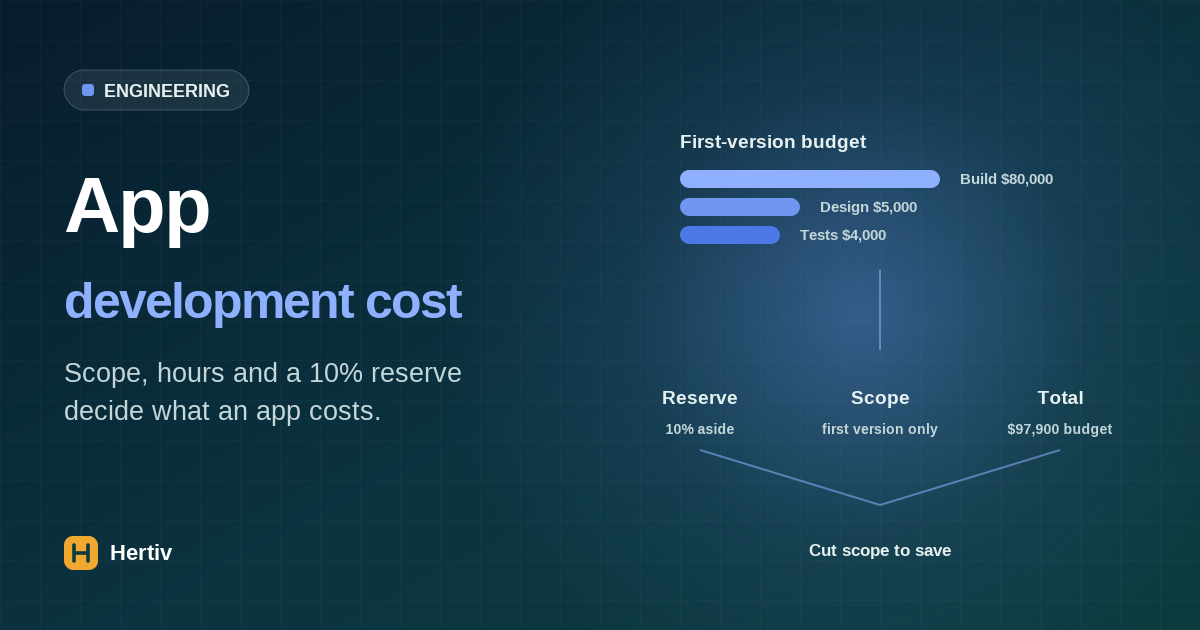
Example (hypothetical): a clinic wants a first-version booking app with accounts, slots, reminders and payments. The team estimates 1,000 hours of work at an assumed rate of $80 an hour, which is 1,000 x 80 = $80,000 for the build.
Design adds $5,000 and testing adds $4,000, so the total is $80,000 + $5,000 + $4,000 = $89,000. A 10% reserve adds $8,900, giving a budget of $89,000 + $8,900 = $97,900.
The clinic then cuts one feature, a loyalty scheme, from the first version. That saves about 120 hours, or $9,600, and the app still does the job it was built for. The saving comes from cutting scope, which is the one lever that always works.
Common mistakes
The most common mistake is budgeting for the app you imagine, not the one you will launch. Extra features feel free in a meeting and expensive in a quote. Write the first-version list, freeze it, and put the rest on a later list.
Another mistake is comparing quotes by total alone. A cheap quote that leaves out testing and launch fixes is not cheaper: it just moves the cost to later, when it is harder to control. Compare itemised quotes, line by line.
Teams also forget the running cost. Servers, store accounts, payment fees and support continue after launch, and a product that cannot pay for those will stall. Budget for the first year of running, not just the build.
- Scope creep: features added after the quote was agreed.
- Total-only quotes: no way to see what is included or cut.
- No running budget: the app launches, then stalls for lack of upkeep.
Key takeaways
- App cost is the sum of design, building, testing and launch, not one number.
- Scope drives cost most: each feature adds design, code and tests.
- Compare itemised quotes by hours and features, never by total alone.
- Keep about 10% aside as a reserve for fixes and changes after launch.
- Budget for the first year of running costs, not just the build.
Frequently asked questions
How much does a simple app cost to develop?
There is no single price, because cost depends on features, design, platforms and team. A simple content app with few screens costs far less than a marketplace with payments, chat and two user types. The honest way to price yours is to list the first-version features and get an itemised quote for each one.
What is the cheapest way to build an app?
Cut scope, not quality. Launch one platform with the few features that prove the idea, use standard design patterns, and add the rest later. A small first version that real users try is cheaper than a large app that takes a year to build.
Does building for iOS and Android double the cost?
Not quite double, but it adds real work. Design, testing and store work repeat for each platform, while some server work is shared. Starting with one platform, or using a shared codebase, keeps the first version affordable.
What should be in an app development quote?
A good quote lists each feature with its hours, covers design and testing, states how many weeks of fixes are included after launch, and says who owns the code and accounts. A quote that shows only a total cannot be compared fairly with another.
How much should I keep aside as a reserve?
About 10% of the build cost is a common reserve for fixes and small changes after launch. Real users always surface issues that testing missed, and a reserve means those fixes happen without a new round of funding.
What costs continue after the app launches?
Servers and hosting, store accounts, payment fees, updates for new phone versions, and support. These running costs are smaller than the build, but they never stop, so budget for at least the first year before you launch.


