How Long Does It Take to Develop an App?
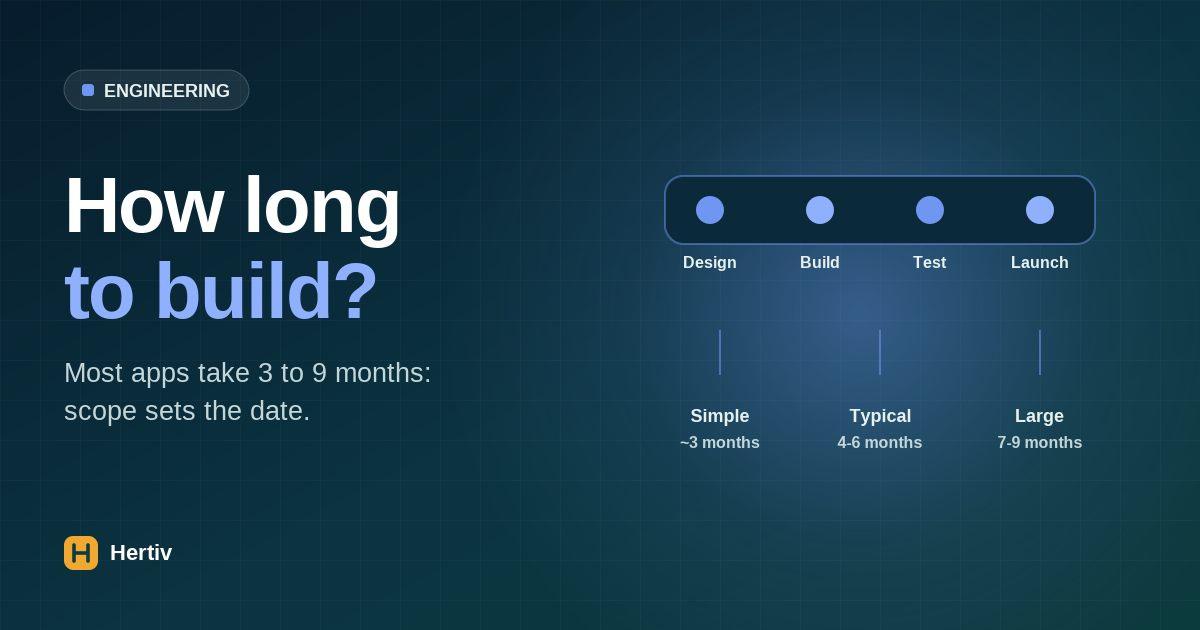
Most apps take 3 to 9 months from first sketch to a store release, with a simple app near 3 months and a feature-rich app closer to 9.
On this page
Short answer
App development time depends on scope, not on the calendar. A simple app with a few screens and one login can reach users in about 3 months. A typical app with payments, accounts and a back office takes 4 to 6 months. A large app with offline mode, chat and several integrations can take 9 months or more, so the honest answer always starts with what the app must do.
How long does it take to develop an app?
App development time is the time from the first agreed scope to a version real users can install, and for most apps that is 3 to 9 months. A simple app with a handful of screens, one login and no payments usually takes around 3 months. A typical app with user accounts, payments, notifications and an admin panel takes 4 to 6 months.
A large app with chat, offline mode and several third-party services can take 9 months or more. The range is wide because the work is not one job but several: design, front-end, back-end, testing and store review. Each one grows with the feature list, and each one can be slowed by unclear decisions.
The table below shows typical timelines by app size, so you can see where your idea sits before you ask for a date. Treat these as planning ranges, not promises, because the same app can take twice as long if the scope keeps changing during the build.
| App size | Typical features | Typical timeline |
|---|---|---|
| Simple | 5 to 8 screens, one login, static content | 2 to 3 months |
| Typical | Accounts, payments, notifications, admin panel | 4 to 6 months |
| Large | Chat, offline mode, maps, several integrations | 7 to 9 months |
| Very large | Multiple user roles, real-time sync, custom back end | 10 to 12 months |
What are the phases of app development?
Every app passes through the same phases, and each one takes a share of the total time. Discovery and design take 2 to 4 weeks: the team agrees the screens, the user flows and what the first version will not include. Development is the longest phase, usually 8 to 20 weeks, split into short builds so the app can be tested as it grows.
Testing runs alongside development and adds 2 to 4 weeks at the end for fixing the issues that only appear on real devices. Store review then takes a few days for most apps, though the first submission can take longer if the store asks for changes. Teams that test early and keep the scope fixed move through these phases faster than teams that add features mid-build.
Discovery deserves more attention than it usually gets. A week spent agreeing the screens and the rules saves several weeks later, because a change made on paper costs far less than a change made in code. Teams that rush discovery often rebuild screens twice, which is why the fastest projects are rarely the ones that start coding first.
What makes an app take longer to build?
Scope is the biggest driver of time. Every extra screen, role and integration adds design, code and testing, and a feature that looks small on a list can hide a week of work. Real-time chat, offline sync and custom payments are common examples: they sound like one feature but touch the design, the back end and the testing plan.
Unclear decisions are the second driver. If the team waits days for an answer on a screen or a rule, the build stalls. A third driver is integrations: connecting to a payment provider, a booking system or an old internal tool can take longer than the app itself if the other side has poor documentation. See how to validate an app idea before you lock the feature list.
How long does an MVP take compared with a full app?
An MVP, the smallest version that real users can try, usually takes 2 to 4 months, while the full app it grows into takes 6 to 12 months. The MVP is faster because it drops the nice-to-have features and keeps only the one job the app must prove. That is why many teams ship an MVP first: they learn what users actually do before they spend months on the rest.
The trade-off is real. An MVP has rough edges by design, and a team that treats it as the finished product will disappoint users. The right way to use it is to plan the next version before the first one ships, so feedback turns into a short list of fixes and additions. Our how to build an MVP guide explains how to pick that first feature set.
How can you shorten the timeline without cutting corners?
The fastest way to shorten a timeline is to shrink the first version, not the testing. Cut features, keep the quality bar. A second lever is to use proven parts: standard login, standard payments and a known back-end stack save weeks compared with building each one from scratch.
- Write the feature list, then mark half of it as version two.
- Agree who decides on design questions, and how fast.
- Use standard login, payments and push notifications.
- Test each build on real devices as soon as it exists.
- Freeze the scope once development starts, and log new ideas for later.
Adding people late rarely helps, because new joiners need time to learn the code. A small team that starts early and keeps the scope fixed usually beats a large team that starts late with a moving target.
Example (hypothetical): a clinic booking app
A clinic wants a booking app with accounts, appointment slots, reminders and payments. The team plans 2 weeks of design, 12 weeks of development and 3 weeks of testing, which adds up to 17 weeks, or about 4 months. The design covers 10 screens, development builds them in three short cycles, and testing checks the booking flow on the phones patients actually use.
Halfway through, the clinic asks for a chat feature. The team prices it at 3 extra weeks and moves it to version two, keeping the 4-month date. If they had added it, the launch would have slipped to about 5 months and the testing would have been squeezed. The lesson is that a date is a trade: every new feature costs time somewhere else.
Common mistakes
The most common mistake is asking for a date before the scope is written down, then treating the guess as a promise. Another is counting only coding time and forgetting design, testing and store review, which together are a third of the work. A third mistake is adding features during the build and expecting the date to hold.
A fourth mistake is skipping testing to hit a deadline, which usually moves the launch anyway, because the store or the first users find the bugs. Plan the date from a written scope, keep a buffer of two weeks, and check progress against the feature list each week. See how much an MVP app costs for the budget side of the same plan.
Key takeaways
- Most apps take 3 to 9 months, with a simple app near 3 months and a large one near 9.
- Design, development, testing and store review all take a share of the total time.
- Scope drives the timeline more than team size does; each feature adds design, code and testing.
- An MVP usually takes 2 to 4 months, while the full app takes 6 to 12 months.
- Cut features for the first version, not testing, and freeze the scope once building starts.
Frequently asked questions
How long does a simple app take to build?
A simple app with 5 to 8 screens, one login and no payments usually takes 2 to 3 months from agreed scope to store release. Design takes about 2 weeks, development about 6 weeks, and testing and store review about 2 weeks.
Does a bigger team build an app faster?
A bigger team can help, but only up to a point. Two or three developers working on a clear scope are often faster than six developers learning the same code base, because coordination and handover take time. Adding people late in a project rarely shortens it.
How long does store review take?
Store review usually takes a few days for most apps. The first submission can take longer if the store asks for changes to permissions, payments or content, so plan at least a week for the first release and test the submission early.
Can I launch in one month?
Only a very small app can launch in a month, such as a single-purpose tool with two or three screens and no accounts. Most apps need design, testing and review time that does not fit in four weeks, so a one-month date usually means a demo, not a release.
What slows an app down the most?
Unclear scope slows apps down the most, followed by late feature additions and slow decisions. Integrations with payment providers or old internal systems are another common delay, especially when their documentation is thin.
Should I build iOS and Android together?
Building both together takes longer than one platform, but less time than building them one after another. If most of your users are on one platform, start there and add the second platform once the first version proves itself.


