How Does Proof of Reserves Work, Step by Step?
Proof of reserves shows that an exchange holds enough assets to cover customer balances. Here is how the snapshot, Merkle tree and attestation fit together.
On this page
Short answer
Proof of reserves is a method an exchange uses to show it holds enough assets to cover what its customers are owed, by combining a snapshot of customer balances with cryptographic proof that it controls the wallets. A Merkle tree lets each customer check their own balance was included, and an independent attestor publishes a report on whether assets covered liabilities at that moment.
What is proof of reserves?
Proof of reserves is a method an exchange or custodian uses to show that it holds enough assets to cover what its customers are owed. It combines a snapshot of customer balances with cryptographic proof that the exchange controls the wallets holding those assets.
The idea is simple: an exchange that holds customer funds should be able to show, at any time, that the assets are actually there. Before proof of reserves became common, customers had to trust the exchange's word. The method replaces that trust with evidence a customer can check.
Proof of reserves does not prove the exchange is solvent. It shows assets at one moment in time, and it does not show the exchange's debts or off-chain obligations. It is one check among several, not a full audit of the business.
For the cost of running attestations, see proof of reserves cost.
What are the building blocks of proof of reserves?
Proof of reserves rests on four parts: a snapshot of customer liabilities, proof that the exchange controls its wallets, a way for each customer to check their own balance, and an independent attestation that ties the parts together.
| Part | What it does | Who checks it |
|---|---|---|
| Liabilities snapshot | Lists every customer balance at one moment | Auditor or attestor |
| Asset proof | Shows the exchange controls the wallets | Anyone who reads the chain |
| Merkle tree | Lets each user verify their balance is included | Each customer |
| Attestation report | States assets exceed liabilities at that moment | Customers and the public |
The snapshot is the part customers never see in full. Balances are private, so the exchange commits to the list with a cryptographic hash instead of publishing names and amounts. The hash lets an auditor confirm the total without revealing individual accounts.
Asset proof is the public part. The exchange signs a message with the private keys of its wallets, or moves a small amount between its own addresses, to show it controls the funds on chain.
How does the Merkle tree check work?
The Merkle tree check lets a single customer confirm their balance is inside the exchange's published total, without seeing anyone else's balance. It is the part that makes proof of reserves checkable by ordinary users rather than only by auditors.
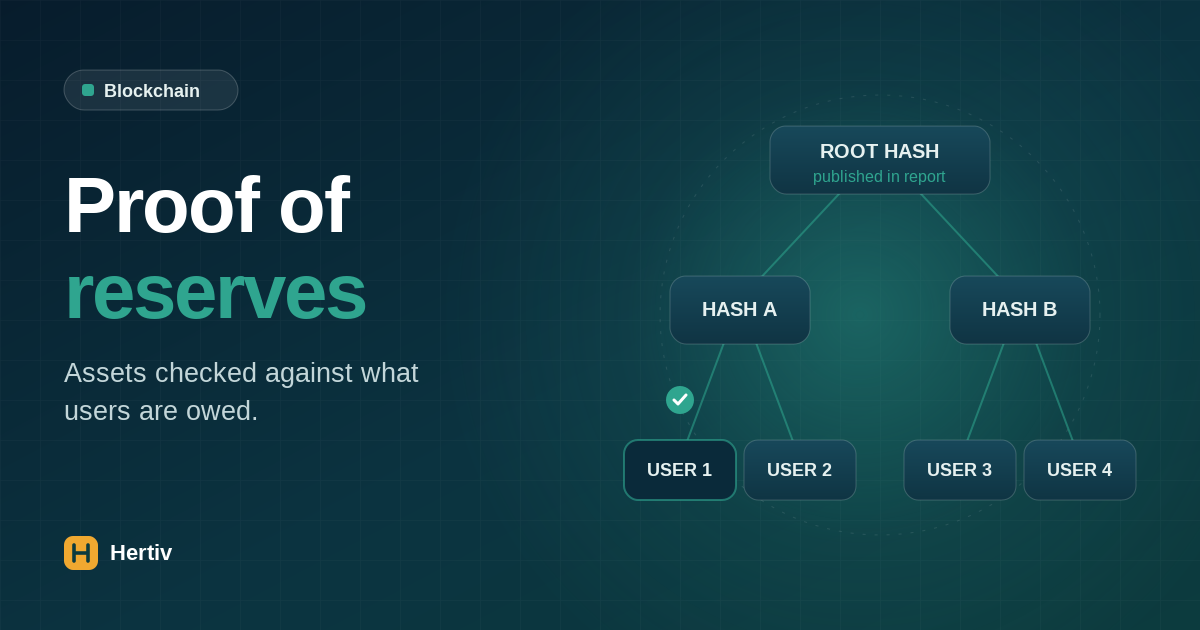
The exchange builds a tree from all customer balances. Each balance becomes a leaf, pairs of leaves are hashed together, and the pairs are hashed again until one root hash remains. The exchange publishes the root hash in its attestation report.
To check, the customer takes their own leaf and the small set of hashes on the path from their leaf to the root, then recomputes the root. If the recomputed root matches the published one, their balance was included in the snapshot.
The check confirms inclusion, not honesty about the total. If the exchange leaves out some customers, those customers will notice when their check fails, but a customer who is included cannot tell whether others were left out. That is why the auditor's check of the full list matters as well.
How does an exchange run a proof of reserves attestation?
An exchange runs a proof of reserves attestation by freezing a snapshot of balances, proving control of its wallets, building the Merkle tree, and handing the results to an independent firm that publishes a report.
- Pick a snapshot time. The exchange fixes a date and time, then records every customer balance as it stood then.
- Prove wallet control. The exchange signs messages with the keys of its hot and cold wallets, or moves funds to show control.
- Build the Merkle tree. Balances are hashed into a tree and the root hash is recorded.
- Hand the data to the attestor. The independent firm checks the snapshot totals, the wallet signatures and the tree.
- Publish the report. The attestor states whether assets covered liabilities at the snapshot time.
- Open the self-check tool. Customers use the exchange's tool to verify their own balance against the root hash.
Most exchanges repeat the process monthly or quarterly. A single attestation says nothing about the days between snapshots, so regular cadence is what makes the practice useful.
Wallet security sits underneath all of this. If the exchange cannot protect its keys, the proof means little, which is why custody design and multisig wallets matter alongside the attestation itself.
What can proof of reserves not prove?
Proof of reserves cannot prove an exchange is solvent, honest about its debts, or safe from a bank run. It shows that assets covered liabilities at one moment, and nothing about what happens before or after that moment.
The biggest gap is liabilities that sit off the balance sheet. An exchange can hold enough coins to cover customer deposits while also owing large sums to lenders or counterparties. Those debts do not appear in a reserves check.
A second gap is timing. An exchange could borrow funds just before the snapshot and return them just after. Regular, unannounced attestations make this harder, but a single scheduled report does not rule it out.
A third gap is the assets themselves. Proof of reserves counts the coins in the exchange's wallets, but it does not judge whether those coins are the ones customers deposited or whether some are pledged elsewhere. Reading the report with these limits in mind is the right way to use it.
Example (hypothetical): an exchange proves its bitcoin reserves
Example (hypothetical): an exchange holds bitcoin for 5,000 customers. At the snapshot time, customer balances total 800 bitcoin. The exchange controls wallets holding 840 bitcoin, so assets exceed liabilities by 40 bitcoin, a ratio of 105 percent.
Each customer gets a leaf in the Merkle tree. One customer with a balance of 2 bitcoin enters their leaf and the path hashes into the exchange's self-check tool, which recomputes the root. The root matches the published root hash, so the customer knows their 2 bitcoin were included in the 800 bitcoin total.
The attestor checks the full list of 5,000 balances, confirms the total is 800 bitcoin, and verifies the signatures on the wallets holding 840 bitcoin. The report states that assets covered liabilities at the snapshot time. It does not state that the exchange has no other debts, and it does not cover the days after the snapshot.
What are the common mistakes?
The most common mistakes are treating proof of reserves as a solvency check, checking it once and never again, and ignoring the attestation report's fine print.
- Reading it as a solvency proof. Assets covering deposits does not mean the business has no debts.
- One attestation, then silence. A single report ages fast; regular cadence is what counts.
- Skipping the self-check. The Merkle tool only helps if customers actually use it.
- Ignoring which assets are counted. Some reports include the exchange's own tokens or illiquid assets at face value.
- Trusting the report without reading it. The attestor's wording shows exactly what was and was not checked.
Key takeaways
- Proof of reserves shows assets at one moment, not solvency
- The Merkle tree lets each customer check their own balance was included
- An attestor confirms the totals and the wallet control
- Off-balance-sheet debts and timing gaps are not covered
- Regular attestations matter more than a single report
Frequently asked questions
How often should proof of reserves run?
Most exchanges run it monthly or quarterly. A single attestation says nothing about the days between snapshots, so a regular cadence is what makes the practice useful, and unannounced runs add extra assurance.
Can a customer check proof of reserves themselves?
Yes, for their own balance. The exchange provides a self-check tool where a customer enters their balance and the path hashes, and the tool recomputes the Merkle root to confirm inclusion.
Does proof of reserves cover all coins an exchange holds?
It covers the wallets the exchange chooses to include in the attestation. The report states which wallets were checked, so read it to see whether any major wallet was left out.
What is the difference between proof of reserves and an audit?
An audit examines the whole business, including debts, controls and financial statements. Proof of reserves is a narrower check: it only compares assets held against customer liabilities at one moment.
Can an exchange fake proof of reserves?
It can borrow funds before a snapshot and return them after, or leave some customers out of the list. Unannounced attestations, independent attestors and customers using the self-check tool all make this harder.
Do proof of reserves reports cover stablecoins and other assets?
They can, but each asset needs its own check. A report that covers bitcoin only says nothing about stablecoin or ether balances, so always check which assets the report lists before drawing conclusions.


