How Does Margin Trading in Crypto Work?
Margin trading lets you trade crypto with borrowed funds, so gains and losses are both larger. Here is how collateral, margin calls and liquidation work.
On this page
Short answer
Margin trading in crypto means borrowing funds from an exchange to open a larger position than your own balance would allow. You put up collateral, the exchange lends the rest, and your profit or loss is calculated on the full position. If the price moves against you far enough, the exchange closes the position to recover its loan.
What is margin trading in crypto?
Margin trading in crypto is trading with borrowed funds, so you open a larger position than your own balance would allow. You put up collateral, the exchange lends the rest, and your profit or loss is calculated on the full position.
The borrowed funds act as a multiplier on the result. A 10 percent price move on a position three times your own money means a 30 percent gain or loss on your collateral, before fees. That is why margin trading can build an account fast and empty it faster.
Margin trading is not investing. It is a short-term trading method that needs active monitoring, because the exchange can close your position if the market moves against you. The rest of this article explains how that works.
Exchanges build these features with care, because a badly designed margin product creates losses that customers blame on the platform. The engineering side is covered in why build a margin trading crypto exchange.
How does a margin trade work, step by step?
A margin trade follows the same steps on most exchanges, and each step has a cost or a risk attached. Understanding the sequence matters more than picking the right coin.
- Deposit collateral into a margin account.
- Choose the pair and the size of the position, including how much you borrow.
- Open the position. The exchange locks your collateral and lends the rest.
- Monitor the position as the price moves; interest accrues on the borrowed funds.
- Close the position, repay the loan plus interest, and keep the remainder.
Interest is charged for as long as the position is open, so a trade held for weeks costs more than the same trade held for a day. Funding rates on some contracts add a second charge that changes with market demand.
Funding charges deserve a closer look. On perpetual contracts, traders on the crowded side pay traders on the other side at set intervals, and the rate flips when sentiment changes. A position that earns funding today can pay funding tomorrow, so the cost is not fixed at the moment you open the trade.
What is the difference between isolated and cross margin?
Isolated margin and cross margin differ in what collateral is at risk. With isolated margin, only the collateral you assign to one position can be lost. With cross margin, your whole margin account balance backs every open position.
| Mode | Collateral at risk | Best for | Main risk |
|---|---|---|---|
| Isolated | One position only | Single trades with a hard limit | Each trade stands alone |
| Cross | Whole account balance | Several positions at once | One bad trade drains all |
Isolated margin suits traders who want a hard limit on each trade. Cross margin suits traders who run several positions and want one to support another, but a single bad trade can drain the whole account.
Beginners should start with isolated margin and small sizes. The comparison with borrowed-funds trading is covered in how margin trading compares with borrowed-funds trading.
What is a margin call, and when does liquidation happen?
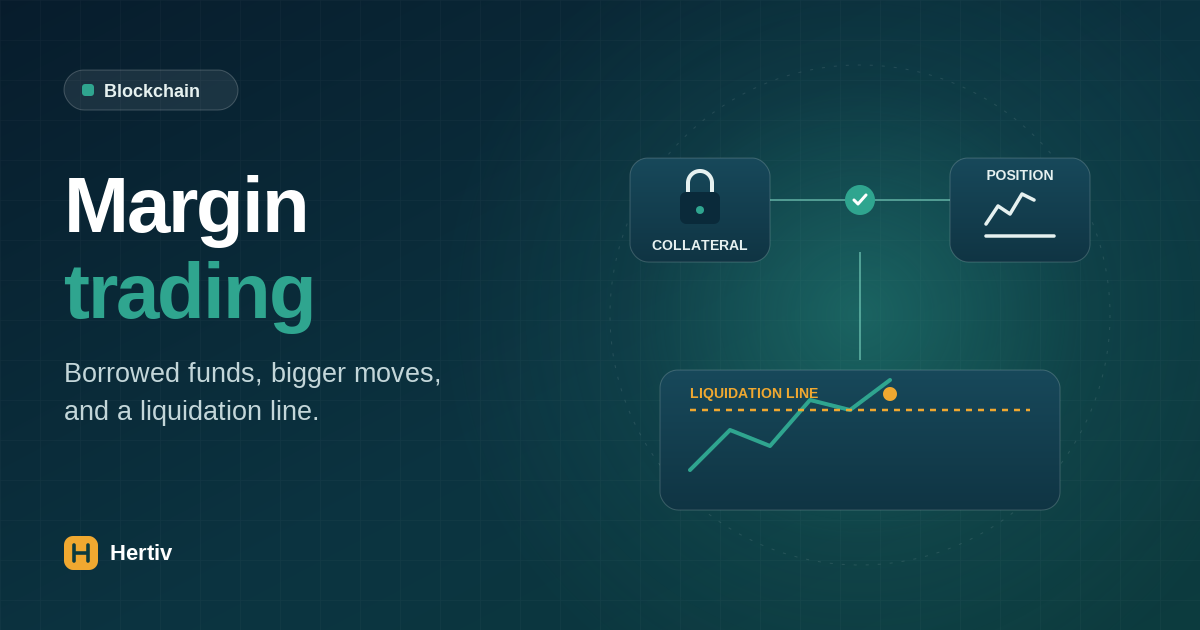
A margin call is a warning that your collateral has fallen close to the minimum the exchange requires. Liquidation is what happens if it falls further: the exchange closes your position automatically to recover the borrowed funds.
The trigger is the maintenance margin, a minimum ratio between your collateral and the borrowed amount. When the price moves against you, your collateral shrinks relative to the loan. Cross the maintenance line and the exchange starts closing the position, usually at the market price.
Liquidation rarely returns your full collateral. The exchange sells at whatever price it can get, charges a liquidation fee, and keeps the remainder of the loan covered first. A stop order can limit the damage, but in a fast-moving market it may fill far from the price you set.
Some exchanges liquidate in parts rather than all at once, closing enough of the position to restore the margin ratio and leaving the rest open. Partial liquidation gives the trader a chance to recover if the price bounces, but it also means the position can be closed in stages while the trader watches. Either way, the trader should know which method the exchange uses before opening a position.
What does margin trading cost?
Margin trading costs interest on the borrowed funds, trading fees on the full position, and sometimes a funding charge that changes with demand. The costs are calculated on the position size, not on your collateral, so they are larger than spot trading fees for the same money.
Interest accrues hourly or daily depending on the exchange, and rates rise when many traders borrow at once. Funding charges apply on some contract types and can flip direction, so a position can earn or pay depending on which side of the market is crowded.
The cost that surprises most traders is the fee on the full position. A 0.1 percent fee on a 30,000 dollar position is 30 dollars, even if your own collateral is only 10,000 dollars. For choosing between margin modes, see which crypto margin mode to choose.
Example: a trade with borrowed funds
Example (hypothetical): a trader has 2,000 dollars and opens a 6,000 dollar long position, borrowing 4,000 dollars from the exchange. The position is three times the trader's own money.
The price rises 5 percent. The position gains 300 dollars, and after 10 dollars of interest and fees the trader keeps 290 dollars, a 14.5 percent gain on the 2,000 dollars of collateral. The same 5 percent move without borrowing would have gained 100 dollars.
If the price falls 5 percent instead, the position loses 300 dollars plus 10 dollars of costs, or 310 dollars, a 15.5 percent loss on the collateral. A fall of about 33 percent would wipe out the 2,000 dollars entirely, before fees.
What are the common mistakes?
The most common margin trading mistakes are sizing the position by hope, ignoring the interest clock, and trading without an exit plan.
- Borrowing the maximum the exchange allows on the first trade.
- Holding a margin position for weeks and letting interest eat the gain.
- Using cross margin without realising one trade can drain the whole account.
- Setting no stop order, or setting one so tight that normal price moves trigger it.
- Adding collateral to a losing trade instead of accepting the loss.
Key takeaways
- Margin trading uses borrowed funds to open a position larger than your own balance
- Gains and losses are calculated on the full position, so both are multiplied
- Isolated margin limits the risk to one position; cross margin risks the whole account
- A margin call warns you; liquidation closes the position to recover the loan
- Interest and fees are charged on the full position, not just your collateral
Frequently asked questions
How much money do you need to start margin trading crypto?
Exchanges set a minimum collateral amount, often low, but the real question is how much you can afford to lose. Start with an amount whose full loss would not hurt your finances, and keep the position small.
Can you lose more than you deposit in margin trading?
On most major exchanges, liquidation closes the position before the loss exceeds your collateral, so losses are usually capped at what you deposited. In extreme market moves, a position can close below zero and leave a debt, though some exchanges cover that gap.
What is the difference between margin trading and spot trading?
Spot trading uses only your own money: you buy the asset and own it. Margin trading borrows funds to open a larger position, so gains and losses are larger, interest accrues, and the exchange can liquidate the position.
Is margin trading crypto legal?
It depends on the country and the exchange. Some jurisdictions restrict or ban retail margin trading, and some exchanges block it by location. Check the rules where you live before opening a margin account.
How do you avoid liquidation in margin trading?
Use small position sizes, keep extra collateral in reserve, set stop orders, and watch the maintenance margin level. No method removes the risk entirely, so only trade with money you can afford to lose.
Does margin trading work for long-term holding?
No. Interest accrues for as long as the position is open, and the risk of liquidation grows with time. Margin trading suits short-term trades; long-term holding is cheaper and safer without borrowed funds.


