Which Crypto Margin Mode Should You Choose: Isolated or Cross?
Isolated margin risks only the funds on one trade; cross margin puts your whole balance behind every position. Here is how to choose between them.
On this page
Short answer
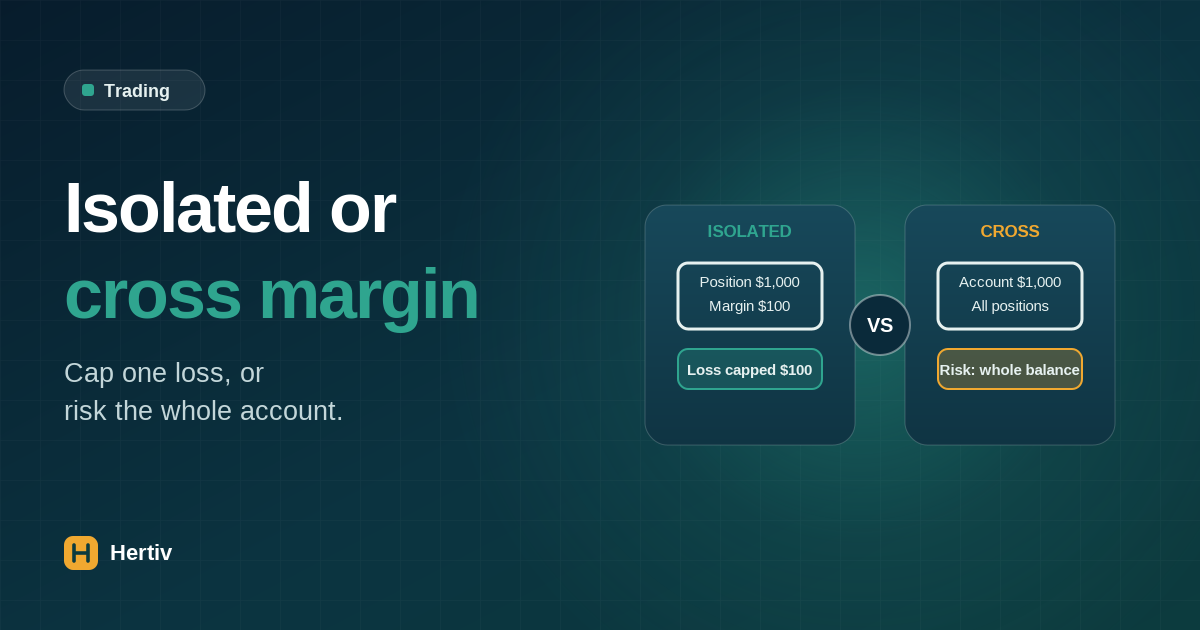
A crypto margin mode is the rule an exchange uses to decide which funds back a trader's borrowed position. The two modes are isolated margin, where one position has its own collateral, and cross margin, where the whole account balance backs every open position.
What are crypto margin modes?
A crypto margin mode is the rule an exchange uses to decide which funds back a trader's borrowed position. The two modes are isolated margin, where one position has its own collateral, and cross margin, where the whole account balance backs every open position.
Margin trading means opening a position larger than the funds you deposit, using borrowed funds from the exchange. The mode decides what happens when the trade moves against you: whether the loss is capped at the funds assigned to that one position, or whether it can draw on everything else in the account.
| Feature | Isolated margin | Cross margin |
|---|---|---|
| Collateral | Funds assigned to one position | Whole account balance |
| Liquidation risk | Only that position closes | Whole account is at risk |
| Loss cap | Limited to the assigned funds | Can reach the full balance |
| Survives a dip | Less likely | More likely |
| Best for | Testing one trade | Hedging several positions |
The mode is a choice you make per position, on most exchanges, and you can switch modes between trades. It does not change the direction of the trade; it changes what a bad move can cost you.
How does isolated margin work?
Isolated margin works by giving each position its own pool of collateral, separate from the rest of the account. If the position is liquidated, the exchange closes only that position and takes only the funds assigned to it, leaving the rest of the balance untouched.
The trade-off is that the position has no backup. A sharp move against it can liquidate it even while the rest of the account sits in cash. Traders use isolated margin when they want a hard limit on what one idea can cost: they decide the maximum loss before opening the trade, assign that amount, and accept that the position may close early.
Isolated margin also keeps positions independent. A loss in one trade cannot eat the funds backing another, which makes it easier to track which ideas worked and which did not. See margin trading vs borrowed-funds trading for how the borrowed part works.
How does cross margin work?
Cross margin works by putting the whole account balance behind every open position. The exchange draws on any free funds in the account to keep a losing position open, so a position that would have been liquidated under isolated margin can survive a dip.
The trade-off is the opposite one: a bad move can now reach everything in the account. If several positions move against you at once, they draw on the same shared balance, and the whole account can be liquidated together. Cross margin is a tool for keeping positions alive, not a safety net.
Traders use cross margin when positions hedge each other, for example a long and a short in related assets, or when they want to avoid a liquidation on a position they expect to recover. It needs more attention than isolated margin, because the balance backing each position changes as other positions move. Learn the contrast in margin trading vs borrowed-funds trading.
Which mode fits which trader?
Which margin mode fits depends on what you are trying to do with the trade and how much of the account you are willing to put at risk. The table below is a starting point, not a rule, and most traders use both modes for different trades.
| Trader | Better mode | Why |
|---|---|---|
| New to margin | Isolated | Loss is capped per trade |
| Testing one idea | Isolated | One idea, one known risk |
| Hedging positions | Cross | Shared balance supports both sides |
| Long-term position | Cross | Survives short dips |
| Many small trades | Isolated | Losses stay separate |
| High conviction, one trade | Isolated | Risk is decided in advance |
A common pattern is to use isolated margin for speculative trades and cross margin for hedges and long-term holds. The decision is per trade, so you do not have to pick one mode for the whole account. If you are building the trading side of a product, crypto exchange development covers how these modes are implemented.
How to choose in 5 steps
You choose a margin mode by working out the worst case for the trade, then picking the mode whose worst case you can accept.
- State the trade. Write down the asset, direction, position size and the price at which you would be wrong.
- Work out the isolated loss. With isolated margin, the worst case is the funds assigned to the position. Decide whether that number is acceptable.
- Work out the cross loss. With cross margin, the worst case is the full account balance if every position moves against you. Decide whether that is acceptable.
- Check the other positions. If other positions share the account, cross margin puts them at risk too. Isolated margin keeps them separate.
- Pick the mode and the size. Choose the mode, set the position size so the worst case fits your plan, and set a stop or an exit rule before opening the trade.
Do the arithmetic before the trade, not after it. A mode chosen in the middle of a losing trade is usually chosen for the wrong reason.
Example (hypothetical): two traders, one market drop
Example (hypothetical): two traders each open a $1,000 position with $100 of their own funds, a 10-times position size. Both hold the same asset, and the price falls 10%.
Trader A uses isolated margin. The 10% fall on a $1,000 position is a $100 loss, which equals the full $100 assigned to the position, so the exchange liquidates it. Trader A loses $100 and the rest of the account is untouched.
Trader B uses cross margin with a $1,000 account balance. The same $100 loss is drawn from the shared balance, leaving $900, and the position stays open.
If the price falls 20%, the loss becomes $200 and the position is still open, but the balance is down to $800. Trader B survives the dip and keeps the chance of a recovery, while Trader A is out of the trade. The difference is not the trade; it is what a bad move is allowed to cost.
What are the common mistakes?
The most common margin mode mistakes are using cross margin without realising the whole account is at risk, sizing a position from the account balance instead of from the loss you can accept, and changing modes in the middle of a losing trade.
- Cross margin by default. Some exchanges default to cross margin. Check the mode before every trade, because the default may not be the one you intended.
- Sizing from the balance. A $1,000 balance does not mean a $1,000 risk. Size from the loss you can accept, then pick the mode that caps it there.
- Ignoring other positions. Under cross margin, a new position shares the balance with every open trade. One bad position can take down the rest.
- No exit rule. A mode is not a plan. Decide the price at which you exit before opening the trade, in both modes.
- Switching modes mid-trade. Moving a losing position from isolated to cross margin to keep it alive turns a capped loss into an open one.
Key takeaways
- Isolated margin caps the loss at the funds assigned to one position
- Cross margin puts the whole account balance behind every open position
- Use isolated for tests and single ideas, cross for hedges and long holds
- Work out the worst case for each mode before opening the trade
- Check the mode before every trade; some exchanges default to cross
Frequently asked questions
What is the difference between isolated and cross margin?
Isolated margin gives one position its own collateral, so a liquidation closes only that position and takes only its assigned funds. Cross margin puts the whole account balance behind every open position, so a losing trade can draw on all free funds.
Which margin mode is safer?
Isolated margin is safer in the sense that the loss is capped at the funds assigned to one position. Cross margin is safer in the sense that a position is less likely to be liquidated by a short dip. Neither is safe on its own; the risk depends on position size.
Can I switch margin modes?
On most exchanges you can switch modes between trades, and some allow switching an open position. Switching a losing position from isolated to cross margin to keep it alive turns a capped loss into an open one, so decide the mode before opening the trade.
Does cross margin mean I can lose more than my balance?
In normal trading you lose at most the funds in the account, though extreme moves and fees can push a balance negative on some venues. Check the exchange's rules on negative balances and liquidation before trading.
How much should I risk per trade?
There is no single right number. A common approach is to decide the loss you can accept on the trade, size the position so that loss matches your plan, and use isolated margin to cap it there.
Do exchanges charge different fees per mode?
Fees usually depend on the position size and the venue, not on the mode. Check the exchange's fee page for current rates, since maker and taker fees vary by market and volume tier.


