Hashgraph vs Blockchain: How They Differ
Hashgraph and blockchain both record transactions, but they order them differently. Learn how each works, where each fits, and which to choose.
On this page
Short answer
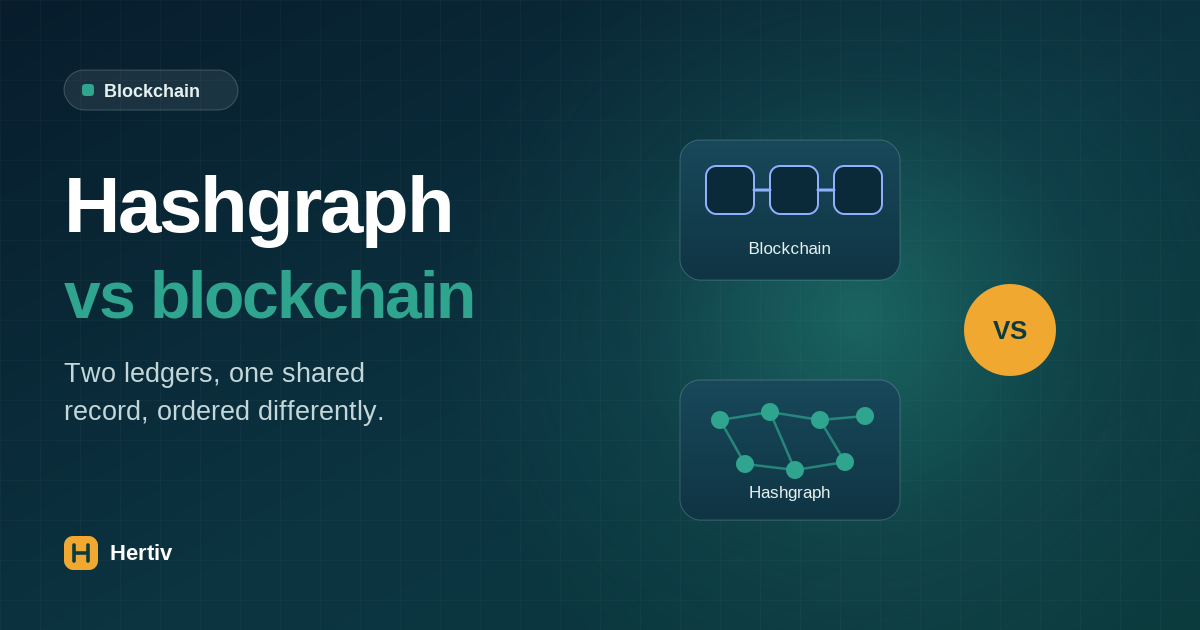
Hashgraph and blockchain are both distributed ledgers, but they reach agreement differently. A blockchain orders transactions into blocks chained together one after another, while a hashgraph uses a gossip protocol and virtual voting to agree the order without mining or block producers.
What is the difference between hashgraph and blockchain?
Hashgraph is a distributed ledger that records events in a directed acyclic graph and agrees their order through gossip and virtual voting, while a blockchain records transactions in blocks linked in a chain and agrees them through a consensus rule such as proof of stake. The difference is in the data structure and in how agreement is reached, not in the goal: both aim to give many parties one shared, tamper-resistant record.
In a blockchain, transactions are grouped into blocks, and each block points to the one before it. Validators or miners agree on the next block, then the chain grows by one. This is simple to explain and easy to audit, but only one block is added at a time.
In a hashgraph, each participant shares what it knows with a few others at random, and the gossip spreads quickly across the network. Every event records which earlier events its creator had seen, so the network can work out the order and the time of each transaction without a separate vote for every decision. The result is a ledger with no blocks and no mining.
Hashgraph is best known through Hedera, the public network built on it. Blockchains include public networks such as Ethereum and Solana, and private networks built with frameworks such as Hyperledger Fabric.
How does a blockchain work?
A blockchain works by grouping transactions into blocks, linking each block to the previous one with a cryptographic hash, and asking the network to agree on the next block before it is added. Once a block is added and confirmed by later blocks, changing it would require redoing the work of every block after it.
The exact agreement rule depends on the network. In proof of stake, validators lock up tokens and are chosen to propose and confirm blocks; dishonest behaviour can cost them their stake. In proof of work, miners compete to solve a puzzle, and the first to solve it adds the next block. Private blockchains often use simpler voting among known participants.
Blocks give the chain two useful properties. First, the order of transactions is clear: a transaction in block 100 happened before one in block 101. Second, the history is easy to check, because anyone can walk the chain of hashes from the latest block back to the first.
The trade-off is throughput. Because only one block is added at a time and each block needs network-wide agreement, a blockchain processes a limited number of transactions per second. Faster chains raise block size or shorten block times, but that can make running a node harder. For background on how networks share data, see blockchain interoperability.
How does hashgraph work?
Hashgraph works by gossip and virtual voting. Each member of the network repeatedly picks another member at random and shares everything it knows, including new transactions and the history of what it has seen. Because each event records the two events its creator had seen, the full history of gossip is stored in the graph itself.
Once the graph is shared, every member can work out the same order of events and the same agreement result without sending extra votes across the network. The votes are virtual: each member computes what the others would have voted, based on the shared history. This is why hashgraph can reach agreement quickly and without mining.
Hashgraph also gives a fair ordering of transactions, because the agreed order reflects when each transaction was first seen by the network rather than which block producer picked it up. That matters for markets and auctions, where the order of trades can be worth money.
The trade-off is complexity and governance. The algorithm is harder to explain than a chain of blocks, and the best-known network, Hedera, is run by a council of organisations, which is a different trust model from a fully open validator set.
How do hashgraph and blockchain compare?
Hashgraph and blockchain compare differently on speed, finality, fairness, maturity and decentralisation, and no single row decides the choice. The table below summarises the main differences.
| Factor | Blockchain | Hashgraph |
|---|---|---|
| Data structure | Blocks linked in a chain | Events in a graph, no blocks |
| Agreement | Proof of stake, proof of work, or voting | Gossip plus virtual voting |
| Speed | Varies widely by network | High, with fast confirmation |
| Finality | Probabilistic on some chains, final on others | Fast and final once agreed |
| Fair ordering | Depends on block producer | Built in, based on time first seen |
| Maturity | Many networks, tools and developers | Younger, fewer tools and developers |
| Decentralisation | Varies from open to permissioned | Council-governed on Hedera |
Speed is where hashgraph is usually strongest. Because agreement does not wait for the next block, transactions can be confirmed in seconds with low fees. Some modern blockchains are also fast, so the gap is smaller than it was a few years ago.
Maturity is where blockchains are strongest. There are far more developers, libraries, wallets, exchanges and auditors for blockchains, and far more examples of production systems. That ecosystem matters when you need to hire, integrate with partners or pass a security review.
Example (hypothetical): a payments team choosing between the two
Example (hypothetical): a payments team needs to settle 10,000 small transfers a day between merchants. On a blockchain option, each transfer costs $0.50 in fees and takes about 30 seconds to confirm, so daily fees are 10,000 x $0.50 = $5,000 and the team must handle confirmations that arrive at different times.
On a hashgraph option, each transfer costs $0.05 in fees and confirms in about 3 seconds, so daily fees are 10,000 x $0.05 = $500, a saving of $4,500 a day. Fair ordering also removes the risk that a block producer reorders trades.
But the team also counts integration costs. The blockchain option has ready-made wallets, accounting tools and three auditors the team already knows. The hashgraph option needs custom wallet work and one auditor who supports it, adding about $60,000 to the build. At $4,500 a day saved, that extra cost is recovered in about 14 days of operation.
The team still picks the hashgraph option for this use case, because the volume is high and the fees dominate. For a low-volume tokenisation project, the same team would likely pick the blockchain option, because the ecosystem would matter more than the fee saving.
What are the common mistakes?
The most common mistakes when comparing hashgraph and blockchain are treating speed as the only factor, ignoring the ecosystem, and assuming one ledger fits every use case.
- Choosing on throughput alone. Speed matters for payments, but it matters far less for a registry that updates a few times a day.
- Ignoring developer availability. A ledger with few developers means slower hiring, fewer libraries and higher integration costs.
- Overlooking governance. A council-run network and an open validator set have different trust assumptions, and your partners may care about that difference.
- Confusing a product with a ledger. Hedera is one network built on hashgraph; hashgraph is the algorithm. Judge the network, not just the idea.
- Skipping the exit plan. Check how you would move data and users off the ledger if the network or your needs change.
Which one should you choose?
You should choose hashgraph when you need high-volume, low-fee transactions with fast finality and fair ordering, and you are comfortable with a younger ecosystem and council governance. Payments, micropayments, supply chain tracking and audit logs are the strongest fits.
You should choose a blockchain when you need the widest ecosystem, the most developers and auditors, and the most integration options. Tokenisation, DeFi, identity and enterprise networks usually fit better on a blockchain, because partners and tools already exist there.
For many teams the decision is not final. A common pattern is to build the core product on a blockchain with a large ecosystem, then move high-volume settlement to a faster ledger once the product works. If you need help weighing the options for your use case, a partner for blockchain development can prototype both and compare the real costs.
Key takeaways
- Hashgraph orders events in a graph with gossip and virtual voting; blockchain orders transactions in blocks
- Hashgraph confirms fast with low fees and fair ordering, but has a younger ecosystem
- Blockchains offer the widest choice of tools, developers and auditors
- Speed matters most for high-volume payments; ecosystem matters most for tokenisation and enterprise use
- Prototype the same use case on both ledgers before committing
Frequently asked questions
Is hashgraph a type of blockchain?
No, strictly speaking it is not. Hashgraph is a different kind of distributed ledger that uses a graph of events instead of a chain of blocks. People sometimes call it a blockchain alternative, but the data structure and the agreement method are different.
Is hashgraph faster than blockchain?
Usually yes for confirmation speed and fees, because agreement does not wait for the next block. But some modern blockchains are also fast, so the gap depends on which networks you compare. Measure both with your own transaction volumes before deciding.
What is Hedera?
Hedera is the public network built on hashgraph. It is governed by a council of organisations and offers services for tokens, smart contracts, file storage and consensus timestamps. It is the main production network using the hashgraph algorithm.
Can hashgraph run smart contracts?
Yes. Hedera supports smart contracts, including contracts written for the Ethereum Virtual Machine, so some Ethereum code can run on it with changes. Check compatibility for your specific contracts before assuming they will move across unchanged.
Is hashgraph more secure than blockchain?
Both can be secure when designed well, but they rely on different assumptions. Hashgraph relies on its gossip and voting protocol and on its council governance, while a blockchain relies on its consensus rule and validator set. Security depends on the implementation, the network size and the governance, not on the label.
Do I need to pick one ledger forever?
No. Many teams start on one ledger and add another later for a specific job, such as high-volume settlement. Design your product so the ledger is one component, not the whole architecture, and the switch will be far cheaper.


