How Tokenization Is Changing the Global Oil Market
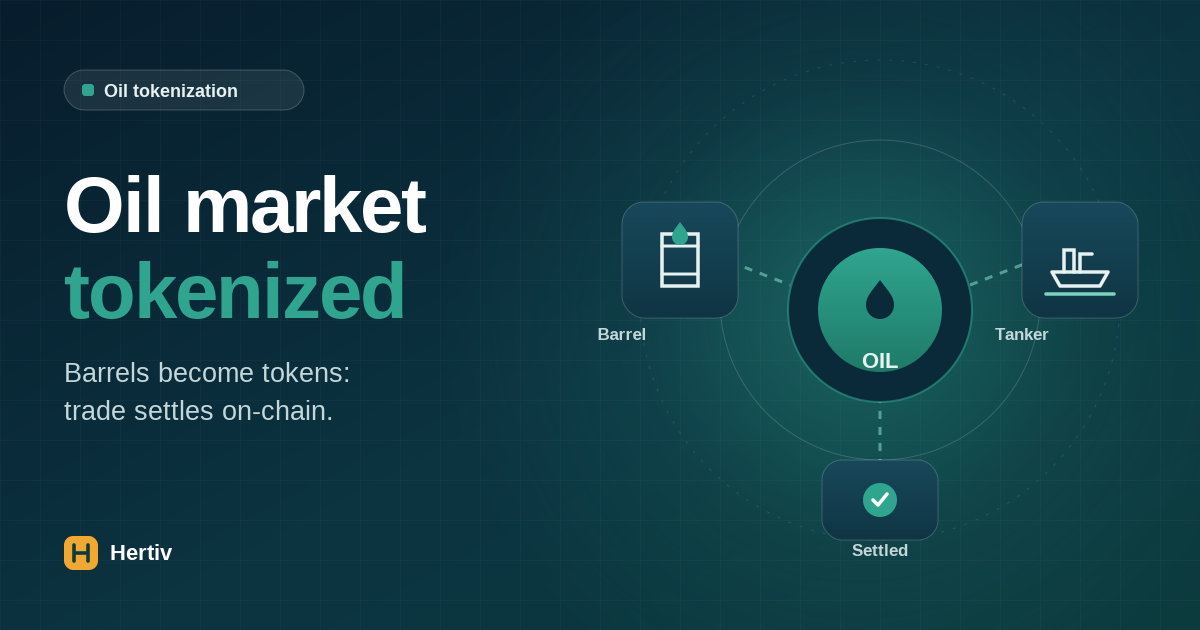
Tokenizing oil turns barrels, cargoes and storage rights into digital tokens that trade on a blockchain. Here is how it works and what still holds it back.
On this page
Short answer
Global oil market tokenization means recording ownership of oil — a cargo, a stored tank, or future output — as digital tokens on a blockchain. The tokens can be split, traded and settled without moving the oil. It aims to make oil trading faster, open to smaller buyers, and easier to finance, but it depends on trusted custodians, clear rules and buyers who accept tokens as proof of ownership.
What is global oil market tokenization?
Global oil market tokenization is the practice of recording ownership of oil, or a claim on oil, as a digital token on a blockchain. The token stands for a defined quantity of crude oil, refined fuel, storage space or future output, and it can be transferred between parties without moving the physical oil.
Oil has always traded in large lots through brokers, banks and paper documents such as bills of lading. Tokenization adds a digital record that follows the oil from seller to buyer, showing who owns each share at any moment. The record is shared across the parties in the trade instead of sitting in separate systems.
The idea belongs to the wider field of real-world asset tokenization, which covers property, funds and commodities. Oil is one of the largest and most complex markets to apply it to, because a single cargo can involve a producer, a trader, a shipper, a refinery, an insurer and several banks. For the basics of the field, see RWA tokenization: a practical guide for issuers.
How does an oil token work?
An oil token works by linking a digital record to a real, held quantity of oil. A custodian or warehouse confirms the oil exists, a token is issued against it, and the token moves between wallets as ownership changes. When the token is redeemed, the holder claims the physical oil or its cash value.
| Token type | What it stands for | Who uses it |
|---|---|---|
| Cargo token | One shipment of crude or fuel | Traders and refiners |
| Storage token | Oil held in a named tank | Producers and funds |
| Output token | A share of future production | Producers raising finance |
| Settlement token | Payment tied to a delivery | Buyers and banks |
Most designs keep the token and the oil separate: the token is a claim, not the oil itself. The custodian holds the physical stock and reports it, while the blockchain records who holds each claim. If the custodian fails to deliver, the token is only as good as the legal agreement behind it.
Price feeds matter too. An oil token needs a trusted source for the market price of the grade it stands for, so buyers and sellers can agree what a token is worth on the day of the trade. Without that link, the token cannot be priced fairly.
Where is tokenization used in the oil market today?
Tokenization is used in the oil market today mainly in pilots and small live trades, rather than as the normal way oil changes hands. The most common uses are trading cargoes, financing stock, and proving where a shipment came from.
In trading, a token can split a cargo into smaller shares so that more than one buyer can take part. A cargo of 100,000 barrels is too large for most buyers, but tokens can divide it into lots that smaller firms can afford. That widens the pool of buyers for a single shipment.
In financing, producers and traders use tokens to borrow against oil they hold. A lender can see the tokenised stock on a shared record and release funds against it, instead of waiting for paper documents to be checked by several parties. Similar thinking already applies to energy assets in general, as explained in Tokenization in Energy: How Power Assets Become Tokens.
Provenance is a third use. A token can carry the origin, grade and inspection record of a cargo, so a buyer can check what they are buying before the ship arrives. This helps where buyers need proof that a cargo meets a contract grade or a sanctions rule.
What does tokenization change for buyers and sellers?
Tokenization changes oil trading mainly by speeding up settlement and by making ownership easier to split and check. In paper-based trading, documents pass between parties over days, and each party keeps its own copy. A shared token record cuts that chain down to a single transfer.
- Faster settlement. Ownership moves when the token moves, so a trade can settle the same day instead of waiting for documents to arrive.
- Smaller lots. A cargo can be divided into tokens, so buyers who cannot take a full cargo can still take part.
- Clearer ownership. The record shows who holds each share, which reduces disputes about who owns what during a voyage.
- Easier finance. Lenders can see tokenised stock and release funds against it with less paperwork.
It does not change the physical side of the trade. The oil still has to be pumped, shipped, stored and refined, and those steps still depend on ports, pipelines and inspectors. Tokenization changes the record of the trade, not the oil itself.
Costs can fall as well, because fewer intermediaries need to check the same documents. But the savings depend on the parties agreeing on one system and one set of rules, which is still rare in a market where each trader runs its own process.
Example (hypothetical): a refinery sells a tokenised cargo
Example (hypothetical): a refinery buys a cargo of 100,000 barrels of crude at 80 units per barrel, a total value of 8,000,000 units. It plans to refine the oil over two months and wants to sell part of the cargo early to free up cash.
The refinery tokenises 10 percent of the cargo, worth 800,000 units, and splits it into 800 tokens of 1,000 units each. Each token stands for 125 barrels, since 10,000 barrels divided by 800 tokens equals 125 barrels per token. Two smaller buyers each take 400 tokens, paying 400,000 units each, and the refinery keeps the remaining 90,000 barrels for its own plant.
Under the old paper process, the sale would take about five working days: documents would pass between the refinery, the buyers, the storage operator and the bank, with each party checking the same papers. With tokens, ownership moves when the tokens move, and the trade settles the same day, saving about four days.
When the buyers are ready to take their oil, they redeem their tokens with the storage operator, which releases 5,000 barrels to each buyer. The token record then shows the cargo fully accounted for: 90,000 barrels refined by the refinery and 10,000 barrels delivered to the two buyers.
What are the limits and risks?
The limits and risks of oil tokenization start with trust in the custodian. A token is a claim on oil held by someone else, so if the custodian misreports the stock or fails, token holders have a legal claim but no oil in hand. The blockchain record cannot fix a missing cargo.
Regulation is the second limit. Oil trades cross borders, and the rules for tokens differ by country. A token that counts as a security in one market may be treated differently in another, which makes it hard to run one token across the whole trade. Teams planning a token issue should read the rules for each market they touch, as the guide to how RWA tokenization works explains.
Liquidity is a third risk. A token is only useful if someone will buy it, and early oil token markets have few buyers. A holder who cannot sell may have to wait until the oil is delivered, which removes much of the benefit of tokenising it.
Finally, the price link can break. If the price feed for a grade is thin or delayed, tokens can trade at the wrong price. Buyers should check how the price is set and who provides it before taking a position.
What are the common mistakes?
The most common mistakes in oil tokenization are treating the token as the oil itself, skipping the legal paperwork, and building for a market that does not exist yet.
- Confusing the token with the oil. A token is a claim. If the custodian, the contract and the insurance are weak, the token is weak too.
- Skipping legal review. A token sale still needs contracts that say what happens if delivery fails, a grade is wrong or a party defaults.
- Assuming buyers will appear. Tokenising a cargo does not create demand. If no buyer wants that grade at that price, the tokens sit unsold.
- Ignoring settlement rules. Payment, delivery and tax rules still apply, and a token does not remove them.
- Overstating the savings. Early pilots still run paper processes alongside tokens, so costs can be higher, not lower, at first.
Key takeaways
- Oil tokenization records ownership of barrels, cargoes or storage rights as digital tokens on a blockchain
- Tokens split large cargoes into smaller lots, so smaller buyers can take part in a trade
- Settlement can move from days of paper checks to a same-day token transfer
- The token is only a claim: custody, contracts and insurance still decide whether holders get their oil
- Early markets are thin, so liquidity and regulation remain the main limits
Frequently asked questions
What does it mean to tokenize oil?
It means recording ownership of a defined quantity of oil, or a claim on it, as a digital token on a blockchain. The token can be split and transferred between parties, while the physical oil stays in storage or in transit until it is delivered or redeemed.
Who buys tokenised oil?
Mainly traders, refiners and funds that already trade oil, plus smaller buyers who cannot take a full cargo. Early markets are small, so most tokenised oil trades happen between parties who already know each other.
Does tokenization change the price of oil?
No. The market price of a grade is set by supply and demand in the physical market. Tokenization can change how ownership is split and settled, but it does not set the price of the oil itself.
Is tokenised oil regulated?
It depends on the country and the token design. Some tokens may be treated as securities, and cross-border trades must follow the rules of each market involved. Teams should get legal advice before issuing or buying tokens.
What happens if the custodian fails?
Token holders rely on the legal agreement with the custodian and on insurance. If the custodian cannot deliver the oil, holders have a claim against the custodian, but the blockchain record alone cannot produce the physical cargo.
Can small investors buy tokenised oil?
In theory, yes, because tokens can divide a cargo into small lots. In practice, most current offers are aimed at professional buyers, and retail access depends on local rules and on platforms that are licensed to sell to the public.


