Generative AI in Consumer Packaged Goods: Where It Helps
Generative AI helps CPG teams write product copy, plan demand and test packaging faster. It works best where a person checks the output.
On this page
Short answer
Generative AI in consumer packaged goods is AI that creates text, images and plans to speed up the work behind everyday products, from food and drink to cleaning and personal care. It writes product descriptions, drafts packaging copy, forecasts demand and tests ad ideas, but it does not decide what to sell. Teams that get value use it to draft and test faster, with a person checking every output first.
What is generative AI in consumer packaged goods?
Generative AI in consumer packaged goods, or CPG, is the use of AI that creates new content to speed up the work behind everyday products. A CPG company sells the same product in thousands of stores, so it writes the same kind of copy again and again: product descriptions, pack claims, shelf-talkers, ads and retailer listings. Generative AI drafts those faster, and it also helps plan how much to make and where to send it.
It differs from the general AI these companies already use. Demand forecasting and price optimisation have been around for years, and they predict numbers. Generative AI creates words, images and plans, which is a different job, and it fits the creative and planning work that used to take weeks of human drafting.
The key point is the boundary. Generative AI drafts and suggests; people decide. A product claim, a pack design and a demand plan all need a person to check them, because a wrong claim on a pack or a wrong forecast in a factory costs far more than the time the draft saved.
Where does generative AI help in CPG?
The help falls into five areas, and each one has a clear owner and a clear check.
| Use case | What the AI drafts | Who checks it |
|---|---|---|
| Product descriptions | Listings for each retailer | Brand and legal teams |
| Packaging copy | Claims and label text | Regulatory team |
| Marketing and ads | Ad variants and social posts | Marketing team |
| Demand planning | Forecasts and scenarios | Supply chain planners |
| Retailer pitches | Range reviews and sell-in decks | Sales team |
Product descriptions are the easiest win. One product can need a different listing for each retailer, and the differences are small: character limits, required fields, tone. Generative AI drafts each version from the same source facts, and the brand team checks them against the approved claims. For the wider picture of AI in this sector, AI use cases in FMCG covers the broader tools, including forecasting and shelf analytics.
How does it help with product copy and packaging?
Product copy is where CPG teams feel the volume most. A single product line can need hundreds of listings, and each one must be accurate, on-brand and legal. Generative AI takes the approved product facts — ingredients, size, benefits, warnings — and drafts each listing in the format a retailer needs, which turns a week of copy work into a day of checking.
Packaging copy is slower and stricter. The words on a pack are legal claims, and a wrong claim can force a recall or a fine. Here the AI drafts options and the regulatory team approves them, which is a different workflow from listings: the AI is a brainstorming partner, not a writer. Teams that treat it as a writer on packs get into trouble, because the AI does not know the law in each market.
The practical rule is simple. If the text is a claim about the product, a person with the right training approves it. If the text is a description of a known fact, the AI can draft it and a brand reviewer can check it. That split keeps the speed without the risk.
How does it help with marketing and demand planning?
Marketing is the second big area. A CPG brand runs the same campaign across many channels, and each channel needs its own version: a short video script, a social post, a search ad, a retailer banner. Generative AI drafts the variants from one brief, and the marketing team picks the best few to test. That is faster than writing each variant by hand, and it lets the team test more ideas in the same budget.
Demand planning is quieter but worth more money. Generative AI helps planners write scenarios: what happens to demand if a competitor launches, if a heatwave arrives, or if a retailer runs a promotion. It drafts the scenario in plain language and pulls the numbers from the forecast, so the planner can compare options in a meeting instead of waiting for a new model run.
The check here is the numbers. A scenario is only useful if the figures come from the real forecast, not from the AI's memory, so teams connect the tool to their planning data and treat any number it invents as a red flag. For the testing side, how to test AI models covers the checks that catch invented figures before they reach a plan.
Example (hypothetical): a drinks brand plans a summer launch
Picture a drinks brand launching a new flavour for the summer. The team needs 40 retailer listings, 12 ad variants, a pack claim and a demand plan, and it has three weeks.
The brand team feeds the approved product facts into the AI and gets 40 listings drafted in an afternoon. Two reviewers check them against the claims sheet and fix six: three had the wrong pack size, two used a claim the legal team had not approved, and one mixed up two flavours. The checking takes a day, and the listings go out a week earlier than the old process allowed.
The marketing team drafts 12 ad variants from one brief and tests four of them in a small online run. Two perform well, and the team scales those two.
The demand planner asks the AI for three scenarios — a hot summer, a normal summer, a cool summer — and the numbers show that the hot scenario needs 15% more stock in the first month. The planner orders the extra stock and avoids a stockout in the first two weeks of launch.
The pack claim is the slowest part. The AI drafts five options, and the regulatory team rejects three and rewrites one. The final claim takes a week, which is the same as before, because the law, not the drafting, sets the pace.
What are the common mistakes?
The most common mistakes when using generative AI in CPG are trusting invented numbers, letting the AI write legal claims, and skipping the check step.
- Trusting invented numbers. Generative AI can invent a figure that looks exact. Any number in a forecast, a claim or a pitch must come from the real data, and a planner should check it against the source.
- Letting the AI write pack claims. A claim on a pack is a legal statement. The AI can draft options, but the regulatory team approves the final words, in every market.
- Skipping the check step. The speed of drafting tempts teams to publish without review. The check is the whole point of the workflow, and cutting it removes the value.
- One tool for every market. Claims, tone and rules differ by country. A draft that works in one market can break the rules in another, so the check must happen per market.
- No source facts. If the AI has no approved product facts to work from, it will invent them. Feed it the claims sheet first, and it will draft from facts.
For the marketing side of the same pattern, generative AI in marketing shows how the draft-and-check workflow runs in other industries.
How should a CPG team start?
Start with product descriptions, because they are high volume, low risk and easy to check. Pick one product line, feed the AI the approved facts, draft the listings, and have two reviewers check them. Measure the time saved and the errors found, and use those numbers to decide whether to expand.
Next, add ad variants, because the test cycle is short and the results are visible in days. Then add demand scenarios, because the value is large but the data connection takes longer to set up. Leave pack claims last, because the regulatory check is the slowest part and the risk is the highest.
The team needs three things before it starts: an approved claims sheet, a named checker for each output, and a rule that no output reaches a customer without a human sign-off. With those in place, the tool saves time. Without them, it creates rework.
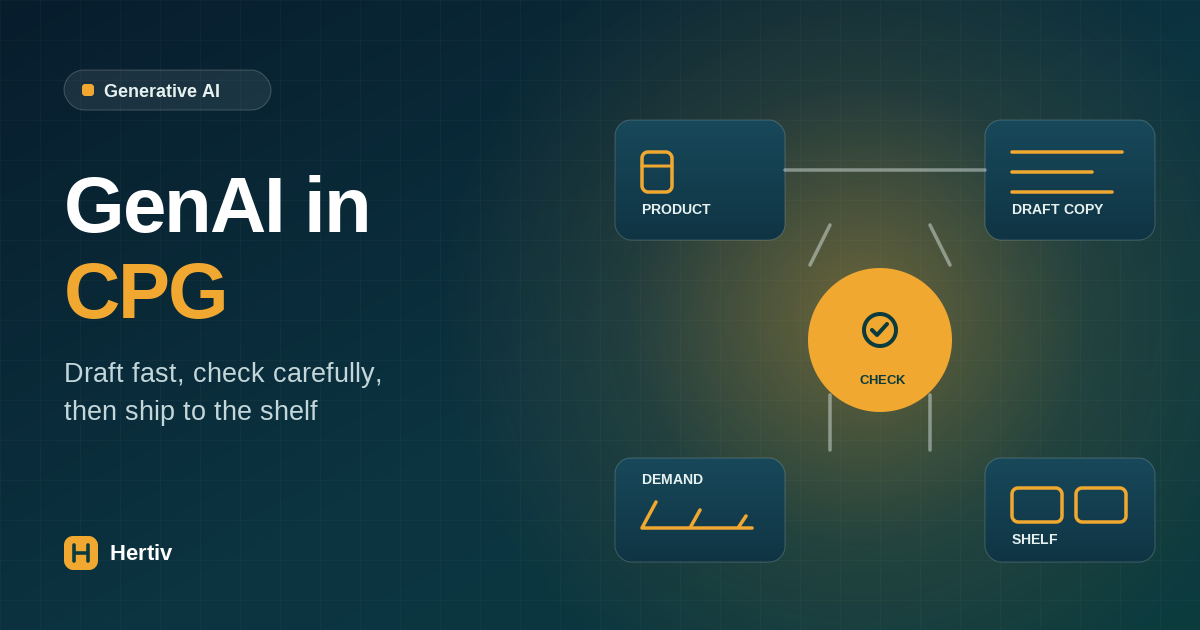
That is the whole pattern: draft fast, check carefully, and keep the decisions with people. Generative AI is a faster pen, not a new product team.
Key takeaways
- Generative AI drafts product copy, ads and demand scenarios for CPG teams
- Product descriptions are the easiest win; pack claims are the slowest and riskiest
- Any number the AI gives must be traced to real data, or it is a guess
- Ad variants and demand scenarios show value in days, not months
- Start with listings, then ads, then scenarios, and keep pack claims last
Frequently asked questions
What is the difference between generative AI and regular AI in CPG?
Regular AI in CPG mostly predicts numbers, such as demand forecasts and price optimisation. Generative AI creates new content: product descriptions, ad variants, pack copy and written scenarios. The two work together, but they are different jobs, and the checks differ too. A forecast needs a data check, while a product description needs a brand and legal check.
Can generative AI write the claims on my packaging?
It can draft options, but it should not write the final claim. The words on a pack are legal statements, and the rules differ by market. The regulatory team must approve the final wording, because a wrong claim can force a recall or a fine. Treat the AI as a brainstorming partner for packs, not as the writer.
How do I stop generative AI inventing product facts?
Feed it the approved product facts first, such as the claims sheet with ingredients, sizes, benefits and warnings, and tell it to use only those facts. If the tool has no source facts, it will invent them. Check every output against the claims sheet, and treat any fact you cannot find there as an error.
Is generative AI useful for small CPG brands?
Yes, and often more so than for large ones, because a small team writes the same copy with fewer people. Product listings and ad variants are the best starting point, because the volume is high and the check is simple. Pack claims still need the same regulatory care, whatever the size of the brand.
What data does generative AI need to help with demand planning?
It needs the forecast and the sales history, not just a prompt. The AI drafts scenarios in plain language and pulls the numbers from the planning data, so the planner can compare options. If the tool is not connected to the real data, any number it gives is a guess and should not be used in a plan.
How long does it take a CPG team to see value from generative AI?
Product listings usually show value in the first week, because the volume is high and the check is fast. Ad variants show value in a few weeks, once the test cycle runs. Demand scenarios and pack claims take longer, because the data connection and the regulatory check set the pace. Start with listings and measure the time saved.


