Generative AI in Telecom: What It Does and Where It Pays
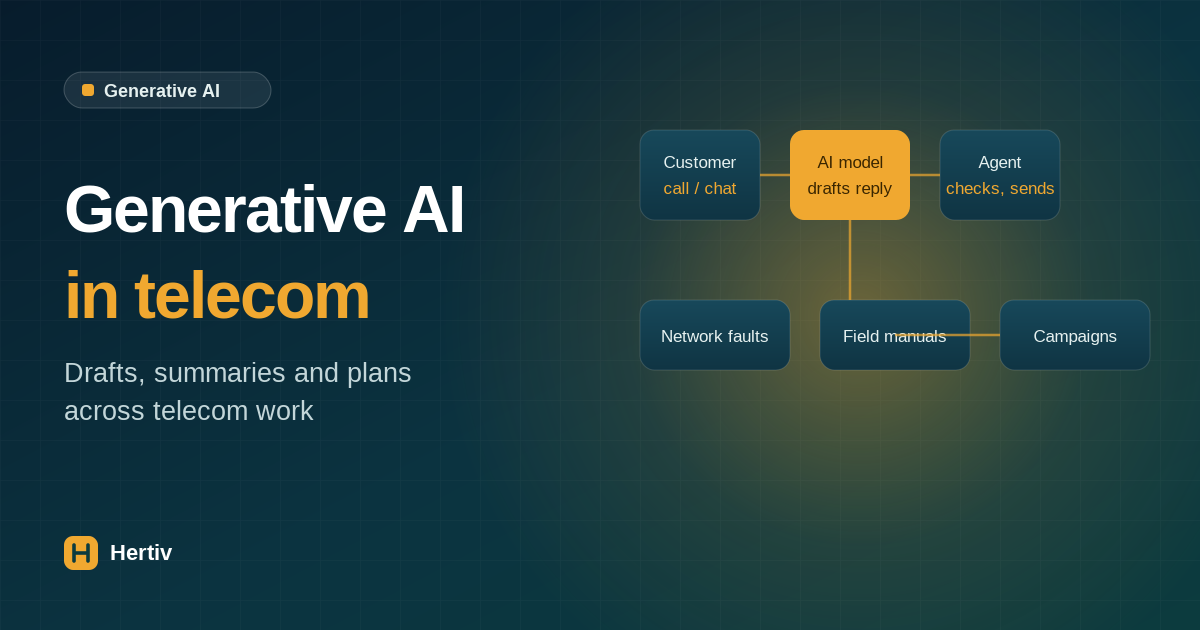
Generative AI in telecom drafts customer replies, summarises calls and helps engineers fix faults. It pays where call volumes are high and staff need fast answers.
On this page
Short answer
Generative AI in telecom is the use of large language models to create text, summaries and plans across a telecom operator's work: customer service, network operations, field work, sales and marketing. It works best where teams handle high volumes of similar questions or need fast answers from large sets of manuals, tickets and network data.
What is generative AI in telecom?
Generative AI in telecom is software that uses large language models to draft, summarise and answer questions inside a telecom operator. It reads customer messages, call transcripts, network tickets and technical manuals, then produces replies, summaries and recommendations that staff can check and send.
It differs from the chatbots operators used before because it works with free text and with the operator's own data. An older bot matched keywords to a fixed script. A generative system can read a long fault report, pull the relevant manual, and draft a fix that an engineer reviews.
The main places it is used are the contact centre, network operations, field engineering and marketing. Each area has its own data and its own checks, so a single model rarely serves all of them well. For how agents fit the same work, see AI agents in telecom.
Where is it used in telecom?
Generative AI in telecom is used in five areas, and each one has a different return. Customer service usually comes first because the volume is high and the results are easy to measure.
| Area | What it does | Why it pays |
|---|---|---|
| Customer service | Drafts replies, summarises calls | High volume, fast payback |
| Network operations | Summarises faults, suggests fixes | Shorter outages, less rework |
| Field engineering | Finds manuals, writes job notes | Fewer repeat visits |
| Sales and marketing | Drafts offers, product copy | Faster campaigns |
| Planning | Drafts coverage and capacity notes | Faster decisions |
Customer service is the usual starting point. A contact centre that handles thousands of similar questions a day can measure the time saved per reply, while network operations needs more careful testing because a wrong suggestion can extend an outage.
How does it help customer service?
Generative AI helps telecom customer service in three ways: it drafts replies for agents, it summarises calls after they end, and it answers simple questions directly in chat. The agent stays in control of what goes to the customer.
Drafting is the safest start. The model reads the customer's message and the account history, then drafts a reply that the agent checks and sends. Summaries come next: after a call, the model writes a short record of what was agreed, so the agent does not type it by hand. Direct answers in chat should come last, and only for questions with a clear, checked answer, such as billing dates or plan details.
The risk is a confident wrong answer about a bill, a plan or a fault. Guardrails matter: the model should only quote prices, dates and plan terms from the operator's own systems, never from its own text. For how chat systems fit the same work, see ChatGPT for telecommunications.
How does it help network operations?
Generative AI helps network operations by turning long fault tickets and alarm logs into short summaries, and by finding the relevant manual or past fix for the engineer on duty.
A fault can generate dozens of alarms and pages of logs. The model reads them and writes a short summary: what failed, which customers are affected, and what was tried already. It can also search past tickets for a similar fault and show the fix that worked, with a link to the record.
The model should not change network settings on its own. Its job is to prepare the information so an engineer decides faster. Operators that let a model act without a human check usually regret it after the first bad change. For the analytics side of the same work, see predictive analytics in telecom.
What data and guardrails does it need?
Generative AI in telecom needs clean data and firm guardrails. The model is only as good as the manuals, tickets and customer records it can read, and the guardrails decide what it may say and do.
- Connect the right data. Link the model to the billing system, the fault system and the manual library, and keep that data current.
- Limit what it can quote. Prices, plan terms and dates must come from the operator's systems, not from the model's text.
- Keep a human in the loop. An agent or engineer checks the output before it reaches a customer or changes a network setting.
- Log everything. Keep the question, the answer and the source, so a wrong answer can be traced and fixed.
- Protect customer data. Strip or mask personal details before they reach the model, and follow the privacy rules of each country.
Data quality is the part most teams underestimate. A manual that is out of date will produce a wrong fix, and a billing system that is not connected will leave the model guessing. Fix the data first, then scale the model.
Example: a contact centre cuts handling time
Example (hypothetical): a telecom contact centre handles 50,000 written chats a month, and each chat takes an agent about 8 minutes to handle by hand.
With a generative AI draft, the agent reads the draft, fixes it and sends it in about 5 minutes instead of 8. That saves 3 minutes per chat, so the monthly saving is 50,000 x 3 = 150,000 minutes, which is 2,500 hours a month.
At $25 an hour, that is 2,500 x $25 = $62,500 a month in agent time, before the cost of the model, the integration and the review work. The centre does not cut staff by that amount; it uses the time to clear the queue faster and to handle the harder cases that the model cannot draft for.
What are the common mistakes?
The most common mistakes with generative AI in telecom are letting the model answer without checks, connecting it to stale data, and measuring output instead of outcomes.
- No human check. A model that replies to customers without review will eventually invent a price or a promise.
- Stale manuals and tickets. Out-of-date documents produce confident, wrong answers about faults and plans.
- Measuring replies, not results. Counting drafts written is easy; counting faster resolution and fewer repeat contacts is what matters.
- One model for every job. Customer service, network faults and marketing need different data and different checks.
- Ignoring privacy. Customer data must be masked and handled under the privacy rules of each country.
- Skipping the feedback loop. Wrong answers that nobody reports will keep coming back.
Key takeaways
- Generative AI drafts replies, summaries and plans across telecom work
- Customer service pays first, because the volume is high and the return is easy to measure
- In network operations it summarises faults; it should not change settings on its own
- Prices, dates and plan terms must come from the operator's systems, not the model
- Fix the data and the guardrails before scaling to more teams
Frequently asked questions
What is generative AI in telecom?
Generative AI in telecom uses large language models to draft customer replies, summarise calls and fault tickets, find the right manual, and write plans. It reads the operator's own data and produces text that staff check before it is sent or acted on.
Where does generative AI help telecom operators most?
Customer service usually comes first, because call and chat volumes are high and the time saved per reply is easy to measure. Network operations and field engineering follow, where fast summaries and manual lookups cut repeat visits and outage time.
Can generative AI answer telecom customers directly?
It can, but only for questions with a clear, checked answer, such as billing dates or plan details. For anything about a bill, a fault or a promise, an agent should check the draft first, because a wrong answer is worse than a slow one.
Is customer data safe with generative AI?
It can be, if personal details are masked before they reach the model and the data is handled under the privacy rules of each country. Operators should also log every question and answer so a wrong reply can be traced and fixed.
How do you measure whether it works?
Measure resolution time, repeat contacts and customer satisfaction, not the number of drafts written. A model that writes many drafts but does not cut repeat contacts or handling time is not paying for itself.
Should a telecom operator build or buy generative AI?
Most operators buy the model and build the connections to their own billing, fault and manual systems. Buying is faster, while the operator's own data and guardrails are what make the answers accurate and safe.


