ChatGPT in Telecom: How Carriers Use It Today
Carriers use ChatGPT to draft support replies, summarise network incidents and search knowledge. Here is where it helps, and the guardrails that keep it safe.
On this page
Short answer
ChatGPT in telecom means using a large language model inside a carrier's operations: drafting support replies, summarising network incidents, searching internal knowledge and preparing agents for calls, always with a human checking the output before anything is sent.
What is ChatGPT for telecommunications?
ChatGPT for telecommunications is the use of OpenAI's ChatGPT, or similar large language models, inside a telecom company's operations. Carriers use it to answer customer questions, summarise network incidents, draft sales replies, search internal knowledge and help agents handle calls faster.
It is not a telecom product on its own. It is a general-purpose language model applied to telecom work, usually connected to the carrier's own systems so it can quote a customer's plan, check an outage or follow a support script instead of guessing.
| Use case | What ChatGPT does | Human check |
|---|---|---|
| Customer support | Drafts replies and finds answers | Agent reviews before sending |
| Network incidents | Summarises alerts into plain language | Engineer confirms the summary |
| Sales and retention | Drafts offers and follow-ups | Agent checks price and terms |
| Knowledge search | Answers from manuals and policies | Staff check the cited source |
| Agent training | Role-plays difficult calls | Trainer reviews the session |
How do carriers use ChatGPT in customer support?
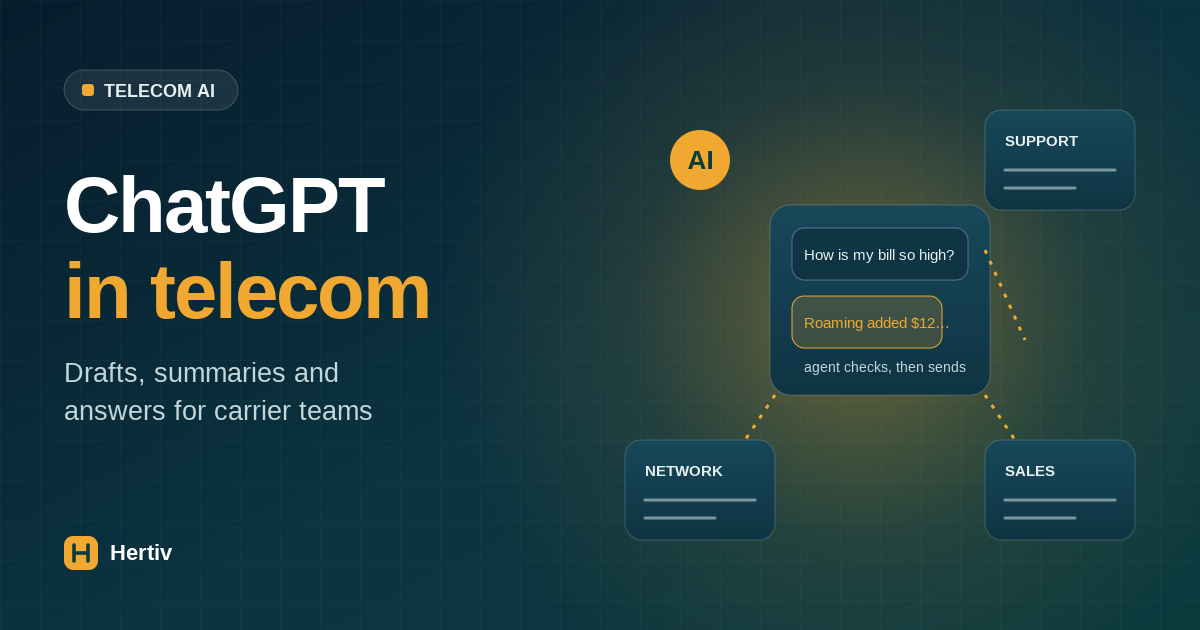
Carriers use ChatGPT in support mainly as a drafting and search tool for human agents. When a customer asks about a bill, a plan change or a roaming charge, the model reads the account notes and the relevant help articles, then drafts a reply that the agent checks and sends.
The gain is speed, not replacement. An agent who used to search three systems for an answer can now read one draft and fix it. The check matters because the model can quote the wrong plan or miss a recent change, and a wrong answer about a bill is worse than a slow one. The same human-in-the-loop pattern appears in AI agent use cases.
Some carriers also use it for the first reply in chat, where the model asks for the account number and the reason for contact, then hands over to a person. That handover must be smooth, or customers repeat themselves and the time saved is lost.
How does it help with network operations?
In network operations, ChatGPT helps by turning raw alerts into plain language. A night shift can receive hundreds of alerts from towers, routers and fibre links; the model groups related alerts, writes a short summary of what changed, and suggests the runbook that fits. It can also pull the last known good state from the change log, so the engineer sees what changed just before the alerts started.
Engineers still make the call. The summary saves reading time, but the decision to reroute traffic or dispatch a field team needs a person who knows the network. Network work of this kind is part of cloud computing in telecom.
It also helps with incident reports. After an outage, the model can draft a timeline from the alert log and the engineers' notes, which the team edits before the report goes to customers or regulators.
What about sales, marketing and retention?
In sales, ChatGPT drafts follow-up messages, plan comparisons and renewal offers that agents personalise before sending. The model works from the customer's current plan, usage and the offers that are actually available, so the draft is grounded in real data rather than invented.
For retention, it helps agents prepare for a call: it summarises the customer's history, flags the last three complaints and suggests the options that fit the account. The agent still decides what to offer, because price and terms need a human check.
Marketing teams use it to draft campaign copy and to sort open feedback into themes, such as billing confusion or coverage complaints. That sorting helps product teams see which problems come up most, without reading thousands of messages by hand.
What are the risks and guardrails?
The main risks are wrong answers, data leaks and over-trust. A model can state a price that does not exist, quote an old policy, or invent a network status. It can also mix up two similar plans and quote the wrong one. If that answer reaches a customer, the carrier must honour it or apologise, and both cost money.
Data is the second risk. Customer records, call transcripts and network data must not flow into a model that other customers can query. Carriers handle this with enterprise agreements, private deployments or by stripping personal data before the model sees it. Billing data is one example: telecom billing software holds the records the model must not leak.
The guardrails are practical: connect the model to real systems so it quotes real data, require a human review before customer-facing answers, log every answer with its source, and keep a clear rule for when the model must say it does not know.
Example (hypothetical): a carrier pilots ChatGPT in support
Example (hypothetical): a carrier with 200 support agents pilots ChatGPT for billing questions. Each agent handles about 60 chats a day, and billing questions take about 8 minutes each because the agent searches the billing system, the plan catalogue and the help articles.
The pilot connects the model to those three sources and adds a review step: the agent reads the draft, fixes errors and sends it. After four weeks, the team measures the result on 1,000 billing chats. Average handling time falls from 8 minutes to 5 minutes, saving 3 minutes per chat, or 50 hours across the 1,000 chats.
The error rate is checked too: 40 of the 1,000 drafts contain a wrong price or plan detail, and agents catch 38 of them before sending. Two wrong answers reach customers and are corrected the same day. The carrier keeps the review step and expands the pilot to roaming questions next.
What are the common mistakes?
The most common mistakes with ChatGPT in telecom are letting it answer customers without a check, feeding it unprotected customer data, and measuring speed while ignoring accuracy.
- No human review. An unchecked model will eventually quote a wrong price or policy in public.
- Customer data in the wrong place. Records sent to a shared model can leak across customers.
- No grounding. A model without access to real plans and prices will invent them.
- Measuring only speed. Faster replies that are wrong cost more than slow replies that are right.
- Skipping the handover. A chatbot that cannot hand over cleanly makes customers repeat themselves.
Key takeaways
- ChatGPT drafts and searches; agents decide and send
- Grounding in real plans and prices stops invented answers
- Network summaries save reading time but engineers make the call
- Customer data needs enterprise controls before it reaches a model
- Measure accuracy as well as speed
Frequently asked questions
Can ChatGPT replace telecom support agents?
No, not in practice. It drafts replies, finds answers and summarises history, but agents check the draft, handle the cases the model cannot, and take over when a customer is unhappy. Carriers that treat it as a drafting tool get better results than those that treat it as a replacement.
Is customer data safe with ChatGPT?
It depends on the setup. Data sent to a shared public model is not safe for customer records. Carriers use enterprise agreements, private deployments or data-stripping so that personal data never reaches a model that other customers can query. Check the agreement before connecting any customer data.
Why do telecom chatbots give wrong answers?
Usually because the model has no access to the real plan, price or outage data, so it guesses. The fix is grounding: connect the model to the billing system, the plan catalogue and the network status feed, and require a human review for answers about bills, contracts and outages.
How much can ChatGPT save a telecom support team?
It depends on the use case and the review step. A common pattern is a few minutes saved per chat on routine questions, because the agent reads a draft instead of searching three systems. The saving only counts if accuracy stays the same, so teams measure error rates alongside handling time.
Does ChatGPT work for network fault detection?
It does not detect faults; monitoring systems do that. Its job is to read the alerts those systems produce, group related ones and write a plain-language summary for engineers. The decision to reroute traffic or dispatch a field team stays with the engineer.
What should a carrier pilot first?
Billing questions are a good first pilot: the questions repeat, the data is structured, and the answer is easy to check. Start with one team, add a human review step, measure handling time and error rate for a month, and only then expand to other topics.


