How Much Does Generative AI Development Cost?
Generative AI development cost depends on scope, data work, model choice and testing. Here is what goes into the budget and how to estimate it before you commit.
On this page
Short answer
Generative AI development cost is set by scope, data preparation, model choice, integration and testing, not by the model alone. A small pilot with one workflow and clean data costs far less than a production system with retrieval, evaluation and human review. The reliable way to budget is to price each part separately, then add a reserve for the evaluation and rework that every first build needs.
What does generative AI development cost depend on?
Generative AI development cost is the total spend to design, build, test and run a generative AI feature in production. It is set by scope, data work, model choice, integration and testing, not by the price of the model alone.
Most budgets break into the same parts. Price each one separately and the total stops being a guess.
| Cost part | What it covers | What drives it |
|---|---|---|
| Scoping and design | Choosing the workflow, success metric and fallback | Number of workflows and reviewers |
| Data preparation | Cleaning, labelling and connecting source documents | How messy and spread out the data is |
| Model and API use | Calls to a hosted model or running an open model | Volume, context size and model size |
| Integration | Connecting the model to your product and systems | Number of systems and permission rules |
| Evaluation and testing | Test sets, human review and quality checks | How wrong answers cost you |
| Running costs | Hosting, monitoring and ongoing data work | Usage volume and update frequency |
Data preparation is the part teams most often underestimate. If the source documents are duplicated or out of date, retrieval quality suffers and the team pays for the cleanup later anyway. See how to build an AI proof of concept for how to scope the first version before pricing the whole programme.
What drives the cost up or down?
Four factors move the cost most: how ready the data is, how narrow the scope is, which model you use, and how much human review the workflow needs.
Data readiness is first. A team with a clean help centre and a labelled set of past cases can start building in days. A team whose documents live in five systems with conflicting versions needs weeks of cleanup before the model work starts. That cleanup is real work, and it belongs in the budget either way.
Scope is second. One workflow with one owner and one success metric is cheap to build and easy to measure. Five workflows at once multiply integration, testing and change management, and make it hard to tell which one is working.
Model choice is third. A hosted API charges per call and needs no infrastructure, which suits a pilot. Running an open model needs servers and operations skill, but the per-call cost falls as volume grows. The cheaper option depends on your volume, not on the list price.
Human review is fourth. Workflows where a person checks the output before it reaches a customer are cheaper to ship safely than fully automated ones, because the fallback is a person, not a guardrail system you must also build.
Build, buy or use an API?
The cheapest route depends on how much of the problem is already solved by someone else. A hosted API, a vendor product and a custom build are three different budgets, not three prices for the same thing.
| Route | Up-front cost | Best when |
|---|---|---|
| Hosted API | Low | You need a pilot fast and volume is modest |
| Vendor product | Medium | A standard workflow fits your need |
| Custom build | High | Your data and workflow are specific to you |
A hosted API is the usual start. You pay per call, you can change models, and you learn what the workflow really needs before committing to infrastructure. A vendor product suits standard workflows such as support triage, where the vendor has already built the interface and the evaluation loop.
A custom build makes sense when the workflow touches your own systems and data in ways no product covers, or when usage volume is high enough that per-call pricing beats the cost of running your own model. If you are unsure which route fits, a short generative AI development scoping phase will price all three against the same workflow.
How to estimate the cost in five steps
You estimate the cost by pricing the work, not by asking for a single number. Five steps give a budget you can defend.
- Define one workflow and one success metric. Name the task, who uses it and what good looks like, such as time saved per ticket or extraction accuracy on a labelled sample.
- List the data work. Count the source systems, the documents to clean and the test cases to label. Data work is usually a third of the first build.
- Price the model path. Estimate call volume and context size for an API, or server and operations cost for a self-hosted model, at your expected usage.
- Price integration and evaluation. Count the systems to connect, the permission rules to build and the review loop to staff. Add time for the first round of fixes after testing.
- Add a reserve and a monthly run cost. Hold back 10% for rework, and price hosting, monitoring and data updates as a monthly line, not a one-off.
Write the estimate down as parts, not as a total. When the scope changes, you can see which part moves and by how much. If you are scoping a first build, how to build an AI MVP shows how to keep the first version small enough to measure.
Example (hypothetical): a first version for a support team
Example (hypothetical): a support team wants a draft assistant that answers from its help centre. The team scopes one workflow: draft replies for billing questions, with a human approving every draft before it goes out.
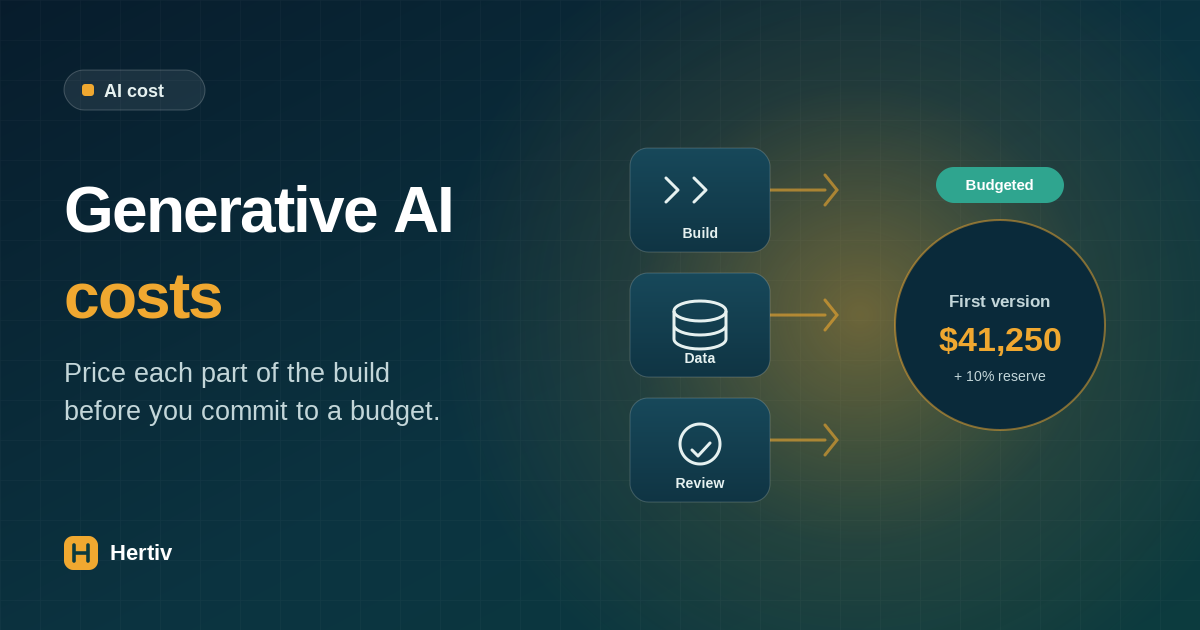
The estimate breaks down as follows. Build work is 500 hours at $60 an hour, which is $30,000. Data preparation, cleaning 400 help articles and labelling 100 past tickets, costs $5,000. Evaluation, building the test set and running the first review rounds, costs $2,500. The subtotal is $37,500.
The team adds a 10% reserve for rework, which is $3,750, bringing the first-version budget to $41,250. Running costs are priced separately at about $800 a month for API calls and monitoring at the expected ticket volume.
The point of the arithmetic is not the number. It is that each part has a name and a size, so when the team cuts scope it knows exactly what it saves and what it gives up.
What are the running costs after launch?
Running costs after launch are the monthly lines that keep the feature working: model calls or server time, monitoring, data updates and human review time.
Model calls scale with volume. A pilot with 1,000 calls a day costs little; a feature used by every customer on every page load needs a volume estimate before launch, not after. Context size matters too: long prompts cost more per call than short ones, so prompt design is also a cost decision.
Monitoring is the second line. You need logs of prompts, outputs and human decisions, plus alerts when quality drops or a new failure pattern appears. Without it, the first sign of a problem is a customer complaint.
Data updates are the third line. Source documents change, products change and policies change. Someone must keep the retrieval corpus current, or answers slowly go stale. Budget a few hours a month for this from the start, and treat it as part of the product, not as an afterthought.
What are the common mistakes?
Most generative AI budgets fail in the same ways: the data work is left out, the first version is too broad, and the running cost is never priced.
- Budgeting only the model. The model is often the smallest line. Data, integration and evaluation cost more.
- Starting with five workflows. Broad pilots spread the budget thin and make success impossible to measure.
- Skipping the evaluation set. Without labelled test cases, quality debates are anecdotal and fixes are guesses.
- No reserve for rework. The first version always needs fixes after real users try it. Plan for them.
- Forgetting running costs. A feature that is cheap to build and expensive to run is still expensive.
- Copying a vendor benchmark. Vendor numbers do not predict performance or cost on your data.
If you want a second view before committing, an MVP scope review will show which parts of the plan can be cut without losing the measurement.
Key takeaways
- The model is often the smallest line; data, integration and evaluation cost more.
- One workflow with one owner and one metric is the cheapest first build.
- Price each cost part separately, then add a 10% reserve for rework.
- Hosted APIs suit pilots; self-hosted models suit high, steady volume.
- Running costs are monthly: calls, monitoring, data updates and review time.
Frequently asked questions
How much does it cost to build a generative AI app?
A narrow pilot with one workflow and clean data can be built for a few tens of thousands of dollars, while a production system with retrieval, evaluation and human review costs more. The honest answer depends on scope and data readiness, so price the parts separately instead of asking for one number.
Is it cheaper to use an API or build your own model?
An API is usually cheaper at low volume because you pay per call and run no infrastructure. Running your own model can be cheaper at high, steady volume, but you also pay for servers, operations and monitoring. Compare both at your expected usage, not at list price.
What is the biggest hidden cost in generative AI projects?
Data preparation is the usual surprise. Cleaning documents, labelling test cases and connecting source systems often takes a third of the first build. Teams that leave it out of the budget pay for it later, when retrieval quality is poor and the cleanup cannot be skipped.
How long does a first generative AI build take?
A narrow proof of concept typically takes a few weeks when the data is ready. Moving to production adds integration, evaluation and change management, which usually take longer than the model work itself. Plan the pilot and the production version as separate steps.
Do I need fine-tuning for a first generative AI product?
Usually not. Retrieval over your own documents plus a clear prompt handles most support, search and copilot cases. Fine-tuning helps when you need consistent format or tone at scale, and it is easier to justify once you have an evaluation set.
How do I keep running costs under control?
Track call volume and context size, shorten prompts where possible, and cache repeated answers. Review the monthly bill against usage, and set alerts for sudden jumps. Most cost overruns come from volume nobody measured, not from the model price itself.


