How to Build an AI MVP That Proves the Idea
An AI MVP tests whether people value the model's output, not whether the model is perfect. Start with one task, real data and a clear pass mark.
On this page
Short answer
An AI MVP is a small working version of an AI product that tests one job with real users and real data, usually in a few weeks. It proves that people value the model's output enough to keep using it, before the team invests in training, scale or a polished interface.
What is an AI MVP?
An AI MVP is a minimum viable product built around one AI capability, made to test whether users value what the model does. It is a working product, not a demo: real users, real data, and a real task they already do today.
The difference from a normal MVP is the uncertainty. A normal MVP tests whether people want a feature. An AI MVP tests that plus whether the model is good enough: whether its answers are accurate, fast and trustworthy enough for the job. A model that is right 70 percent of the time can be useless for medical triage and fine for drafting social posts.
An AI MVP is also different from a proof of concept. A proof of concept tests whether the technology works at all; an MVP tests whether people will use it and pay for it.
Many teams confuse the two and build a demo that impresses in a meeting but teaches nothing about users. The distinction is explained in how to build an AI proof of concept, and the two should not be treated as the same step.
What makes an AI MVP different from a normal MVP?
An AI MVP is different because the product's core is probabilistic: it gives good answers most of the time and wrong ones sometimes. That changes what you build, what you measure and how users react.
| Area | Normal MVP | AI MVP |
|---|---|---|
| Core risk | Do people want the feature? | Do people want it, and is the model good enough? |
| Quality bar | It works or it does not | How often it is right, and how bad the errors are |
| Data needed | Some test data | Real examples of the task, with correct answers |
| Feedback loop | Usage and interviews | Usage, interviews, plus corrections on model output |
| Failure mode | A bug users report | Quietly wrong answers users stop trusting |
| First version | Smallest feature set | Smallest task, with a human checking the output |
The most important difference is the failure mode. A normal bug is visible and reported. A wrong AI answer can look confident, so users may act on it or quietly stop using the product. That is why an AI MVP needs a human in the loop from day one, checking the output before it reaches users.
Cost is the second difference. A normal MVP's cost is mostly engineering time. An AI MVP adds model calls, data preparation and evaluation, and those costs grow with every user. Keep the test small so the bill stays small while you learn.
How to pick the one job your AI MVP will do
Pick one job by finding a task that is frequent, painful and narrow enough for a model to do well. A task done daily by many people, where the current way is slow or dull, is a good candidate.
Start by listing the jobs your users do with the product today, then score each one on three questions. How often does it happen? How painful is the current way? How easy is it to tell whether the model's answer is right? The best job scores high on all three.
Good first jobs are narrow: drafting replies to common support questions, summarising a long document into five points, or extracting fields from invoices. Bad first jobs are open-ended: a general chatbot that answers anything, or a model that writes whole reports unsupervised.
Write the job down in one sentence, with the user and the outcome: 'a support agent drafts a reply to a refund request in under a minute'. If you cannot write that sentence, the scope is still too wide. A AI product development plan should start from that sentence, not from a model choice.
What data do you need before building?
You need real examples of the task, with correct answers, before you build. A model cannot be tested on made-up data, and a test set built by the same team that built the product will flatter the result.
Collect 50 to 100 real examples of the job: real support tickets with the reply that actually solved them, real documents with the summary a human wrote, real invoices with the fields filled in. Keep them separate from any data used to train or tune the model, so the test is honest.
Check the data for quality before building. Are the answers consistent, or did three people solve the same ticket three different ways? Are there personal details that must be removed? Is the data recent, or does it describe a product version that no longer exists? Dirty or stale data is the most common reason an AI MVP disappoints.
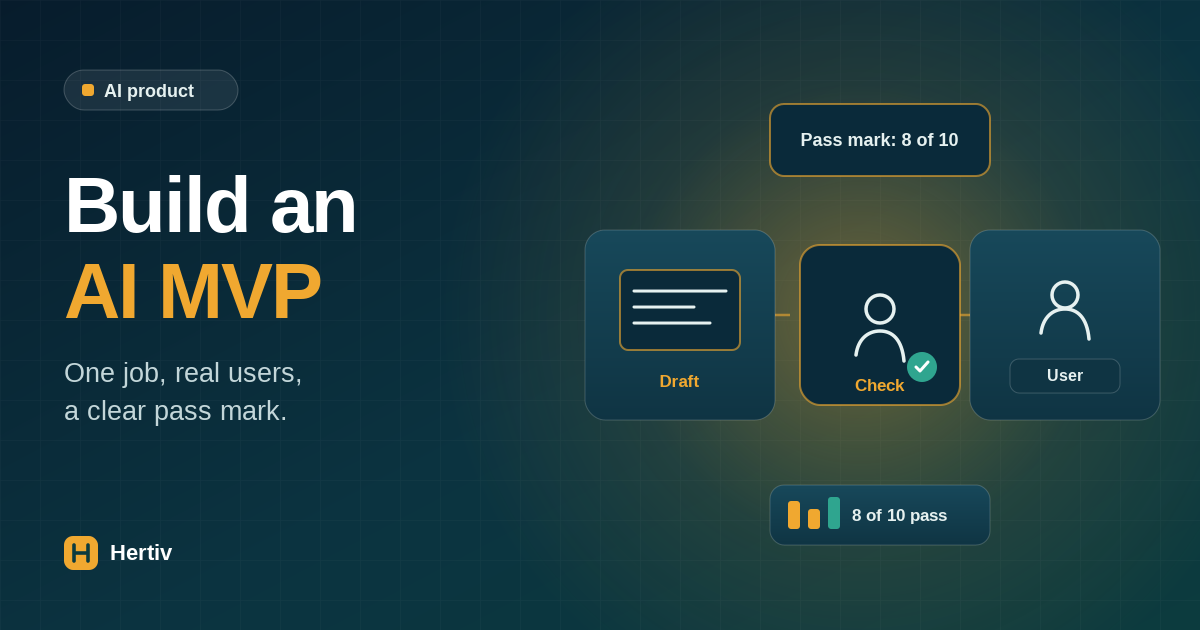
Also decide what good looks like in advance. Pick a pass mark, such as 'at least 8 out of 10 answers are correct and usable without editing', and write it down. Without a pass mark, every result looks like progress and nothing is ever good enough to ship.
How to build an AI MVP in six steps
Build an AI MVP in six steps, each one small enough to finish in days, not weeks. The order matters: prove the job first, then the model, then the product around it.
- Define the job and the pass mark. One sentence for the job, one number for success, and a named user who will test it.
- Gather the test set. Collect 50 to 100 real examples with correct answers, kept apart from training data.
- Try the simplest model first. Use an existing model with a clear prompt before considering fine-tuning or training. Most first versions do not need either.
- Add a human check. Route the model's output to a person who approves or edits it before it reaches the user.
- Put it in front of real users. Give it to a small group doing the real job, and watch what they accept, edit and ignore.
- Measure against the pass mark. Count correct answers, edits and rejections, then decide: improve, change the job, or stop.
Keep the interface minimal. A simple form, a chat box or a button inside an existing tool is enough; a polished design can wait until the model proves itself. If the team needs help scoping the test, an AI proof of concept engagement can set up the first version in weeks.
Example (hypothetical): a support team's AI draft tool
Example (hypothetical): a 10-person support team handles 200 tickets a day, and each reply takes about 4 minutes to write. The team wants an AI MVP that drafts replies for the agent to check and send.
Writing every reply by hand takes 200 tickets times 4 minutes, which is 800 minutes, or about 13 hours and 20 minutes a day across the team. With the MVP, the model drafts replies for 120 of the 200 tickets, and an agent checks each draft in 1 minute.
The 80 remaining tickets still take 4 minutes each, which is 320 minutes. The total becomes 120 minutes of checking plus 320 minutes of writing, which is 440 minutes, or about 7 hours and 20 minutes. That saves roughly 6 hours a day.
The pass mark is set before launch: at least 8 out of 10 drafts must be usable with no more than a small edit. After two weeks, the team counts the results: 96 of 120 drafts pass, which is 8 out of 10. The MVP proves the idea, and the team decides to expand it to more ticket types.
Note what the MVP did not do: it did not reply to customers on its own, it did not cover every ticket type, and it did not replace any agent. It proved one job with a human checking the output, which is exactly what a first version should do.
What are the common mistakes?
The most common mistakes are picking too wide a job, skipping the test set, and letting the model talk to users unsupervised. Each one turns a cheap test into an expensive lesson.
- Too wide a job. A general chatbot that answers anything is hard to test and easy to break; one narrow task is testable.
- No test set. Without real examples and correct answers, nobody can say whether the model is good enough.
- No human check. Unsupervised model output reaches users, and one confident wrong answer can destroy trust.
- Training too early. Fine-tuning or training a model before trying an existing one wastes weeks and money.
- No pass mark. Without a number for success, the team keeps polishing forever and never ships.
- Ignoring cost per user. Model calls that look cheap for ten users become a real bill at a thousand.
An MVP is also not the whole product: keep the scope to one job and one user group, which is why what an MVP is is worth rereading before the build starts.
Key takeaways
- An AI MVP tests one job with real users and real data, not a demo
- The core risk is twofold: people must want it, and the model must be good enough
- Pick a frequent, painful, narrow job and write it in one sentence
- Collect 50 to 100 real examples with correct answers, kept apart from training data
- Keep a human checking the output, and set a pass mark before launch
Frequently asked questions
How long does it take to build an AI MVP?
A narrow AI MVP usually takes a few weeks, not months. Gathering the test set and defining the job takes the first week, trying an existing model takes days, and a small pilot with real users takes another week or two. Training a custom model from scratch is a different project and should not be the first version.
Do we need to train our own model?
Almost never for a first version. Start with an existing model and a clear prompt, and only consider fine-tuning if the test set shows a gap that prompting cannot close. Training from scratch is expensive and slow, and it hides the real question: whether users value the output at all.
How much data does an AI MVP need?
Fifty to one hundred real examples of the task, with correct answers, is enough to test a first version honestly. More data helps later, but the first test needs quality over quantity: real, recent examples that match the job, with personal details removed.
Should the AI reply to users directly?
Not in a first version. Keep a human checking the output before it reaches users, so wrong answers are caught and trust is protected. Direct replies can come later, once the pass mark is met consistently and the error types are understood.
What if the model fails the pass mark?
Then the MVP did its job: it taught you cheaply. Narrow the task, improve the prompt or the data, or change the job entirely. A failed test that costs weeks is far better than a full product built on an unproven model.
How is an AI MVP different from an AI proof of concept?
A proof of concept tests whether the technology works at all, usually with internal testers and sample data. An MVP tests whether real users value it, with real data and a real job. Build the proof of concept first if the technology is uncertain, then the MVP to test demand.


