Fixed Price vs Time and Materials: Which Contract Fits?
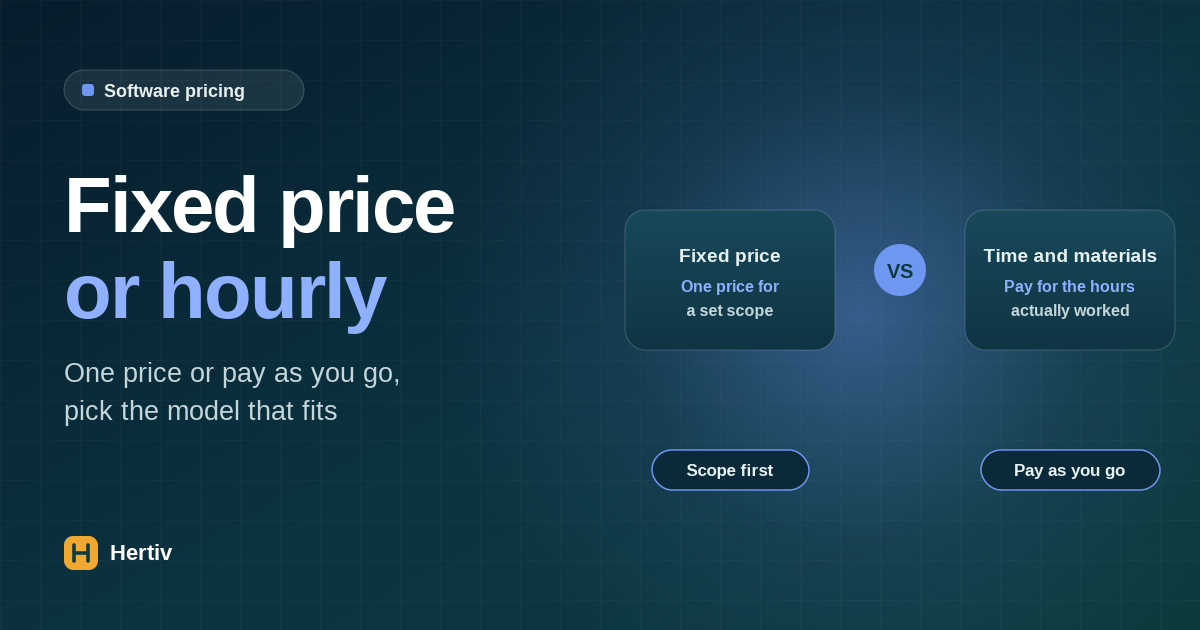
Fixed price is one price for a defined scope; time and materials means paying for the hours worked plus costs. Which fits depends on how clear your scope is.
On this page
Short answer
Fixed price is a contract where the vendor quotes one price for a defined scope of work, and time and materials is a contract where you pay for the hours actually worked, plus materials and other agreed costs. Fixed price suits work with a clear, stable scope, while time and materials suits work where the scope will change as you learn more.
What is fixed price vs time and materials?
Fixed price and time and materials are two ways to pay for software work. With fixed price, the vendor quotes one price for a defined scope, and that price does not change unless the scope changes. With time and materials, you pay for the hours the team actually works, at agreed rates, plus materials and other agreed costs.
The difference is who carries the risk of the work taking longer than planned. Under fixed price, the vendor carries that risk, because the price is set. Under time and materials, the client carries it, because the bill grows with the hours. That is why the choice matters more than the price itself.
| Point | Fixed price | Time and materials |
|---|---|---|
| Price | One agreed price for the scope | Hours worked times the rate, plus costs |
| Scope | Written down and frozen before work starts | Can change as the work goes on |
| Risk of overrun | Mostly the vendor's risk | Mostly the client's risk |
| Changes | Need a written change order and a new price | Handled by re-prioritising the backlog |
| Best for | Clear, stable scope with known requirements | Work where the scope is still being found |
Neither model is better in general. A fixed price contract for a vague project forces the vendor to guess, and the guess shows up as a high price or a fight over what the scope included. A time and materials contract for a fully defined project can cost more than a fixed quote for the same work. The right model follows the clarity of the scope.
How does a fixed price contract work?
A fixed price contract works by agreeing the scope, the price and the delivery date before the work starts. The vendor studies the requirements, estimates the effort, adds a margin for risk, and quotes one number. The client pays in stages, often a deposit, then payments at agreed milestones, then a final payment on delivery.
The scope document is the heart of the contract. It lists the features, the screens, the integrations and the acceptance tests. Anything not listed is not included, and adding it needs a change order with its own price and date. That is why fixed price projects spend a lot of time on requirements before coding starts.
Fixed price works best when the requirements are stable and the vendor has built something similar before. A second version of an existing app, a website with a clear design, or a defined integration are good fits.
The vendor can estimate with confidence, and the client gets a known cost. If you are scoping the first version of a product, read what an MVP is first, because a smaller first scope makes a fixed quote far more reliable.
How does a time and materials contract work?
A time and materials contract works by paying for the work as it happens. The vendor quotes hourly or daily rates for each role, such as developer, designer and tester, and the client pays for the hours actually spent, plus agreed costs such as cloud services or licences. The client usually gets a weekly or fortnightly report showing hours, tasks and progress.
There is no frozen scope. Instead, the team works from a prioritised list of tasks, and the client can change the order or add new tasks as the work goes on. The client stays close to the work, reviews progress each week, and can stop the project at any point without paying for work that was never done.
This model works best when the scope is unclear, when the product is new, or when the team needs to learn from users as it builds. A startup building its first product, a team replacing a legacy system, or a project with many unknowns are good fits. The trade-off is that the final cost is not known at the start, so the client must watch the budget closely.
Which model fits which project?
The model that fits your project depends on three things: how clear the requirements are, how likely they are to change, and how much control you want over the work. Clear, stable requirements point to fixed price. Unclear or changing requirements point to time and materials.
Ask these questions before you choose. Can you write down the features, screens and integrations in a document both sides agree on? If not, fixed price will be a guess. Will you learn things from users that change the plan? If yes, time and materials lets you act on what you learn. Do you need a firm budget approved by a board? If yes, fixed price gives you a number to approve.
Many projects mix the two. A common pattern is a fixed price discovery phase, where the vendor studies the problem and writes the scope, followed by time and materials for the build, where the scope will change.
Another pattern is fixed price for a defined first version and time and materials for the work after launch. A cost guide for the first version, such as MVP app development cost, can help you size that first fixed-price slice.
How do you estimate the cost under each model?
You estimate the cost under each model by breaking the work into parts and pricing each part, but the parts you price are different. Under fixed price you price the scope. Under time and materials you price the team and the time.
- List the features. Write down every feature, screen and integration the first version needs, in plain words.
- Estimate each feature in hours. Ask the vendor for an hour estimate per feature, and ask what it assumes, such as design being ready or an API existing.
- Multiply by the rate. For time and materials, hours times the rate gives the labour cost. Add cloud, licences and testing time on top.
- Add a reserve. For fixed price, the vendor adds the reserve inside the quote. For time and materials, you should add your own reserve of about 10 to 20 percent, because the scope will change.
- Compare like with like. A fixed quote and a time and materials estimate for the same scope should be close. If they are far apart, one side has misunderstood the scope.
Always ask what the estimate excludes. Design, testing, deployment, documentation and training are often left out of a quote, and they can add a large share of the cost. A clear estimate lists them, so you can compare two vendors on the same basis.
Example (hypothetical): building a booking app two ways
Example (hypothetical): a clinic wants a booking app with three features: patient sign-up, appointment booking and reminders. A vendor quotes a fixed price of 48,000 dollars for the three features, with a 10-week delivery date and a written scope.
Under time and materials, the same vendor estimates 600 hours at 70 dollars an hour, which is 42,000 dollars, plus 3,000 dollars for testing and 2,000 dollars for cloud and licences in the first year. That totals 47,000 dollars. The clinic adds a 10 percent reserve of 4,700 dollars, bringing the budget to 51,700 dollars.
The fixed price is cheaper on paper, at 48,000 dollars against a 51,700 dollar budget. But the clinic then asks for a fourth feature, a payment step, in week six. Under fixed price, that needs a change order, priced at 6,000 dollars, taking the total to 54,000 dollars and adding two weeks.
Under time and materials, the team swaps out the reminders feature, adds the payment step, and the total stays near 51,700 dollars. The lesson is that the cheaper model depends on how much the scope will change, not on the first quote. For more on scoping the first version, see how to build an MVP.
What are the common mistakes?
The most common mistakes in choosing a pricing model are picking the model before the scope is clear, comparing quotes that cover different work, and treating a fixed price as a promise that nothing will change.
- Choosing on price alone. The cheapest quote often covers the least work, so compare the scope lists, not the totals.
- Freezing a scope nobody read. If the client never read the scope document, the first change request becomes a dispute.
- No reserve under time and materials. Without a reserve of 10 to 20 percent, the first scope change breaks the budget.
- No weekly reporting. Time and materials without a weekly hours and progress report lets costs drift unnoticed.
- Treating fixed price as risk-free. A fixed price moves the risk to the vendor, who may cut quality to protect the price.
Key takeaways
- Fixed price is one price for a defined scope; time and materials is pay for hours worked
- Fixed price puts the overrun risk on the vendor; time and materials puts it on the client
- Clear, stable scope points to fixed price; unclear or changing scope points to time and materials
- Always add a reserve under time and materials, about 10 to 20 percent
- Compare quotes by the scope they cover, not by the total alone
Frequently asked questions
Is fixed price always cheaper than time and materials?
No. Fixed price is cheaper when the scope is stable and the vendor can estimate it well. When the scope changes, each change order adds cost and time, and the total can pass the time and materials cost for the same work. The cheaper model depends on how much the plan will change.
Can I switch models halfway through a project?
Yes, if both sides agree. A common switch is from fixed price to time and materials after the first version ships, when the work becomes maintenance and small improvements. The switch needs a new agreement that sets the rates, the reporting and how the remaining scope is handled.
What should a fixed price contract include?
It should include the scope document, the price, the payment stages, the delivery date, the acceptance tests, and the process and price for changes. It should also say what is excluded, such as design, testing, hosting or training, so there is no argument later.
What should a time and materials contract include?
It should include the hourly rates for each role, the maximum hours or budget cap if any, the reporting rhythm, who approves the hours, and how the client can pause or stop the work. A cap on hours or a monthly budget limit helps the client keep control.
How do I know the hours billed are real?
Ask for a weekly report that lists the hours per task and per person, and review it with the vendor each week. Ask for access to the task tracker so you can see what was done. If the hours and the visible progress do not match, raise it at once rather than at the end.
Which model do most startups use?
Most startups use time and materials for the first version, because the scope is still being found and user feedback changes the plan. Once the product is stable and the next version has a clear scope, some switch to fixed price for defined pieces of work.


