DLT vs Blockchain: What Is the Difference?
Distributed ledger technology is the broad idea; blockchain is one way to build it. Here is how the two differ, when each fits, and what to check before you choose.
On this page
Short answer
Distributed ledger technology, or DLT, is a way for several parties to share one record that each of them holds a copy of, while a blockchain is one type of DLT that stores records in linked blocks. Every blockchain is a distributed ledger, but not every distributed ledger is a blockchain: other designs store records in graphs or tables without blocks. Choose by trust, speed and openness.
What is the difference between DLT and blockchain?
Distributed ledger technology is a way for several parties to share one record, with each party holding a copy that stays in sync with the others. A blockchain is one type of distributed ledger: it groups records into blocks, links each block to the one before it, and asks the network to agree before a block is added.
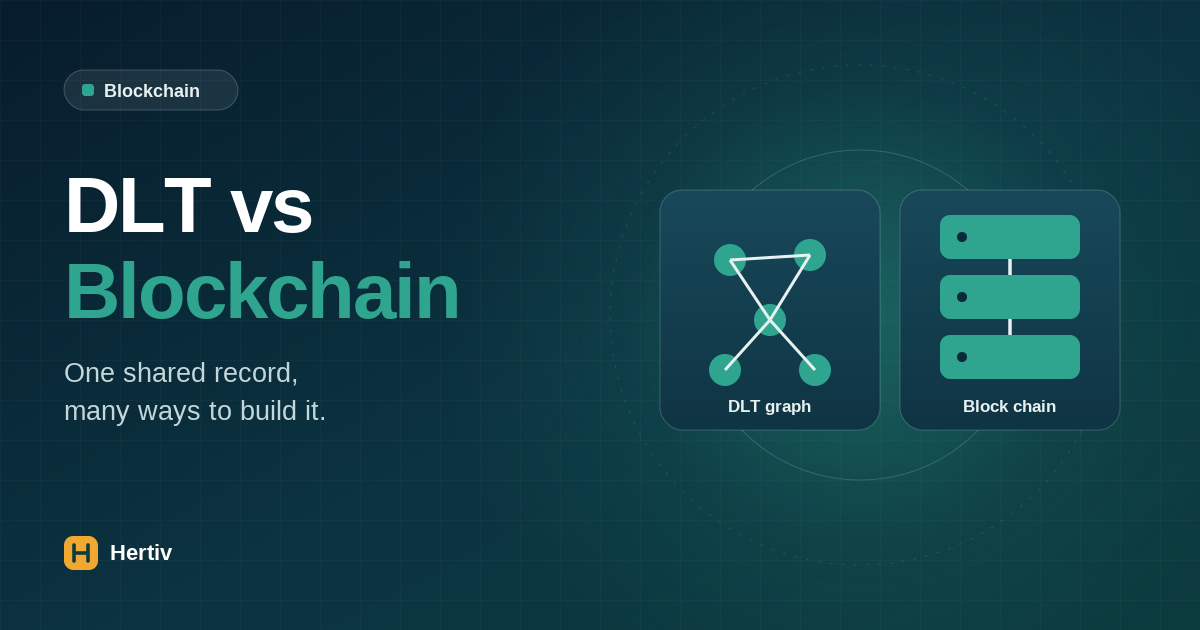
The difference is one of scope. DLT is the broad idea of a shared, synchronised record. Blockchain is a specific design inside that idea, defined by blocks and a chain of hashes. Other DLT designs exist: some store records in a directed graph, where each new record points to earlier ones, and some use a shared table with a voting step instead of blocks.
That matters because the word "blockchain" is often used when the speaker means DLT in general. If a vendor says its product is a blockchain, ask whether records are actually grouped into blocks and chained together. If they are not, the product may still be a sound distributed ledger, but it is not a blockchain. For the basics of the blockchain design itself, see what a blockchain is.
How does distributed ledger technology work?
A distributed ledger works by giving every participant a copy of the same record and a way to agree on changes. When one party proposes a new record, the others check it against the rules they share, and once enough of them agree, each copy is updated. No single party holds the only version, so no one can quietly rewrite history.
Agreement, or consensus, is the heart of the design. In a permissioned ledger, a known set of participants votes on each change. In a permissionless ledger, anyone can join the process, so agreement needs a rule that stops one party from voting many times, such as proof of work or proof of stake. The ledger itself does not decide who is right; the consensus rule does.
Ledgers also need a way to order records, so two parties cannot spend the same asset at the same time. Blockchains order records by putting them in blocks in sequence. Graph-based ledgers order them by linking each record to the ones it builds on. Table-based ledgers order them by the vote that approves them. The mechanism differs, but the job is the same: one shared order everyone accepts.
How does a blockchain work?
A blockchain works by grouping transactions into blocks, hashing each block, and linking it to the block before it. A hash is a short fingerprint of the block's contents, so changing one character in an old block changes its hash and breaks the link to every block after it. That makes tampering easy to spot.
Before a block is added, the network must agree it is valid. In public blockchains, miners or validators compete or stake funds to earn the right to propose the next block. In private blockchains, a known group of validators signs each block. Either way, the rule is the same: a block joins the chain only when the network accepts it.
The chain structure gives blockchains two strengths. First, the record is append-only, so history is preserved and disputes can be settled by reading the chain. Second, every participant can check the chain themselves, which removes the need to trust a single operator.
The cost is speed: waiting for the network to agree on each block is slower than writing to a plain database. If you are weighing a chain against other ledger designs, blockchain interoperability shows how chains connect to other systems.
DLT vs blockchain: side-by-side comparison
The table below puts the two ideas side by side. The first row is the one to remember: blockchain is a subset of DLT, not a rival to it.
| Feature | Distributed ledger technology | Blockchain |
|---|---|---|
| What it is | The broad idea of a shared, synchronised record | One type of DLT, using linked blocks |
| How records are stored | Graphs, tables or blocks, depending on design | Always in blocks, chained by hashes |
| How agreement is reached | Voting, staking or other consensus rules | Block validation by miners or validators |
| Who can join | Open or restricted, by design | Public or private, by design |
| Typical speed | Can be fast when the group is small and known | Slower, because each block needs network agreement |
| Best known for | Shared records across organisations | Cryptocurrencies and tokenised assets |
Notice that most rows are the same for both columns. That is the point: the two share the same goal of a record nobody owns alone. They differ in the shape of the record and in how agreement is reached.
When should you choose DLT, and when blockchain?
Choose a non-blockchain DLT when you need a shared record among known parties and speed matters more than public verifiability. A group of banks settling trades, or suppliers tracking parts through a chain, may not need blocks at all. A graph-based ledger can confirm each record quickly, because only the parties involved need to agree, and the full network does not have to vote on every entry.
Choose a blockchain when the record must be checkable by strangers and the history must be hard to rewrite. Public blockchains suit open networks where anyone can join and no one is trusted in advance. Private blockchains suit regulated settings where the participants are known but the record still needs an audit trail that no single party can alter. In both cases, the chain of hashes is what gives outsiders confidence in the record.
Choose neither when a plain shared database would do. If one organisation owns the data, or if all parties already trust each other and a single operator, a database is simpler, faster and cheaper. A distributed ledger earns its cost only when several parties need the same record and none of them wants the others to control it. Enterprise blockchain work usually starts with this question, not with a choice of platform.
Example (hypothetical): a trade-finance network picks a design
Example (hypothetical): eight banks share a trade-finance network that processes 200 shipping documents a day. Each document must be checked by four of the eight banks before it is accepted, so the network performs 200 times 4, or 800 checks a day. The question is which ledger design fits.
On a blockchain, the 200 documents are grouped into blocks of 50, so the network agrees on 4 blocks a day. Each block needs the whole network to validate it, which takes about 10 minutes per block, or 40 minutes of agreement time a day. On a graph-based ledger, each document is checked only by its four assigned banks, so the work is spread out and a document is confirmed in about 2 minutes.
The banks pick the graph design, because all eight are known and regulated, and speed matters more than letting strangers verify the record. They keep the blockchain option in mind for a later step, when they plan to open the network to shipping companies that are not banks. The lesson is that the design follows the trust model, not the other way round.
What are the common mistakes?
The most common mistakes are treating DLT and blockchain as the same thing, picking a blockchain for a problem a database would solve, and forgetting the cost of agreement.
- Using the words interchangeably. Saying "blockchain" when you mean a shared record leads to wrong expectations about speed, cost and who can verify the data.
- Choosing a blockchain by default. If one organisation owns the data and everyone trusts it, a database is simpler and faster.
- Ignoring consensus costs. Every design pays for agreement somehow, in time, in fees or in hardware, and that cost grows with the number of participants.
- Forgetting privacy. A shared record is not a private one: decide what each participant can see before you build.
- Skipping the exit plan. Moving data out of a ledger is hard, so agree on export and migration before the first record is written.
A short pilot answers most of these questions. Build the smallest version of the shared record, measure how long agreement takes, and check who can see what. If the pilot works, scale it; if it does not, you have learned cheaply. Blockchain development teams usually start exactly this way.
Key takeaways
- DLT is the broad idea of a shared record; blockchain is one design inside it
- Blockchains store records in linked blocks; other ledgers use graphs or tables
- Every design pays for agreement, in time, fees or hardware
- Use DLT when known parties share a record; use a blockchain when strangers must verify it
- Start with a small pilot and measure agreement time before scaling
Frequently asked questions
Is a blockchain the same as a distributed ledger?
No. A blockchain is one type of distributed ledger. Every blockchain is a distributed ledger, because it shares a record across many copies, but a distributed ledger is not always a blockchain: some designs store records in graphs or tables instead of blocks.
Can a distributed ledger exist without blocks?
Yes. Graph-based ledgers link each new record to earlier ones without grouping them into blocks, and some ledgers use a shared table with a voting step. These designs can confirm records faster than a blockchain, because only the parties involved need to agree.
Which is faster, DLT or blockchain?
It depends on the design. A permissioned ledger with a small, known group of participants can confirm records quickly. A public blockchain is slower, because the whole network must agree on each block. Speed is a property of the design and the group, not of the label.
Do I need a blockchain or a database?
Use a database when one organisation owns the data or when all parties trust a single operator. Use a distributed ledger when several parties need the same record and none of them should control it alone. The ledger earns its extra cost only when trust is genuinely shared.
What is a permissioned ledger?
A permissioned ledger is a distributed ledger where only approved participants can read, write or validate records. It suits banks, suppliers and other groups that know each other but still want a shared record no single member controls.
Is Bitcoin a DLT or a blockchain?
Both. Bitcoin runs on a public blockchain, and that blockchain is a distributed ledger: thousands of copies of the same record, kept in sync by the network. Calling it a blockchain is the more precise description, because it names the design.


