Digital Transformation Strategies That Work for Business
A digital transformation strategy ties technology change to business results, not a shopping list of tools. The ones that work start from one costly problem.
On this page
Short answer
A digital transformation strategy is a plan that ties technology change to business results, starting from one costly problem rather than from a list of tools to buy. It states what will change, in what order, who owns it and how success will be measured, before any software is chosen.
What is a digital transformation strategy?
A digital transformation strategy is a plan that ties technology change to business results, starting from one costly problem rather than from a list of tools to buy. It states what will change, in what order, who owns it and how success will be measured, before any software is chosen.
The word transformation is often used loosely. Replacing paper forms with a web form is digitisation, and it is useful, but it is not transformation. Transformation means the work itself changes: a manual approval chain becomes an automated flow, or a product that was sold once becomes a service billed monthly.
A strategy matters because technology projects without one tend to drift. Teams buy tools, run pilots and present demos, yet the underlying process stays the same. A written strategy keeps every project tied to a result the business cares about, such as lower cost per order, faster delivery or fewer errors.
| Strategy | What changes | Typical first project |
|---|---|---|
| Digitise processes | Manual work becomes automated flows | Order entry or approvals |
| Modernise systems | Old software replaced or rebuilt | Core system or data platform |
| Data and AI | Decisions use live data, not habit | Forecasting or pricing |
| New digital products | New revenue from digital channels | Customer portal or app |
| Operating model | Teams and roles change with the tech | Shared services or support |
Which strategy fits your business?
The right strategy depends on where the pain is. A company losing orders to slow manual work should digitise processes first. A company whose core system cannot change should modernise systems first. A company with good data but slow decisions should start with data and AI.
Most businesses should pick one strategy and one project, not all five at once. A single project that saves real money earns trust and funding for the next one. Five projects started together usually compete for the same people and stall.
Ask three questions before choosing: which process costs the most time or money, which system blocks change most often, and which team is ready to change how it works. The answers point to the strategy. The cost of getting this wrong is covered in the cost of digital transformation, which breaks down where budgets usually go.
Where to start: assess, pick, pilot
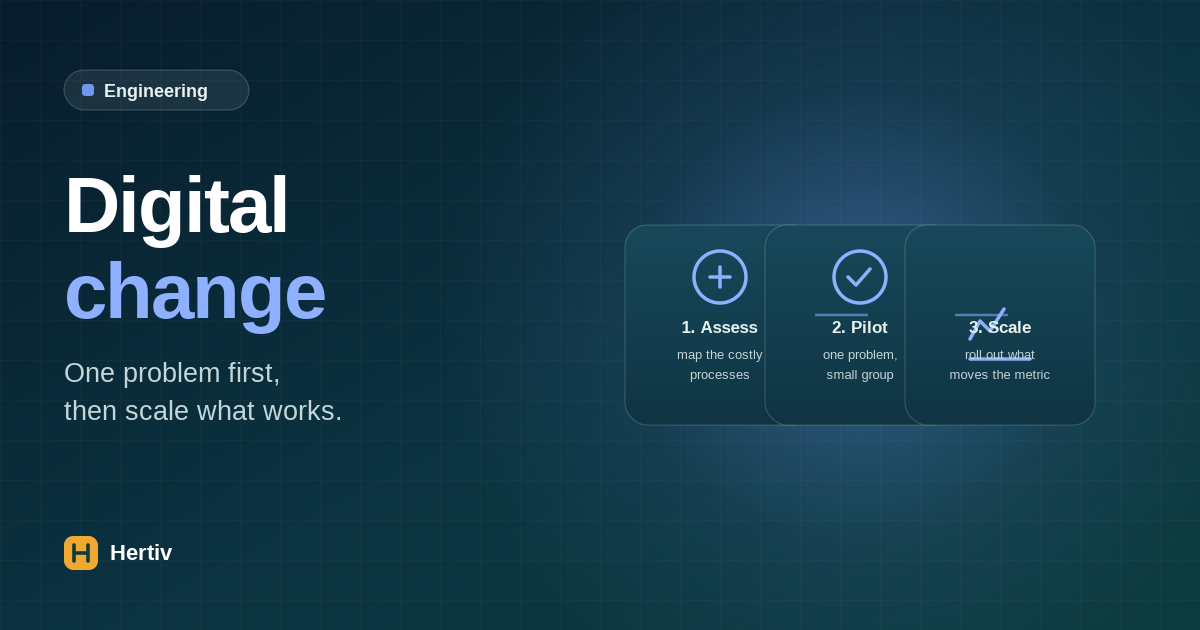
Start by assessing the current state honestly. Map the five most expensive or slowest processes, list the systems they run on, and note where data lives. This takes weeks, not months, and it stops the team from fixing a process that was never the problem.
Next, pick one problem with a clear owner and a measurable result. Good first problems include order entry that takes days, approvals that wait on one person, or stock counts that are always wrong. The owner must be a business manager, not an IT manager, because the change is to how work is done.
Then run a pilot with a small group and a fixed end date. A pilot that runs for six weeks and is measured against a baseline teaches more than a year-long programme that never ships. If the pilot works, roll it out; if it fails, you have learned cheaply. Plan the rollout so the business keeps running, as in digital transformation without downtime.
People, process and technology
Technology is the smallest part of a transformation. People and process decide whether the new system is used or quietly ignored. A new tool with the old process is just a faster way to do the wrong thing.
Process comes first: redesign the work before choosing the software. Map the current steps, remove the ones that add no value, and only then automate what is left. Automating a bad process just makes bad work faster.
People come next. Staff need training, time to practise and a reason to change. The reason is usually that the new way removes a task they hate, such as retyping data or chasing approvals. If the change only adds work for them, they will resist it, and they will be right.
Technology comes last, chosen to fit the redesigned process. This order feels slow, but it is faster in practice: software bought before the process is designed usually needs to be replaced or heavily customised. For the build itself, custom software development fits when off-the-shelf tools cannot match the redesigned process.
How to measure progress
Measure results, not activity. The number of tools bought or meetings held tells you nothing. Pick one metric per project before it starts, and track it every month.
Useful metrics include cost per order, time from order to delivery, error rate, staff hours spent on manual entry, and customer waiting time. Each one is easy to measure and hard to argue with. A project that moves one of these numbers is working; a project that moves none of them is not.
Review progress monthly with the business owner, not just the project team. If a metric is not moving after three months, change the approach or stop the project. Stopping a failing project early is a success, because it frees people and budget for work that does move the number. Cloud platforms often carry the new systems, so cloud services are part of most measurement plans.
Example (hypothetical): a 300-person distributor
Example (hypothetical): a distributor with 300 staff takes 200 orders a day by phone and email, and staff retype each order into the system. Order entry takes 20 minutes per order.
Manual entry: 200 orders times 20 minutes equals 4,000 minutes a day, or about 67 hours a day across the team. The team builds a customer portal and an automated order flow, cutting entry to 5 minutes per order. New entry: 200 times 5 equals 1,000 minutes, or about 17 hours a day. Saving: 67 minus 17 equals 50 hours a day.
The project takes two people for 26 weeks at 40 hours a week, which is 2,080 hours, at $70 an hour, which is $145,600, plus $20,000 for tools, giving $165,600 in total.
At 50 hours saved a day and a loaded cost of $40 an hour, the saving is $2,000 a day, so the project pays for itself in about 83 working days. The arithmetic is simple; the hard part is getting customers to use the portal, which is why the pilot starts with the ten largest customers.
Common mistakes in digital transformation
The most common digital transformation mistakes are buying software before redesigning the process, and running too many projects at once.
- Buying tools first. Software chosen before the process is designed rarely fits.
- Too many projects at once. Five pilots compete for the same people and stall.
- No business owner. A project owned only by IT becomes a technology project, not a business change.
- No baseline metric. Without a before number, you cannot prove the after number.
- Ignoring the people who do the work. Staff who were never consulted will not adopt the new way.
- Big-bang rollout. Changing everything at once creates outages and resistance.
Key takeaways
- A strategy ties technology change to a business result
- Pick one strategy and one project, not five at once
- Redesign the process before choosing the software
- Measure one metric per project, every month
- Staff adoption decides whether the change sticks
Frequently asked questions
How long does digital transformation take?
There is no fixed timeline. A single process project can show results in a few months, while a full transformation of a mid-size company usually takes one to three years. The work is better run as a series of small projects than as one large programme.
What is the difference between digitisation and digital transformation?
Digitisation turns paper or manual steps into digital ones without changing the work itself. Transformation changes how the work is done, such as replacing an approval chain with an automated flow or turning a one-off sale into a service.
Do small businesses need a digital transformation strategy?
Yes, but a short one. A small business can write a one-page plan naming the costliest process, the first project and the metric it will move. The plan matters more than its length, and a one-page plan that is followed beats a long one that is not.
What is the biggest risk in digital transformation?
The biggest risk is building something nobody uses. That happens when the process was never redesigned, staff were never consulted, or the project had no business owner. A pilot with real users and a fixed end date catches this early.
Should we hire consultants for digital transformation?
Consultants can help with assessment and design, but the business must own the strategy. An outside team can map processes and build software, yet only internal managers can change how their teams work. Keep ownership inside the company.
How much does digital transformation cost?
It depends on scope: a single process project can cost less than a new hire, while a full programme runs into six figures and beyond. The honest answer is to price one project at a time, starting with the one that pays for itself fastest.


