What Are Diffusion Models and How Do They Work?
A diffusion model creates images, audio and video by learning to remove noise step by step. How it works, where it is used, and what it costs to run.
On this page
Short answer
A diffusion model is a generative model that creates new content by learning to reverse a process that gradually adds noise to data. During training it sees data at many noise levels and learns to predict the noise, so at generation time it can start from pure noise and remove it step by step until a clean image, sound or video remains.
What is a diffusion model?
A diffusion model is a generative model that creates new content by learning to remove noise from data, one small step at a time. It starts from pure random noise and runs a learned denoising process until a clean image, sound clip or video appears.
The idea comes from physics, where diffusion describes how a substance spreads out until it is evenly mixed. In machine learning, the model is trained on the reverse of that process: given a noisy version of a real example, it learns to predict what was removed, and repeating that prediction many times rebuilds the example.
Diffusion models became the standard approach for image generation in the early 2020s, and they now appear in text-to-image tools, image editors, music generators and video tools. Their main strength is quality: they produce sharp, detailed results and handle fine texture better than most earlier generative approaches.
They are not the only generative approach. Other families, such as generative adversarial networks and autoregressive models, generate in a single pass or one piece at a time. Diffusion trades speed for quality, since it needs many steps to produce one result. If you want the training detail, how to train a diffusion model covers the steps in order.
How does the forward process add noise?
The forward process adds noise to a training example in small steps until nothing of the original is left. At each step the data is mixed with a little random noise, and after enough steps the result looks like pure static.
The schedule matters. Early steps add a small amount of noise, so the broad shapes are still visible, and later steps add more, so only fine detail is destroyed first and large structure last. A common schedule runs for hundreds or a thousand steps, with the noise level rising gradually from almost nothing to almost everything.
The forward process needs no learning at all. It is a fixed recipe applied to real data, and its only job is to produce training examples at every noise level, from a nearly clean image to pure noise. That gives the model a full ladder of examples to learn from.
Think of it like a photograph left in the sun: the image fades a little each day until only blank paper is left. The forward process is that fading, done in a controlled way so the model can learn to run it backwards.
How does the reverse process create new content?
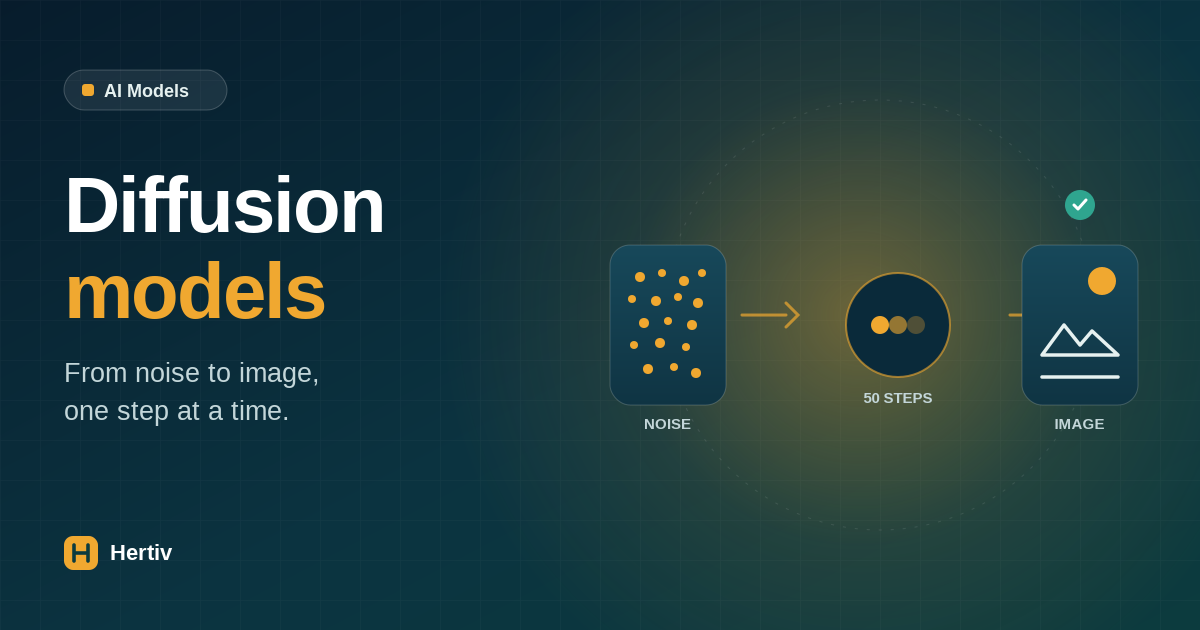
The reverse process creates new content by starting from pure noise and removing a little of it at a time, using the trained model to guess what should be there. Each step makes the result slightly cleaner, and after all the steps a finished image, sound or video appears.
At each step the model looks at the current noisy version and predicts the noise that was added to it. It subtracts that prediction, which moves the result one step closer to clean data. Because the model was trained at every noise level, it knows what a slightly cleaner version should look like at each point.
The number of steps is a setting you choose. More steps usually mean better quality, because each correction is smaller and the model has more chances to fix errors. Fewer steps are faster but can leave blur or artefacts, so most tools let you trade quality against time.
Guidance controls what the model makes. A text prompt is fed into the model at every step, so the denoising is steered toward the described subject, style and composition. Stronger guidance follows the prompt more closely; weaker guidance gives the model more freedom.
What are diffusion models used for?
Diffusion models are used most for image generation, but the same idea now covers audio, video, 3D shapes and scientific data. The common thread is any data type where a good result can be reached by removing noise in stages.
| Use | What the model produces | Typical input |
|---|---|---|
| Text-to-image | Images from a written prompt | Prompt, style words, size |
| Image editing | Changed regions of an existing image | Image, mask, prompt |
| Audio and music | Sound clips, songs, voice | Prompt, reference audio |
| Video | Short clips from text or an image | Prompt, first frame |
| 3D shapes | Models for games and product views | Prompt, reference image |
| Drug and material design | Candidate molecules and structures | Target properties |
Image editing is a strong fit because the model can denoise only the part of the image you select, leaving the rest untouched. That is how tools replace a background, change an object or extend an image beyond its edges without redrawing the whole picture.
Video is harder, because each frame must stay consistent with the ones before it. Most video tools generate short clips and keep the motion simple, then rely on the same denoising steps applied across frames. For the best-known image models, the best Stable Diffusion models compares the options.
How are diffusion models trained?
Diffusion models are trained by showing the model noisy examples and asking it to predict the noise, over and over, at every noise level. The training data is a large set of real examples, such as images with captions, and the model learns the patterns that separate signal from noise.
Training runs like this. First, pick a real example and a random noise level. Next, add that much noise to the example. Then ask the model to predict the noise that was added. Finally, measure the error and update the model so its next prediction is closer. Repeat that loop millions of times across the whole dataset.
Two design choices shape the result. The noise schedule sets how fast noise is added, and the model architecture sets how the prediction is made. Most image models use a U-Net style network that reads the noisy input at several scales, so it can judge both broad shapes and fine detail at once.
Training is expensive, because the model must learn to denoise at every level, and the dataset must be large and varied. That is why most teams use a pre-trained model and adapt it, rather than training from scratch. Fine-tuning on a smaller set of your own images is the usual route for a specific style or subject.
Example (hypothetical): a design team generates product images
Example (hypothetical): a small design team needs 100 product images for a new catalogue, each showing the same lamp in a different room setting. Hiring a photographer for 100 setups would take weeks, so the team uses a diffusion model instead.
Each image takes 50 denoising steps, and each step takes about 0.2 seconds on the team's graphics card. That is 100 images times 50 steps, which is 5,000 model passes, and 5,000 times 0.2 seconds is 1,000 seconds, or about 17 minutes of generation time.
The team then reviews the results. About 70 of the 100 images are good enough to use as they are, and 30 need a prompt change or a second run. The rework takes another 30 images times 50 steps times 0.2 seconds, which is 300 seconds, or 5 minutes. The total is about 22 minutes of generation for a full catalogue.
The point is not that generation is free. The team still spends time writing prompts, checking results and fixing the failures. The saving comes from avoiding 100 separate photo setups, not from skipping the review step. For brand work, diffusion models for brand success covers how teams keep generated images on brand.
What are the common mistakes?
The most common diffusion model mistakes are expecting perfect results from one prompt, skipping the review step, and treating generated output as free of legal or quality risk.
- One prompt, one try. A single prompt rarely gives a usable result. Plan for several rounds of prompt changes and re-runs.
- Too few steps. Cutting the step count to save time leaves blur and artefacts. Test the lowest step count that still looks clean.
- Ignoring the training data. A model trained on generic images will not know your product, logo or style. Fine-tune or use reference images.
- No review step. Generated images can contain wrong text, extra fingers or mixed-up objects. Check every image before it ships.
- Forgetting rights and licences. Check the licence of the model and the rules for commercial use before publishing generated work.
- Overfitting the prompt. Packing a prompt with every detail at once makes the result worse. Start simple and add one detail at a time.
Key takeaways
- A diffusion model creates content by learning to remove noise step by step, starting from pure noise
- The forward process adds noise on a fixed schedule; the reverse process is what the model learns
- More denoising steps usually mean better quality, at the cost of slower generation
- Text prompts steer the denoising at every step, which is how the model follows a description
- Image editing, audio, video and 3D all use the same denoise-in-stages idea
- Every generated result needs a human review step before it ships
Frequently asked questions
What is a diffusion model in simple terms?
It is a model that learns to turn noise into a clean result by removing a little noise at a time. It is trained on examples with noise added at many levels, so it learns what clean data looks like at each stage, and can then start from pure noise and work backwards to a finished image, sound or video.
How is a diffusion model different from a GAN?
A GAN trains two networks against each other, one that generates and one that judges, and produces a result in a single pass. A diffusion model produces its result over many small denoising steps. Diffusion models are usually slower but produce sharper, more detailed results and are easier to train stably.
Why do diffusion models need so many steps?
Each step removes only a small amount of noise, so the model can correct its own errors as it goes. A single big jump from noise to a clean image would leave the model guessing too much at once. The step count is a trade-off: more steps give cleaner results, fewer steps give faster results.
Can diffusion models generate video?
Yes, by applying the same denoising process across frames so the motion stays consistent. Most video tools generate short clips, because keeping many frames consistent is harder than generating one still image. Quality improves quickly, but long, complex scenes remain a weak point.
Do you need a powerful computer to run a diffusion model?
For generation, a modern graphics card is usually enough for images at common sizes, and many tools run in the cloud so your own machine does not matter. Training a model from scratch needs far more compute, which is why most teams start from a pre-trained model and fine-tune it.
What does guidance do in a diffusion model?
Guidance controls how closely the result follows the text prompt. Stronger guidance keeps the image tied to the described subject and style, while weaker guidance lets the model improvise more. Too much guidance can make images look stiff or repetitive, so most tools let you set the level.


