DevOps Maturity Model: Find Your Level and Move Up
A DevOps maturity model scores how a team builds, tests and deploys software, from manual work to full automation. Use it to find your level and pick the next step.
On this page
Short answer
A DevOps maturity model is a scale that describes how far a team has come in automating and improving the path from code to production. It usually has four or five levels, from manual builds and deploys to fully automated pipelines with fast feedback, and it helps a team see which capability to improve next instead of copying another team's tools.
What is a DevOps maturity model?
A DevOps maturity model is a scale that describes how far a team has come in automating and improving the path from code to production. It usually has four or five levels, from manual builds and deploys to fully automated pipelines with fast feedback, and it gives a team a shared way to talk about what to improve next.
The model is not a score to chase. It is a map: each level describes what a team can do reliably, and the next level describes the capability that is missing. A team that knows its level can pick one improvement at a time instead of copying another team's tools and hoping they fit.
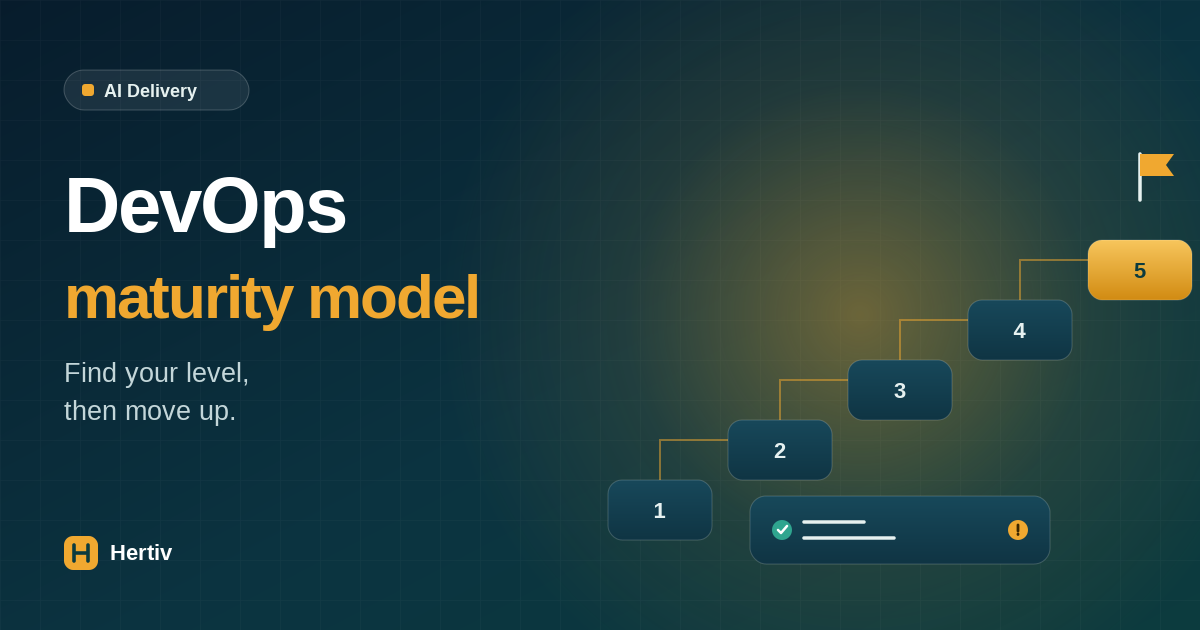
| Level | What the team can do | Typical signs |
|---|---|---|
| 1. Initial | Builds and deploys by hand | Releases are rare and stressful |
| 2. Repeatable | Scripts and a basic pipeline exist | Deploys work but need manual steps |
| 3. Defined | Automated tests and pipeline for every change | Most releases go out without drama |
| 4. Managed | Metrics, alerts and rollback in place | Problems are found before users report them |
| 5. Optimising | Continuous delivery with fast feedback | Small changes ship daily with confidence |
Different models use different names for the levels, but the shape is the same: manual, then repeatable, then defined, then measured, then improving. The rest of this article uses those five levels. For the basics, see what DevOps is.
What does each level look like in practice?
At level 1, everything is manual. A developer builds the code on their own machine, copies files to a server, and hopes the result matches what worked locally. Releases are rare because each one is risky, and when something breaks, the team fixes it by logging into the server.
At level 2, the team has scripts and a basic pipeline. Builds run on a shared server, deploys follow a written checklist, and the same steps run the same way each time. Manual steps remain, usually around testing and approvals, and a release still needs someone to watch it.
At level 3, the pipeline runs every change through automated tests, and a change that passes can be deployed without a meeting. At level 4, the team adds metrics and alerts, so it knows when a deploy goes wrong within minutes and can roll back. At level 5, releases are small, frequent and boring, and the team spends its time improving the pipeline rather than fighting it.
Most teams sit at level 2 or 3. That is normal: the jump from 3 to 4 needs monitoring and rollback habits, and the jump to 5 needs trust in the tests. Knowing which level you are at keeps the next step realistic.
How do you assess where your team stands?
You assess where your team stands by looking at what actually happens during a release, not at what the tools claim. Ask how a change gets from a laptop to production, who has to approve it, how long it takes, and what happens when it fails.
Score five areas honestly: build and test automation, deploy automation, monitoring and alerts, how fast you recover from failure, and how the team works together. Give each area a level from 1 to 5, using the descriptions in the table above, and note the evidence for each score.
Use a short survey and a walkthrough of the last three releases. If the last three releases all needed manual fixes, the deploy score is 2 no matter what the pipeline diagram says. If recovery took a day, the recovery score is low even if the monitoring dashboard looks good.
Do the assessment as a team, not as a manager's verdict. The people who run the releases know where the manual steps hide, and their answers are the assessment. The result is a short list of the weakest areas, which is exactly what the next section uses. For the build sequence, how to implement DevOps in your team shows the steps.
How do you move from one level to the next?
You move from one level to the next by fixing the weakest area first, one change at a time, and proving it works before moving on. Trying to jump two levels at once usually stalls, because each level depends on the habits of the one before it.
- Pick the lowest-scoring area from the assessment and define what the next level looks like for it.
- Automate one manual step in the pipeline, such as running the tests on every change.
- Add a safety net for the new automation, such as a rollback step or an alert when a deploy fails.
- Run three releases with the change in place and check that it works without heroics.
- Record the new way of working in a short runbook, then reassess and pick the next area.
Each step is small on purpose. A team that automates tests this month and adds rollback next month moves further than a team that plans a full platform rebuild and ships nothing. The best practices guide lists DevOps best practices that work in real teams.
What should you measure at each level?
You should measure what shows whether releases are getting safer and faster, not how busy the team looks. The four DORA metrics are the usual starting point: how often you deploy, how long a change takes to reach production, how often a change causes a failure, and how fast you recover.
At levels 1 and 2, measure the basics: deploy frequency and how long a release takes from code complete to live. If you deploy once a month and a release takes a week, the numbers themselves make the case for automation.
At levels 3 and 4, add change failure rate and time to recover. A team that deploys daily but breaks production weekly has a testing problem, and a team that takes a day to recover has a monitoring problem. The metrics point at the next fix.
At level 5, measure the feedback loop: how quickly a developer learns that a change is safe, and how often a small change ships the same day. If feedback is fast, the team ships with confidence; if it is slow, the pipeline is the bottleneck. For the metrics in detail, see DORA metrics for DevOps.
Example: a 30-person team moves from level 2 to level 3
Example (hypothetical): a 30-person software team ships a web app to 200 customers. It deploys once every two weeks, and each release takes a full day, with two engineers watching it. Tests run on a developer laptop, not in the pipeline.
The assessment scores the team at level 2 for builds, level 2 for deploys and level 1 for recovery, because a failed release takes a day to fix. The team picks testing first: it moves the tests into the pipeline so every change is tested automatically before it can be deployed.
The numbers add up. A release used to take 2 engineers times 8 hours, which is 16 hours of work, plus a day to fix failures about half the time. After three months of automated tests, releases take 3 hours, failures drop from 1 in 2 releases to 1 in 10, and recovery takes 2 hours because the team added a rollback step.
The team then reassesses and finds deploys are now level 3 while recovery is level 2, so the next project is alerts and rollback. The model worked because it gave the team one clear next step instead of a long list of tools to buy.
What are the common mistakes?
The most common maturity-model mistakes are treating the level as a grade, copying another team's tools, and measuring activity instead of outcomes. The model is a guide, not a report card.
- Chasing a level number instead of fixing the weakest capability, which buys tools without improving releases.
- Copying a large company's platform when the team is ten people, and spending months on setup.
- Scoring the team from the tool list rather than from what the last three releases actually needed.
- Automating a broken process, so the pipeline now produces the same errors faster.
- Measuring ticket counts or lines of code instead of deploy frequency, failure rate and recovery time.
Avoid these by keeping the assessment honest and the next step small. One real improvement beats a perfect score on paper, and the score should follow the work, not lead it.
Key takeaways
- A maturity model is a map, not a grade: it names the next capability to build
- Assess from the last three releases, not from the tool list
- Fix the weakest area first, one change at a time
- Measure deploy frequency, failure rate and recovery time at every level
- Small, frequent releases are the sign the model is working
Frequently asked questions
What is the simplest DevOps maturity model?
A five-level scale from manual work to continuous delivery: initial, repeatable, defined, managed and optimising. Each level describes what the team can do reliably, and the next level names the capability that is missing. It is simple enough to explain in one meeting.
How long does it take to move up a level?
One level usually takes a few months of steady work, because the change is about habits as much as tools. A team that automates tests this quarter and adds rollback next quarter moves faster than one that plans a full platform rebuild and ships nothing.
Do small teams need a maturity model?
Yes, and the model is more useful for small teams, because it stops them copying a large company's platform. A ten-person team needs one clear next step, such as automated tests, not a platform that takes months to set up.
What are DORA metrics?
Four measures of delivery performance: how often you deploy, how long a change takes to reach production, how often a change causes a failure, and how fast you recover. Together they show whether releases are getting safer and faster.
Should we assess ourselves or hire someone?
Start with a self-assessment by the people who run the releases, using the last three releases as evidence. An outside review helps when the team disagrees about its level, but the team's own view is usually honest enough to pick the next step.
What if different areas are at different levels?
That is normal. Most teams are ahead in one area and behind in another, such as good builds but slow recovery. The model works by naming the weakest area, so you fix that one first instead of improving what is already fine.


