DeFi PoC to Production MVP: How Teams Ship It
A DeFi proof of concept tests one risky idea; a production MVP is a small live product with real users and real money. Here is the path between them.
On this page
Short answer
A DeFi proof of concept to production MVP is the path from a small test of one risky idea to a live product that real users can use with real funds. The proof of concept answers one question, such as whether a swap price holds up. The MVP is the smallest working version that is safe enough to launch, with audits, limits and a way to pause it.
What is a DeFi PoC to production MVP?
A DeFi proof of concept, or PoC, to production MVP is the sequence that takes a decentralised finance idea from a rough test to a live product. The PoC proves one risky assumption. The MVP is the smallest version that real users can try with real money, under limits, and the production launch is that MVP running with real funds at real scale.
The stages are often confused, and the confusion is costly. A PoC is not a product: it runs on a test network, uses fake funds and can be thrown away. An MVP is a product, even a small one: it holds real funds, so it needs audits, access controls and a pause switch before anyone deposits.
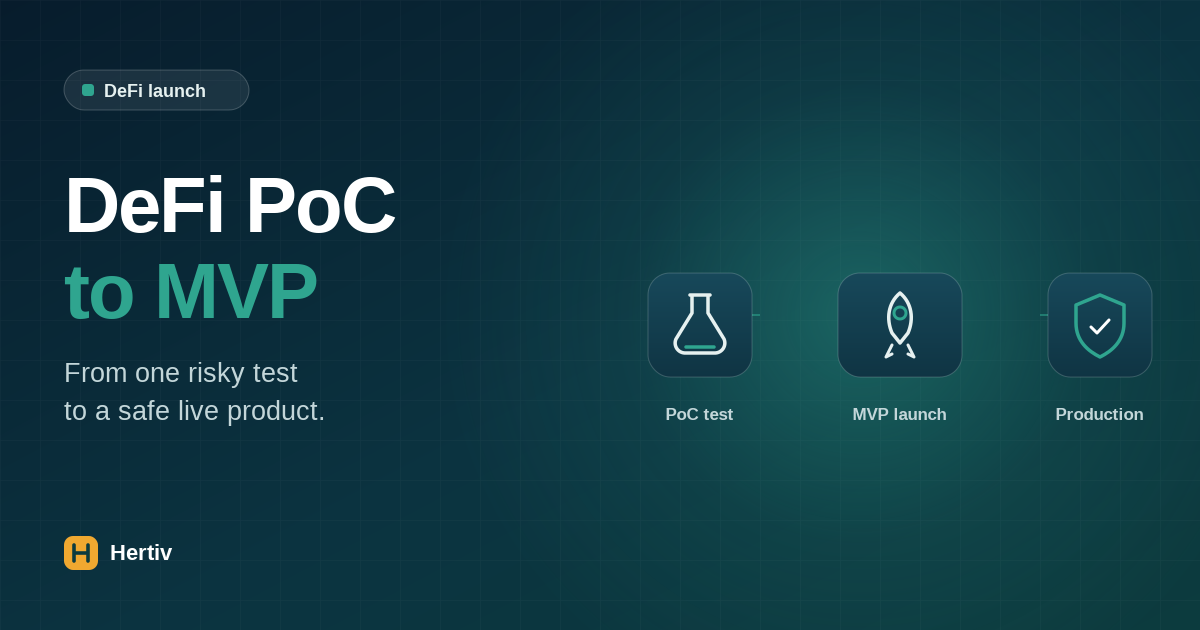
| Stage | What it proves | Exit test |
|---|---|---|
| Proof of concept | One risky idea works | The test answers the question either way |
| MVP | Users will use it with real funds | Core flow works end to end, audited, capped |
| Production | It holds up at real scale | Limits raised step by step, no new failures |
The path is a funnel, not a straight line. Most ideas fail at the PoC stage, and that is the point: a cheap failure on a test network beats an expensive failure with real deposits. For the general build steps, the DeFi development guide covers the building blocks, while this article covers the journey from test to live.
What should the proof of concept prove first?
The proof of concept should prove the single riskiest assumption first, not the easiest one. If the idea depends on a swap price holding during a fast trade, test that. If it depends on users supplying liquidity, test that. Everything else can wait.
A good PoC has one question written down before any code is written, and a clear pass or fail line. A swap PoC might ask whether a trade of a set size loses less than a set amount to price movement. A lending PoC might ask whether a liquidation triggers within a set number of blocks.
The PoC runs on a test network with fake tokens, and it should take weeks, not months. If the PoC grows into a full product with a user interface and a token, it has stopped being a test and started being an un-audited launch, which is the most dangerous stage to be in.
Write down what the PoC will not test. User experience, fees at scale and governance can all be tested later. The PoC exists to kill a bad idea early or to give the team the confidence to build the MVP.
How do you build the MVP?
You build the MVP by cutting the PoC down to the smallest flow that a real user can complete with real funds, then adding the safety parts the PoC skipped: access control, deposit limits, a pause switch and an audit.
Pick one flow and build only that. A lending MVP might support one asset pair, one deposit type and one borrow type. A swap MVP might support two tokens and one route. Every extra token, pair or feature is a new surface for bugs and a new thing to audit.
The contracts should be small and readable. A contract that does one job well is easier to audit than a contract that tries to do five things. Use tested libraries for the standard parts, such as token handling and access control, and write custom code only where the product is genuinely different.
Set the limits before launch: a cap on total deposits, a cap per user and a cap on any single trade. The limits are the safety net while the MVP is new, and they can be raised in steps once the product has run without incident.
Where do security and audits fit?
Security and audits fit between the MVP and the production launch, and they are not optional once real funds are involved. A PoC can skip an audit because it holds no real money. An MVP cannot.
The usual order is an internal review first, then an external audit, then a fix period, then a re-check of the fixes. The internal review catches the obvious issues: who can change the rules, what happens when a price feed fails, and whether the pause switch actually works.
An audit finds problems, but it does not make a product safe on its own. The team still needs monitoring for strange behaviour, a plan for freezing the product if something goes wrong, and a way to contact users quickly. A bug bounty after launch can help, but only after the audit fixes are in.
Keep a record of every audit finding and what was done about it. Users and partners will ask, and a clear record builds more trust than a claim that the product was audited. For the cost side of the work, the DeFi development cost breakdown shows what to budget for.
How do you move from MVP to production?
You move from MVP to production by raising the limits in steps, adding the features users actually asked for, and watching the product under real load before each raise. There is no single launch day; there is a series of small steps.
Start with the cap low and the monitoring tight. Watch deposits, trades, failed transactions and price-feed behaviour for at least a few weeks. If nothing breaks and the numbers behave as expected, raise the cap and add the next asset or pair.
Each step needs a rollback plan. If a new pair behaves badly, the team should be able to pause it without stopping the whole product. That is why the pause switch and the per-feature limits matter more than any single feature.
Governance can come later, but the rules for changing the product should be written down early: who can change a fee, who can add a token, and how quickly. A product that changes its rules without warning loses users faster than one that ships slowly. A short blockchain PoC guide is useful if the team is still at the testing stage.
Example (hypothetical): a lending pool goes live
Example (hypothetical): a small team builds a lending pool for one stablecoin and one collateral token. The PoC asks one question: can the pool liquidate a risky loan within 50 blocks on a test network? The test passes, with liquidations completing in about 30 blocks.
The MVP launches with a cap of 500,000 in total deposits and a cap of 25,000 per user. In the test phase, 200 test deposits averaging 250 each add up to 50,000 in test value. In the first four weeks live, 1,200 real deposits averaging 400 each add up to 480,000, just under the cap.
Two issues appear. A price-feed delay causes one liquidation to run late, and a handful of users try to deposit above the per-user cap and fail. The team fixes the feed handling, adds a clearer message for the cap, and waits two more weeks before raising the total cap to 1,000,000.
After eight weeks without a new failure, the team adds a second collateral token, keeping the same caps and the same monitoring. The launch took longer than planned, but no user lost funds in the process.
What are the common mistakes?
The most common DeFi PoC-to-production mistakes are treating the PoC as a product, skipping the audit, and raising limits before the product has run quietly for a few weeks.
- Shipping the PoC. A test-network build with fake funds has no access control, no limits and no audit. It must not hold real money.
- Too many features in the MVP. Every extra token and pair is a new audit surface and a new failure mode.
- Skipping the pause switch. Without a way to freeze the product, a bug becomes a loss instead of an incident.
- Raising caps too fast. A product that ran well for three days has not proven it can run well for three months.
- No monitoring plan. If nobody watches deposits and failed transactions, the first sign of trouble is a user complaint.
Key takeaways
- A PoC proves one risky idea on a test network; an MVP is the smallest audited version that holds real funds
- Cut the MVP to one flow, one asset pair and strict deposit caps
- Audit after the MVP is built, fix the findings, then re-check before raising limits
- Move to production by raising caps in steps, with a rollback plan at each step
- Write down who can change fees and add tokens before the product goes live
- Monitor deposits, failed transactions and price feeds from the first live day
Frequently asked questions
How long does a DeFi PoC take?
A focused proof of concept usually takes a few weeks, because it tests one question on a test network with fake funds. If a PoC takes months, it has probably grown into an un-audited product, and the team should stop and cut it back to a single test.
When does a DeFi MVP need an audit?
Before it holds any real funds. A PoC on a test network can skip an audit, but an MVP with real deposits needs an external audit, a fix period and a re-check of the fixes. The audit is part of the launch cost, not an optional extra.
What is the smallest safe DeFi MVP?
One flow, one asset pair, a deposit cap, a per-user cap and a pause switch. That is enough to learn whether users will use the product, and small enough to audit properly. Extra tokens and features can wait until the first version runs without incident.
How do you set deposit caps?
Start low enough that a failure would be painful but not fatal, then raise the cap in steps after weeks of quiet running. The cap should reflect the audit coverage and the monitoring in place, not the team's hopes for growth.
Do DeFi MVPs need a token?
No. Most lending and swap MVPs work without their own token, and adding one early creates extra work: token economics, distribution and legal questions. Launch the product first, and only add a token if it solves a real problem for users.
What kills most DeFi MVPs?
The common causes are a PoC shipped as a product, an audit skipped or rushed, limits raised too fast, and no monitoring. Each one is a process failure, not a technology failure, and each one is avoidable with a written plan and a slow launch.


