How Much Does DeFi Cost to Use?
Using DeFi costs more than the fee you see on screen: gas, swap fees, borrowing rates and slippage all add up. Here is what each part costs and how to keep it down.
On this page
Short answer
Using DeFi costs gas for each transaction, a pool fee of about 0.05% to 0.3% per swap, borrowing interest that moves with demand, and slippage between the quoted price and the price you get. There is no account fee, but the parts add up, so work out the full cost before you confirm.
What does DeFi cost?
DeFi cost is the money you pay to use decentralised finance services: the network fee for each transaction, the fee a trading pool charges, the interest on a loan, and the small losses that come from price moves while your trade runs. There is no account fee and no bank in the middle, but the costs are still real and they add up.
The bill is different from the cost of building a DeFi app. Building costs cover development, audits and hosting, while using DeFi costs cover gas, trading fees and borrowing rates. This article covers the user side; the build side is covered in the DeFi development cost breakdown.
Most of the cost is visible before you confirm a transaction: the wallet shows the network fee and the trading fee. The hidden parts are slippage and the price you get versus the price you expected, which is why the total is often more than the fee line suggests.
What are the main cost parts?
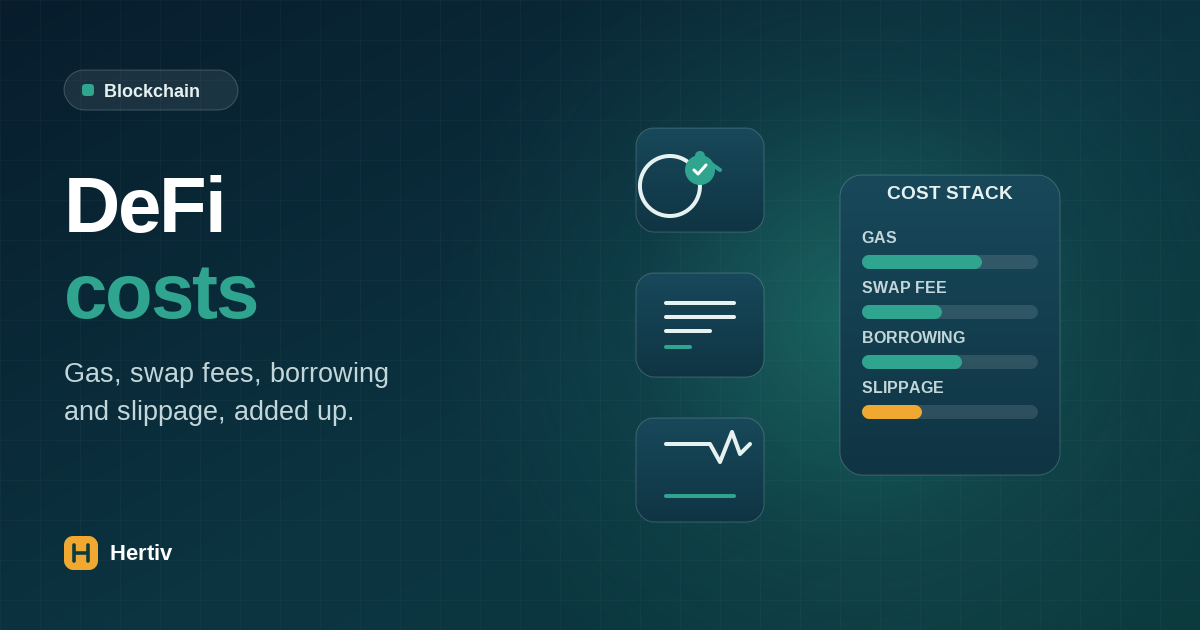
The main cost parts of using DeFi are gas, swap fees, borrowing interest, bridge fees and slippage. Gas pays the network, swap fees pay the pool, interest pays the lender, and slippage is the gap between the quoted price and the price you actually get.
| Cost part | Who gets paid | Planning range |
|---|---|---|
| Gas | The network's validators | $0.01-$10 per transaction |
| Swap fee | The liquidity pool | 0.05%-0.3% of the trade |
| Borrowing interest | The lenders in the pool | Varies with demand |
| Bridge fee | The bridge and the destination chain | $1-$20 per move |
| Slippage | Nobody; it is lost value | 0.1%-1% on normal trades |
Ranges are planning figures, not quotes. Gas depends on the chain and the hour, swap fees depend on the pool, and borrowing rates move with demand. Check the live figures in your wallet before you confirm anything, because a guide cannot know what the network charges today.
How much is gas?
Gas is the fee you pay the network to run your transaction, and it depends on two numbers: how much work the transaction does, and the price of gas at the time. A simple transfer uses 21,000 gas units, while a swap or a loan can use 150,000 to 300,000 units, so complex actions cost several times more than simple ones.
On Ethereum mainnet, a swap at 20 gwei costs 150,000 times 20 gwei, which is 0.003 ETH. At a planning rate of $2,000 per ETH, that is about $6. The same swap on a low-fee chain costs a fraction of that, which is why many users move routine trades to a cheaper network. See how much it costs to build and run on Ethereum for the gas maths in detail.
Gas prices rise when the network is busy and fall when it is quiet. Wallets show a suggested price, and most let you choose a slower, cheaper setting for actions that are not urgent. A trade that can wait an hour is often cheaper than one that must run now.
What do swaps and slippage cost?
A swap costs the pool fee plus slippage. The pool fee is set by the pool, often 0.05% to 0.3% of the trade, and it goes to the people who supplied the liquidity. Slippage is the price move between the quote and the execution, and it is larger for big trades in small pools.
On a $1,000 swap in a deep pool with a 0.3% fee, the fee is $3. If slippage is 0.5%, the trade loses another $5 in value, so the total cost is $8 before gas. The same swap in a thin pool could lose far more to slippage, which is why the pool's size matters as much as its fee.
You can limit slippage by setting a maximum in the wallet. A tight limit protects you from a bad price, but the trade may fail if the price moves past it, and a failed trade still costs gas. A limit around 0.5% suits most normal trades; large trades in thin pools need more care.
What does borrowing cost?
Borrowing in DeFi costs interest that moves with supply and demand in the lending pool. When many people want to borrow the same asset, the rate rises; when lenders outnumber borrowers, it falls. The rate is shown as an annual figure, but interest accrues by the block, so the cost grows from the first hour.
Borrowing also needs collateral, and that collateral has a cost of its own. A loan that needs $150 of collateral for every $100 borrowed ties up money that could earn elsewhere, and if the collateral's price falls, the loan can be liquidated with a penalty on top.
Before you borrow, work out the daily interest, the liquidation price and the fee for repaying early. A loan that looks cheap at 5% a year is not cheap if a price dip liquidates the collateral in the first week. Borrow less than the maximum the pool allows, and keep a buffer.
How do you keep DeFi costs down?
The cheapest way to keep DeFi costs down is to trade less often, use cheaper chains for routine actions, and set slippage limits before you confirm. Every transaction costs gas, so work that can be batched or delayed should be.
- Use a low-fee chain for routine trades. Small swaps and claims cost far less on a rollup or a low-fee chain than on mainnet. See layer 2 cost for planning ranges.
- Batch your actions. One transaction that does several steps costs less than several transactions that each do one.
- Set a slippage limit. A limit of around 0.5% protects normal trades without failing too often.
- Trade in deep pools. A pool with more liquidity loses less to slippage, even if its fee is slightly higher.
- Check gas before you confirm. Non-urgent actions can wait for quiet hours instead of paying peak prices.
None of these steps removes the risk of the position itself. A cheap trade that loses money to a price move is still a losing trade, so cut costs and check the position in the same step.
Example (hypothetical): a month of DeFi use
Example (hypothetical): a user makes 20 swaps in a month, each worth $500, on a low-fee chain, and keeps a $2,000 loan open for the month at a 6% annual rate.
Gas costs $0.50 per swap, so 20 swaps cost $10. Swap fees at 0.3% cost $1.50 per swap, which is $30 for the month. Slippage at 0.5% costs $2.50 per swap, which is $50 for the month.
The loan costs 6% a year on $2,000, which is $120 a year, or $10 for the month. The total for the month is $10 plus $30 plus $50 plus $10, which is $100.
The same month on mainnet would cost far more in gas alone: at $6 per swap, gas would be $120 instead of $10, and the total would be $210. The fees and slippage are the same on either chain, which is why the chain choice matters most for small, frequent trades.
Common mistakes when paying for DeFi
The most common mistake is counting only the fee line and forgetting slippage. A swap with a low fee in a thin pool can cost more than a swap with a higher fee in a deep pool, because the price you actually get is what matters, not the fee you were quoted.
- Counting only the fee. Slippage and gas are part of the cost too; add all three before you compare.
- Trading on mainnet by habit. Routine trades belong on a cheaper chain unless the pool you need is only on mainnet.
- Ignoring the liquidation price. A loan is cheap until the collateral falls; know the price that triggers liquidation.
- Approving unlimited spending. A token approval with no limit stays open; set a limit and revoke approvals you no longer use.
- Chasing a low rate. A lending pool with a low rate and thin liquidity can cost more in slippage than it saves in interest.
Work out the full cost of a trade before you confirm it: gas, fee, slippage and, for loans, interest and liquidation risk. A trade that is cheap on all four is a good trade; one that is cheap on one and dear on the others is not.
Key takeaways
- DeFi cost is gas, swap fees, borrowing interest, bridge fees and slippage together
- Gas depends on the work a transaction does and the price of gas at the time
- Slippage can cost more than the fee, especially in thin pools
- Borrowing needs collateral, and a price fall can liquidate the loan
- Routine trades belong on a low-fee chain, with slippage limits set
Frequently asked questions
Is DeFi free to use?
No. Every transaction pays gas to the network, and swaps pay a pool fee. There is no account or subscription fee, but the per-transaction costs add up, especially on Ethereum mainnet at busy times.
Why did my swap cost more than the fee shown?
The fee line shows only the pool fee. Slippage moves the price between the quote and the execution, and gas is charged on top, so the total is usually higher than the fee alone.
Which chain is cheapest for DeFi?
Low-fee chains and rollups cost far less in gas than Ethereum mainnet for the same trade. The cheapest chain is the one with a deep pool for the pair you trade, not just the lowest gas price.
Can I avoid gas fees in DeFi?
No, every on-chain action pays gas. You can cut it by using a low-fee chain, batching actions into one transaction and waiting for quiet hours, but the fee never reaches zero.
What happens if my loan is liquidated?
The platform sells part of your collateral to repay the loan, and it charges a liquidation penalty on top. Keep a buffer between your collateral value and the liquidation price to lower the risk.
Are DeFi borrowing rates fixed?
Most DeFi lending rates move with supply and demand in the pool, so they rise when borrowing is popular and fall when it is not. A few protocols offer fixed rates, but they are less common.


